
Table of Contents
Summary: Meta Pixel Advanced Tracking Setup
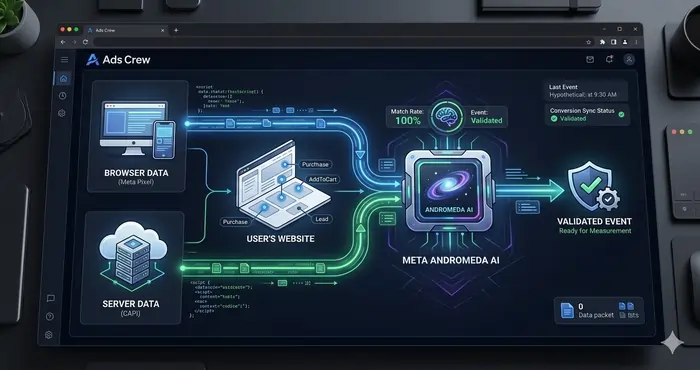
In 2026, a Meta Pixel advanced tracking setup must transcend basic browser-side JavaScript to combat 40% data loss caused by signal interference and cookie depreciation. The modern standard is a Hybrid Signal Architecture combining the Meta Pixel (client-side) with the Conversions API (CAPI) via Server-Side Google Tag Manager (sGTM) or the Cloud Gateway. This infrastructure relies on three pillars: Redundant Deduplication (using unique event_id keys), Advanced Matching (hashing first-party data like emails/PII), and Aggregated Event Measurement (AEM) for iOS 14.5+ compliance. High-performance tracking in 2026 is measured by Event Match Quality (EMQ) scores; setups achieving 8.0+ see significantly lower CPAs by providing Meta’s Andromeda AI with the high-fidelity deterministic data required for accurate conversion modeling.
Introduction: Why Tracking Is Your Greatest Competitive Advantage
A Meta Pixel advanced tracking setup is the absolute backbone of accurate conversion measurement for modern advertising campaigns. In 2026, businesses running campaigns through the ecosystem built by Meta Platforms rely heavily on reliable tracking infrastructure to measure conversions, build audiences, and optimize advertising performance. We have moved past the era where a simple copy-paste of a JavaScript code was sufficient. Today, the quality of your data signals is the primary factor that determines your Cost Per Acquisition (CPA).
Many advertisers install the Meta Pixel and assume their tracking system is complete. However, modern advertising environments require a much more sophisticated approach. Browser restrictions, privacy policies, and aggressive ad-blocking technologies mean that basic pixel installation often fails to capture up to 40% of user interactions. A proper Meta Pixel advanced tracking setup includes multiple systems working together, including browser tracking, server-side tracking, event architecture, and rigorous data validation.
The evolution of the tracking landscape has been driven by the need for “Signal Resilience.” In an age where third-party cookies are depreciating, the ability of a business to maintain a first-party data connection directly with Meta’s servers is what separates high-growth brands from those struggling with “blind” optimization. By implementing an advanced tracking framework, you provide Meta’s Andromeda AI with the high-fidelity signals it needs to find your ideal customers with surgical precision.
What Is a Meta Pixel Advanced Tracking Setup?
The Meta Pixel is a JavaScript tracking script installed on a website to collect user interaction data. It allows advertisers to track website conversions, build retargeting audiences, and optimize ad delivery. However, installing the base script alone does not guarantee reliable data in the 2026 landscape.
A professional Meta Pixel advanced tracking setup must include:
- Resilient Event Architecture: Defining every micro-interaction—from scroll depth to lead form abandonment—that leads to a final sale.
- Conversions API (CAPI) Integration: A server-to-server connection that bypasses browser-based tracking limitations, ensuring that even users with strict privacy settings are accounted for.
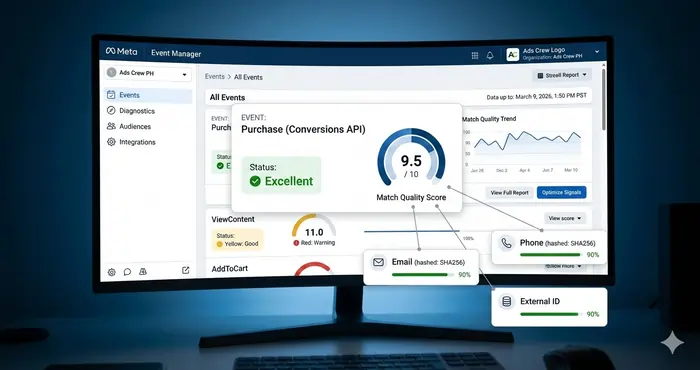
- Advanced Data Matching: Sending hashed user data (emails, phone numbers, and external IDs) to increase your “Match Quality” score.
- Deduplication Logic: A sophisticated verification system that ensures a single purchase isn’t counted twice when tracked by both the browser and the server.
Without this level of detail, your proper Meta Ads account setup will be built on a foundation of “blind” data, leading to wasted spend and inefficient scaling. According to the official Meta Advertising Standards, maintaining data integrity is a core requirement for high-spend advertisers who wish to unlock advanced features like Value-Based Lookalikes.
The Meta Tracking Ecosystem in 2026
Modern advertising tracking relies on multiple integrated technologies that must speak the same language. To achieve a high-performance Meta Pixel advanced tracking setup, you must understand the core components that form your technical silo. As noted by the Forbes Tech Council, the shift toward server-side data is the most significant change in digital marketing this decade, making the “Hybrid Model” of tracking the new industry standard.
| Component | Function | 2026 Importance |
| Meta Pixel | Client-side tracking | Essential for capturing user-agent data and “Real-Time” website triggers. |
| Conversions API | Server-side tracking | The “Truth” signal that captures events blocked by browsers or VPNs. |
| AEM (Aggregated Event Measurement) | Privacy compliance | The framework that allows Meta to process events from iOS 14.5+ users. |
| Event Match Quality (EMQ) | Data validation | A metric from 1-10 that tells you how effectively Meta can link events to profiles. |
When these components are properly configured, your conversion tracking infrastructure becomes a robust shield against data loss. In 2026, the goal is to move beyond “tracking” and toward “signal management,” where every click is a data point used to train Meta’s machine learning models.
Event Tracking & Conversion Architecture
A strong tracking system relies on a clear event architecture. Every meaningful user interaction should be captured as a conversion signal. This is known as Event Tracking & Conversion Architecture, which determines how user actions are collected, processed, and used for optimization.
The Hierarchy of Signals
In a sophisticated Meta Pixel advanced tracking setup, we categorize events into three tiers:
- Top-of-Funnel (ToFU): PageView, ViewContent. These establish the baseline of interest.
- Middle-of-Funnel (MoFU): AddToCart, InitiateCheckout, Lead. These indicate strong intent.
- Bottom-of-Funnel (BoFU): Purchase, Subscribe, CompleteRegistration. These are your ultimate KPIs.
Designing Your Signal Flow
Data follows a strict validation path:
- User Interaction: A customer clicks “Add to Cart.”
- Event Capture: The Meta Pixel triggers in the browser (client-side), while the server simultaneously prepares a CAPI event (server-side).
- Deduplication: Meta’s servers receive both signals but, thanks to a shared
event_id, they realize it’s the same person. - Optimization: The Andromeda AI receives one clean “Add to Cart” signal and immediately adjusts your bidding strategy to find more people with similar behavioral profiles.
By establishing a solid Event Tracking & Conversion Architecture, you ensure that the algorithm is being trained on high-intent actions rather than noise. This architecture is vital for maintaining a redundant Meta ad account structure for high risk environments, where data continuity is the difference between a pause and a permanent ban.
Server-Side Tracking & Conversion API
Browser tracking alone is no longer sufficient due to increasing privacy restrictions and the rise of ad-blockers. Integrating Server-Side Tracking & Conversion API (CAPI) is a non-negotiable component of a Meta Pixel advanced tracking setup. In 2026, relying solely on the browser is essentially leaving 30-50% of your optimization data on the table.
Why CAPI Is Essential
- Bypassing Ad Blockers: Since CAPI sends data from your server directly to Meta’s server, it is invisible to browser-based ad blockers that target JavaScript files like
fbevents.js. - Extending Cookie Life: Many browsers now limit third-party cookies to 24 hours. First-party cookies set via server-side Google Tag Manager (GTM) can last significantly longer, allowing for better attribution of long-cycle purchases.
- Improved Attribution: You can send “Offline” events—such as a lead closing in your CRM five days after the click—back to Meta to prove your ads are driving real-world revenue.
For agencies, this is a core part of a Meta Business Manager setup for agency scaling. If your Server-Side Tracking & Conversion API is not active, you cannot scale to seven figures safely because your data will be too fragmented to support high-budget optimization. For those using WordPress, the Meta Conversions API Gateway provides a streamlined, cloud-based setup path that requires minimal coding knowledge.
Conversion API Infrastructure
A stable Conversion API Infrastructure ensures that server events are delivered reliably without adding latency to your website. There are several implementation methods to choose from, each offering different levels of control and complexity.
A. The Gateway Method
Ideal for medium-sized businesses, the Conversions API Gateway is a hub that connects your web server to Meta via a cloud instance (usually AWS). It offers a “hands-off” experience while providing the benefits of server-side tracking.
B. Server-Side Google Tag Manager (sGTM)
This is the gold standard for a Meta Pixel advanced tracking setup. By running your own tagging server, you can “clean” and “hash” your data before it ever reaches Meta. This provides the highest level of privacy compliance and data control.
C. Partner Integration
Direct plug-and-play for platforms like Shopify or Metricool. While easy to set up, they offer less flexibility for custom event tracking than a manual sGTM setup.
Selecting the right Conversion API Infrastructure ensures a scalable tracking foundation that won’t break during high-traffic periods like Black Friday or large-scale product launches.
Domain Verification & AEM Configuration
Privacy regulations, specifically Apple’s AppTrackingTransparency (ATT) framework, require websites to verify ownership before they can track conversion events from iOS users. In 2026, Domain Verification & AEM Configuration is the “gatekeeper” for all conversion reporting.
The Verification Process
Before you can configure your events, you must verify ownership of your domain in your Meta Business Settings (usually via a DNS TXT record or HTML file upload). This confirms to Meta that you have the authority to track users on that URL. Once verified, you move to AEM (Aggregated Event Measurement).
Why It Matters
Without proper Domain Verification & AEM Configuration, you will see “Partial Reporting” or “Missing Conversions” for users on iOS devices. This is a primary step in any proper Meta Ads account setup. If your domain isn’t verified, Meta cannot prioritize your events, and your optimization will be severely hindered.
Conversion Optimization & Event Prioritization
In the post-iOS 14 world, you are limited to 8 priority events per domain. Conversion Optimization & Event Prioritization is the strategic act of telling Meta which actions represent the highest value to your business.
Example Event Priority Structure for Adscrew PH:
- Purchase (Highest Priority) – Drives the bottom line.
- InitiateCheckout – Signals high intent.
- AddToCart – Signals interest.
- Lead – Vital for high-ticket service businesses.
- ViewContent (Lowest Priority) – Useful for general audience building.
Proper Conversion Optimization & Event Prioritization ensures that even if a user opts out of tracking, Meta can still receive the highest-priority signal (the Purchase) to optimize your campaign. For more on how these limits affect your daily operations, see WordStream’s breakdown of Meta tracking constraints.
Meta Pixel & CAPI Deduplication Setup
The most common mistake in an “Advanced” setup is double-counting. When you activate both the Pixel (browser) and CAPI (server), you are essentially telling Meta about the same purchase twice. This leads to inflated ROAS and poor algorithmic decisions. This is where a proper Meta Pixel & CAPI Deduplication Setup comes into play.
How Deduplication Works
A proper Meta Pixel advanced tracking setup uses two keys to unlock deduplication:
- Event Name: Both signals must be named exactly the same (e.g.,
Purchase). - Event ID: A unique string (often the Order ID) that is attached to both the browser event and the server event.
When Meta’s server receives a browser event and a server event within a short window that share the same event_id, it “deduplicates” them, counting only one. A flawed Meta Pixel & CAPI Deduplication Setup will lead to your ads looking twice as good as they actually are, which eventually causes the AI to optimize for the wrong patterns.
Meta Pixel Troubleshooting & Debugging
Even the most perfect tracking systems require ongoing monitoring. Meta Pixel Troubleshooting & Debugging is a routine task for elite media buyers who understand that “data drift” is inevitable.
Essential Diagnostic Tools:
- Meta Pixel Helper: A Chrome extension for seeing real-time browser triggers and checking for parameter errors.
- Test Events Tool: Located inside Meta Event Manager; it allows you to see live data packets as they arrive from both your browser and your server.
- Diagnostics Tab: This dashboard flags issues like “Missing Event Parameters” or “High Deduplication Error Rates.”
Regular Meta Pixel Troubleshooting & Debugging ensures the Meta Pixel advanced tracking setup continues working correctly. If you encounter a “Disabled” signal or a sudden drop in tracked events, you may also need to check your Meta ad payment method disabled fix protocols, as billing issues can sometimes lead to temporary API suspensions.
Advanced Matching & Match Quality (EMQ)
Event Match Quality (EMQ) is a score from 1 to 10 that measures how effectively your events are linked to specific Meta user profiles. In your Meta Pixel advanced tracking setup, you must implement Advanced Matching to drive this score higher.
Implementation Requirements
Advanced Matching involves sending hashed (SHA256) customer information along with the event. This includes:
- Email Address and Phone Number.
- External ID (your internal database ID).
- First Name, Last Name, City, State, and Zip Code.
For deep technical implementation and data security standards, refer to NIST’s hashing standards, which Meta follows to ensure that user data is encrypted before it ever reaches their servers. By including these identifiers, you allow Meta to achieve match rates above 80%, which significantly lowers your CPMs because the AI doesn’t have to “guess” who your customers are.
Best Practices for 2026 Scaling
To maintain a stable Meta ad account warm up schedule 2026, your tracking must be “Seasoned” and resilient. Scaling to ₱100,000/day requires a tracking system that doesn’t blink.
- First-Party Data Priority: Always prioritize your own server-side signals.
- Security First: Ensure all admins are secured using Meta Business Manager 2FA bypass prevention protocols to prevent unauthorized tracking changes.
- Monthly Data Audits: Every time you update a WordPress plugin or your Shopify theme, you risk breaking your tracking. A monthly “Health Check” is essential for long-term stability.
The Future: AI-Driven Attribution
As we look toward 2027 and beyond, the Meta Pixel advanced tracking setup will shift from “Event Collection” to “Probabilistic Modeling.” Meta’s AI is already filling in the gaps where data is missing using advanced machine learning. However, for the AI to model accurately, it needs a solid baseline of “Deterministic” (actual) data.
By building a robust infrastructure today, you are giving the AI the “Seed Data” it needs to accurately predict future conversions. Advertisers who fail to implement server-side tracking will find themselves increasingly sidelined as Meta’s models become more dependent on high-fidelity, server-verified signals.
Conclusion: Data-Driven Dominance
A professional Meta Pixel advanced tracking setup is the foundation of reliable advertising measurement. Instead of relying on a single browser script, modern tracking systems combine multiple technologies—from Server-Side Tracking & Conversion API to Meta Pixel & CAPI Deduplication Setup—to ensure that conversion data remains accurate and consistent across the entire funnel.
Organizations that invest in a robust tracking infrastructure gain a critical advantage: their campaigns receive stronger optimization signals, their audience segments are more accurate, and their marketing decisions become significantly more data-driven. For a visual summary of 2026 tracking trends and a walkthrough of the new Portfolio UI, check out the Meta Business Portfolio Setup Tutorial.