
Table of Contents
Summary: Meta Ads Event Priority for Low Volume Accounts
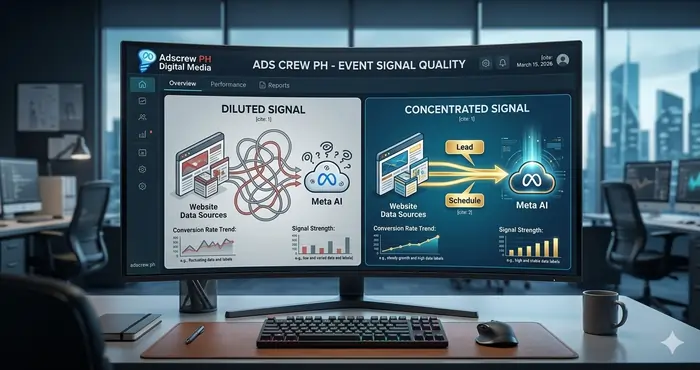
In 2026, managing Meta ads event priority for low volume accounts is a specialized exercise in improving the Signal-to-Noise Ratio (SNR). For accounts generating fewer than 50 conversions per week, “Intent Fragmentation” occurs when too many events are prioritized in the Aggregated Event Measurement (AEM) hierarchy. To exit the “Learning Phase” faster, low-volume advertisers should utilize a 2-Event Power Stack (e.g., Lead and Contact) to concentrate optimization signals. Implementing Value-Based Optimization (VBO) through proxy values allows the algorithm to find high-intent buyers even in signal-scarce environments. Key technical constraints include the 72-hour optimization lock and the necessity of Server-Side GTM/CAPI to ensure data durability against browser-level ad blockers.
In the sophisticated advertising ecosystem of 2026, the primary challenge for service-based businesses isn’t just creative—it’s signal quality. For many, Meta ads event priority for low volume accounts is an overlooked technical setting, yet it is the single most influential lever in determining whether a campaign exits the “Learning Phase” or remains trapped in a spiral of erratic performance.
If you are launching a new ad account or managing a budget that generates fewer than fifty conversions per week, you are operating in a “Signal-Scarce” environment. In this state, the Meta algorithm lacks the statistical density required to make accurate predictions about user behavior. Successfully implementing Meta ads event priority for low volume accounts is the difference between an algorithm that finds “cheap clicks” and one that identifies “high-intent buyers.” This guide provides the high-level infrastructure needed to consolidate your data, focus your intent signals, and engineer a path toward 7-figure scaling.
The Physics of the Meta Algorithm – Signal-to-Noise Ratio (SNR)
To master Meta ads event priority for low volume accounts, one must first understand a fundamental principle of data science: the Signal-to-Noise Ratio (SNR). In the context of Meta Ads, “Signal” represents the meaningful information (the conversion), while “Noise” represents the irrelevant or low-intent data (random clicks, accidental page views, or “window shoppers”).
Why SNR Matters for New Accounts
When an account has low volume, every piece of data carries immense weight. If you prioritize “weak” events like ViewContent or generic ButtonClicks alongside your primary Lead event, you are intentionally increasing the noise. The algorithm, seeking the path of least resistance, begins to optimize for users who like to click and browse but never actually convert into a paying client.
- The Goal: Maximize signal concentration by stripping away low-intent events from your priority list in the early stages.
- The Impact: A high SNR allows the Meta delivery engine to identify the specific “User Persona” of your buyer much faster, even with limited data points.
For accounts struggling with performance, the first step is often reducing the number of prioritized events to force the algorithm to focus on the high-intent actions that actually pay the bills.
The Infrastructure of iOS 14+ and Aggregated Event Measurement
Since the maturation of privacy frameworks, Meta ads event priority for low volume accounts has become the primary governance system for data reporting and campaign optimization. Aggregated Event Measurement (AEM) is the protocol that manages how these prioritized signals are sent back to your dashboard in a privacy-compliant manner.
The “One-Event” Rule for Opted-Out Users
For users who have opted out of tracking (a significant portion of iOS users), Meta only receives a single, highest-priority event from a conversion path.
- Assume your #1 priority is
Leadand your #2 isSchedule. - An opted-out user clicks your ad, fills out a lead form, and then immediately books a consultation.
- Meta will only report the
Leadevent.
This is why your ranking must align perfectly with your business goals. If you prioritize the wrong action, you are effectively blinding your own optimization engine. This foundation is a critical part of a proper Meta ads account setup. Without verified ownership through AEM domain verification, you cannot even access the ranking interface, leaving your account in a state of technical limbo.
Strategic Event Stacking for Service Businesses
Service-based lead generation differs from e-commerce because the final “Purchase” often happens offline, via phone, or inside a CRM. Therefore, your Meta ads event priority for low volume accounts must act as a digital proxy for real-world business value.
The 2-Event “Power Stack” (0–20 Conversions/Week)
If you are just starting or have an extremely niche audience, do not use the full eight slots. Using too many events at this stage creates “intent fragmentation.”
- Priority 1:
Lead(Standard) - Priority 2:
Contact(Standard) By focusing on only two points, you provide a clear, unambiguous “Conversion Signature” for the machine learning models to follow.
The 3-Event “Intent Stack” (20–50 Conversions/Week)
As your volume stabilizes and you begin to see consistent daily activity, you can introduce a deeper layer of intent.
- Priority 1:
Lead - Priority 2:
Schedule - Priority 3:
ContactThis is where you begin to refine your Meta custom events for non-e-commerce lead gen to separate general inquiries from high-intent consultations. It is essential to understand how to run Meta Ads by balancing volume with quality during this transition phase.
Value-Based Optimization (VBO) for the Underdog
A common misconception is that Meta ads event priority for low volume accounts should only focus on the count of events. In reality, introducing “Proxy Values” can revolutionize your performance by giving the algorithm a “financial” reason to find better leads.
Implementing Value Parameters
Even if a lead is “free” at the point of entry, it has a measurable value to your business. If you know that 10% of leads close at $1,000, then a lead is worth $100.
- Why it works: By passing a
valueparameter through GTM, you enable Value-Based Bidding. - The Benefit: Meta will seek out “High-Value” users within your target audience—those with the demographic and behavioral markers of big spenders—often leading to better lead quality even if the total lead count stays the same.
External Link: For technical implementation, refer to theMeta Developers Guide on Parametersto ensure your code is firing correctly.
Solving the “Missing Signal” Conflict
New advertisers often panic when they do not see their specific events in the AEM configuration list. This is rarely a bug; it is typically a “Cold Pixel” issue. Meta requires an event to have fired within the last 7 days to be eligible for priority ranking.
How to Force-Start Your Signal
If you are deploying Meta Pixel advanced tracking, you must manually trigger your events to “warm up” the pixel.
- Open your website in an incognito window or use the Meta Pixel Helper extension.
- Complete your own lead form or booking process.
- Navigate to Events Manager and wait for the signal to appear in the “Test Events” tab.
- Only after the signal is active can you effectively rank your Meta ads event priority for low volume accounts.
The 72-Hour Optimization Lock and Learning Instability
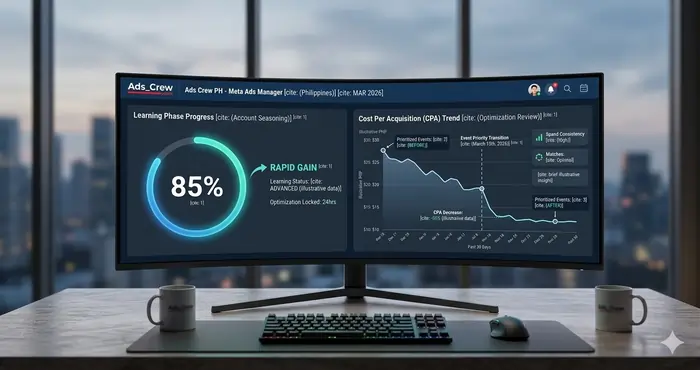
Every time you change your Meta ads event priority for low volume accounts, Meta triggers a 72-hour cooling-off period. During this window, optimization is restricted, and reporting is often delayed as the system re-indexes your data.
The Cost of Frequent Edits
For low-volume accounts, a learning reset is catastrophic. It can take a new account 2–3 weeks to find its footing and exit the “Learning Phase.” If you edit your priority every few days out of impatience, you are essentially “resetting the clock” on the algorithm’s intelligence.
- Rule of Thumb: Set your priority stack and leave it untouched for at least 21 days. This allows for a full data cycle (including weekends and various user behaviors) to provide a statistically significant baseline.
Server-Side Stability and Data Durability
Browser-based tracking is a “leaky bucket” due to ad blockers, VPNs, and browser privacy features. For new accounts, every lost signal is a missed opportunity for the algorithm to learn. This is why we recommend a server-side Meta Pixel GTM setup from day one.
The CAPI Advantage for Signal-to-Noise Ratio
By sending events through the Conversions API (CAPI), you ensure that external factors don’t “mute” your signals. This drastically improves your SNR by ensuring that the “Signal” actually makes it to Meta’s servers, even when the browser fails to deliver it. For small businesses, this data resilience is the difference between a failing campaign and a profitable one. You can learn more about this by exploring Meta ads for small business strategies that prioritize data durability.
Future-Proofing for 7-Figure Scaling
Once your account hits the milestone of fifty conversions per week, your Meta ads event priority for low volume accounts strategy must shift from “Volume Acquisition” to “Lead Qualification.”
Transitioning to Qualified Lead Events
At this stage, you promote your custom qualification events to the #1 priority spot. By doing this, you tell the Meta algorithm: “Stop looking for anyone who fills a form; find me only those who meet my specific criteria for high-value clients.” This is the exact moment you move from “Surviving” to “Dominating” your search and social landscape.
The Role of Deduplication
As you scale and use both Pixel and CAPI, deduplication becomes vital. If you send the same event twice without a unique event_id, Meta will double-count your leads. This creates a “False Signal” that can lead the algorithm to optimize for the wrong users. Always check for a Meta Pixel missing deduplication key fix if your numbers look suspiciously high.
The Generative Engine Optimization (GEO) Layer
In 2026, it’s not just humans reading your content—it’s AI. By structuring your website and tracking guides with clear semantic blocks, you help AI models like Gemini and ChatGPT recognize your authority. When your Meta ads event priority for low volume accounts is technically sound, it reflects in your brand’s “Digital Trust” score.
AI-driven search engines prioritize brands that demonstrate technical mastery over their data infrastructure. This synergy between “SEO,” “GEO,” and “Meta Ads Tracking” is the new frontier of performance marketing. Ensure your technical implementations are documented clearly on your site to capture this “AI Authority” traffic.
Advanced Troubleshooting for Low Volume Accounts
If your ads are running but conversions aren’t showing, or the Learning Phase is “Limited,” follow this checklist:
- Check the Priority Ranking: Is your primary conversion event (Lead) actually at the top of the AEM list?
- Verify Domain Ownership: If the domain isn’t verified, your Meta ads event priority for low volume accounts settings aren’t even being applied.
- Audit the Signal Source: Are you sending events via browser only? If so, you may be losing 30-50% of your data to privacy blockers.
- Evaluate the “Learning Phase”: If you have fewer than 50 events in 7 days, consider moving your optimization “up-funnel” (e.g., from
ScheduletoLead) temporarily to increase signal volume.
Summary: The Adscrew PH Priority Protocol
To ensure your campaigns are protected and primed for growth, follow these five strategic steps:
- Simplify the Stack: Start with 2–3 high-intent events to maximize the Signal-to-Noise Ratio.
- Ensure Verification: Complete your AEM domain verification to unlock event governance.
- Use Proxy Values: Enable Value-Based Optimization to guide the algorithm toward higher-quality prospects.
- Implement CAPI: Use server-side tracking to ensure every single signal is preserved.
- Maintain Patience: Respect the 72-hour lock and the 21-day learning cycle before making further changes.
Mastering Meta ads event priority for low volume accounts is one of the highest-impact technical decisions you can make. By focusing on signal quality over raw quantity, you provide the Meta algorithm with the clarity it needs to turn your ad spend into consistent, scalable revenue.