
Table of Contents
Introduction
If you are serious about building predictable revenue, mastering Meta Ads is no longer optional. It is a competitive necessity.
Organic reach is declining across Facebook and Instagram, competition for attention is rising, and cost-per-click skyrockets when your strategy is weak. Many small businesses waste their marketing budgets because they boost posts without structure, skip proper tracking, and ignore optimization frameworks.
Understanding how to run Meta Ads for small business growth transforms advertising from random spending into a measurable acquisition system. If you are just starting out and need a beginner overview of Meta Ads foundations, you should nail down the basics first. However, this guide is a campaign-level breakdown based on real-world performance marketing principles. Whether you are running Meta Ads for e-commerce businesses, focusing on running Meta Ads for service-based businesses, or learning the nuances of running Meta Ads for local businesses, this system provides the scalable architecture you need.
Eventually, you will even discover the long-term ROI of combining Meta Ads with SEO for better results, but that all starts with building a profitable paid foundation. When implemented correctly, paid social becomes a repeatable growth engine.
How to Run Meta Ads for Small Business Growth
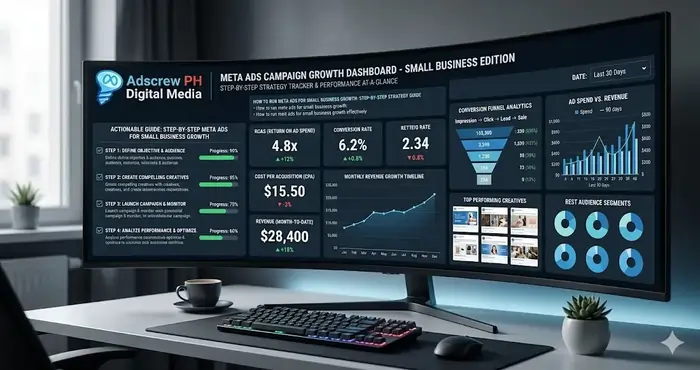
To run Meta Ads successfully in 2026, small businesses must transition from “post boosting” to a structured acquisition system. This involves three core pillars: Technical Foundation (CAPI and Pixel tracking), Algorithmic Alignment (using Sales/Leads objectives rather than Traffic), and Creative-Led Scaling. Predictable revenue is achieved by maintaining a 20/80 split between testing and scaling budgets, ensuring the Meta algorithm has sufficient data (50 conversions per week) to exit the learning phase and optimize for high-intent buyers.
Why Small Businesses Must Master Paid Acquisition
Meta platforms (Facebook, Instagram, Messenger, Audience Network) collectively control billions of daily impressions. For small businesses, this ecosystem provides:
- Direct access to hyper-targeted audiences.
- Geo-targeting down to the city or radius level.
- Lookalike modeling based on your most valuable customer data.
- Real-time campaign optimization.
- Scalable media buying control.
However, results do not come from simply launching ads. They come from structure, tracking precision, creative testing, and scaling discipline. This is the complete system.
Step 1: How to Set Up Your Meta Ads Account Correctly
Before spending a single peso, foundational infrastructure must be flawless. Getting this right prevents future restrictions and scaling bottlenecks.
Professional setup includes:
- Business Manager creation and verification.
- Clean ad account structure with assigned admin roles.
- Two-factor authentication (critical for security).
- Verified payment methods.
- Seamlessly connected Facebook Page and Instagram accounts.
Running ads from personal accounts or improperly configured ad managers inevitably leads to ownership disputes, disabled accounts, and lost pixel data. A stable foundation is your first step toward profitable media buying.
Step 2: Installing and Using Meta Pixel for Advanced Tracking
Tracking separates the amateurs from the professionals. Without accurate data, you cannot optimize, and without optimization, you cannot scale.
Core tracking components include:
- Base Pixel Installation across all site pages.
- Standard Event Setup (ViewContent, AddToCart, InitiateCheckout, Purchase, Lead).
- Domain Verification and Aggregated Event Measurement prioritization.
- Conversions API (CAPI) Integration to combat iOS tracking limitations and data loss.
Expert Tip: For small businesses running lead generation campaigns, configure custom conversion events tied to thank-you pages or qualified lead milestones. In real-world campaigns, cost per acquisition (CPA) often drops 20–40% once the Conversions API is properly implemented alongside the browser pixel.
Step 3: Defining Campaign Objectives Strategically
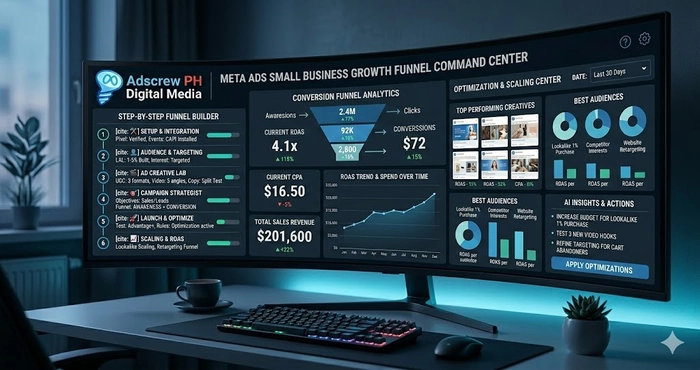
One of the most expensive mistakes small businesses make is choosing the wrong campaign objective, forcing the algorithm to work against them.
Key objectives relevant for growth:
- Sales: For direct e-commerce purchases.
- Lead Generation: For service-based businesses capturing data.
- Conversions: For high-intent actions.
- Traffic: (Use strictly for warm-up or highly specific retargeting).
The Meta algorithm optimizes exactly for what you tell it to. If you optimize for clicks, you get clickers. If you optimize for conversions, you get buyers.
Step 4: Building High-Converting Meta Ads Audiences
Audience structure dictates campaign efficiency.
Expert-Level Audience Layering:
- Cold Layer: Broad targeting (relying on Pixel data), interest-based targeting for niche industries, and Lookalike audiences (1-3%) from past purchasers.
- Warm Layer: Website visitors (7, 14, 30 days), video viewers (25–95%), and engaged social media users.
- Hot Layer: Cart abandoners, initiate checkout users, and email list subscribers.
Separating cold, warm, and hot traffic improves cost control and messaging precision. While broad targeting performs exceptionally well for seasoned pixels, new ad accounts still benefit from strategic interest testing.
Step 5: How to Create Meta Ads That Convert (Creative Strategy)
Even perfect targeting cannot save weak messaging. Creative is your biggest performance lever.
High-performing ads follow a strict structure:
- The Hook: Capture attention in the first 3 seconds.
- Problem Articulation: Call out the pain point.
- Solution Positioning: Introduce your product/service.
- Proof: Inject testimonials, UGC, or hard data.
- Call-to-Action: Tell them exactly what to do next.
If your ads are underperforming, mastering your creative strategy is the fastest method for fixing low CTR in Meta Ads campaigns and naturally improving Meta Ads quality ranking. Furthermore, using AI to optimize Meta Ads campaigns—such as utilizing generative tools for rapid hook ideation and copy variations—can drastically speed up your testing phase. Test 3 distinct angles, using 3 different formats, with 2 hooks per format. Once you find the winners, scale them.
Step 6: Setting Budgets and Placements for Maximum Results
Budget discipline prevents emotional decision-making. Proper setup here is also one of the first things we look at when fixing high CPM issues in Meta Ads, as restricted bidding or cramped placements can artificially inflate costs.
- Testing Phase: Allocate 20–30% of your total advertising budget to structured testing to find winning creatives and audiences.
- Scaling Phase: Push the remaining 70–80% toward your proven, high-ROI ads.
- Daily Budget Rule: Set daily budgets at a minimum of 2–3x your target CPA per ad set to give the algorithm enough data to exit the learning phase.
- Placements: Start with Advantage+ placements. Over-optimizing placements too early chokes algorithmic flexibility.
Step 7: Launching and Monitoring Meta Ads Campaigns Effectively
Hitting “publish” is just the beginning.
Monitor daily metrics like Click-Through Rate (CTR), Cost Per Click (CPC), Conversion Rate, CPA, and Return on Ad Spend (ROAS). However, avoid making premature structural changes within the learning phase. Most campaigns need a minimum of 3–5 days to stabilize. Killing ads too early is a guaranteed way to waste budget.
Step 8: Retargeting Meta Ads Audiences for Maximum ROI
Retargeting is where profitability spikes. Warm audiences convert at 2–5x the rate of cold traffic.
Effective Retargeting Sequence:
- Stage 1: Hit them with social proof (testimonials, unboxings).
- Stage 2: Handle common objections (FAQs, guarantees).
- Stage 3: Present a limited-time incentive (discount, bonus offer).
Allocate at least 20% of your total ad spend to capturing these warm and hot audiences.
Step 9: Scaling Your Meta Ads Campaigns Successfully
Scaling is how you expand revenue beyond the testing phase. Aggressive scaling without data causes volatility; disciplined scaling creates predictable growth. Explore more advanced strategies for scaling your Meta Ads campaigns to ensure stability.
- Vertical Scaling: Increase the budget of winning ad sets gradually by 10–20% every 48 hours to avoid resetting the learning phase.
- Horizontal Scaling: Duplicate winning ads into new audiences or expand your geographic targeting.
- Creative Scaling: Refresh the visual hooks while keeping the proven core messaging intact to combat ad fatigue.
Step 10: Avoiding Meta Ad Account Restrictions
Growth means nothing if your account gets disabled. Protect your acquisition system by maintaining strict compliance.
Compliance Checklist:
- Strictly follow Meta’s official Advertising Standards.
- Avoid exaggerated income or health claims.
- Ensure landing pages match ad copy and include privacy policies.
- Maintain Business Manager verification.
- Avoid prohibited targeting practices.
Stability equals scalability.
Step 11: Tracking and Analyzing Meta Ads Performance
Data interpretation is what separates media buyers from business owners who are just guessing.
- Primary KPIs: CPA, ROAS, and Total Revenue.
- Secondary KPIs: CTR, CPC, Conversion Rate, and Frequency.
Use Meta’s breakdown reports to reveal placement inefficiencies, audience fatigue, and creative decay. Implement weekly structured reporting to prevent reactive, emotional decision-making.
System Knowledge Graph
| Component | Strategic Function | Business Impact |
| Account Setup | Structural stability | Prevents disruptions |
| Pixel & Tracking | Data accuracy | Improves optimization |
| Campaign Objectives | Algorithm alignment | Higher conversion rates |
| Audience Strategy | Buyer precision | Lower CPA |
| Creative Testing | Engagement leverage | Higher CTR |
| Budget Allocation | Risk control | Capital protection |
| Retargeting | Revenue recovery | Increased ROI |
| Scaling Systems | Growth expansion | Revenue acceleration |
| Performance Analysis | Strategic decisions | Sustainable scaling |
Final Conversion-Focused Call to Action
If you are serious about implementing this system at a professional level, the next step is not guessing. It is strategy.
If your business is spending consistently on ads, needs stable account compliance, and is ready to lower acquisition costs while scaling beyond testing, a strategic audit is the fastest path forward.
Apply for a Meta Ads growth strategy session where we will:
- Audit your campaign structure.
- Identify wasted ad spend.
- Evaluate audience targeting and creative performance.
- Map a scalable, customized growth plan.
Build the system. Scale the revenue. Remove the guesswork. Contact Adscrew PH