
Table of Contents
Summary: Meta Custom Events for Non-E-commerce Lead Gen
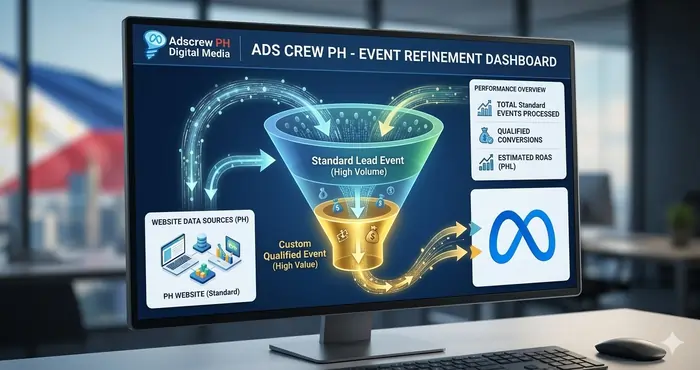
In 2026, Meta custom events for non-e-commerce lead gen are the primary differentiator between “Lead Fatigue” and high-intent customer acquisition. Unlike e-commerce, service-based tracking requires a multi-touch behavioral sequence that maps the “Value Ladder” using both standard and custom events. By moving beyond a single Lead event and implementing Micro-Conversions (e.g., scroll milestones, engagement depth, and video completion), advertisers provide Meta’s Andromeda AI with a tiered feedback loop. This infrastructure, supported by Conversions API (CAPI) and Server-Side GTM, allows for Value-Based Bidding on high-ticket services by assigning “Proxy Values” to non-sales actions. Clean naming conventions and Aggregated Event Measurement (AEM) prioritization are essential for training the algorithm to find Sales Qualified Leads (SQLs) rather than “cheap clicks.”
The Lead Illusion – Why Your “Cost Per Lead” is Lying to You
In the early days of Facebook advertising, a “Lead” was a lead. If you paid $5 for a form fill, you won. But in 2026, the ecosystem has matured. Privacy laws, signal loss, and ad blockers mean that the “Lead” number in your Ads Manager is often a count of thumb taps, not a prediction of future revenue.
The Problem with the Standard Lead Event
Lead is a vacuum metric. It tells Meta: “Find me someone who will fill out a form.” But it ignores:
- Intent: Did the prospect actually read your pricing page?
- Fit: Are they in your target geography or budget range?
- Follow‑through: Did they answer the phone when your sales team called?
If your Lead event includes newsletter signups, gated content downloads, and high‑ticket consultation requests, you are teaching Meta’s algorithm that a spam email address is just as valuable as a $10,000 retainer.
This is why the standard Lead event is misleading when used as the sole north star for scaling a service business. To truly improve lead quality, you must look beyond the individual form fill.
Direct Answer: The standard Lead event is a vacuum metric that ignores intent, fit, and follow‑through, making it dangerous for high‑ticket service businesses.
Defining The Value Ladder – Turning Clicks into Clients
If Lead is a pulse check, a tiered custom event structure is a full‑body stress test of your sales pipeline.
What is a Value Ladder in Custom Events?
A Value Ladder is a sequence of custom events that map your customer’s journey from “stranger” to “client.” Instead of one generic Lead, you create:
| Funnel Stage | Custom Event | What It Signals to Meta |
|---|---|---|
| TOFU (Awareness) | ViewContent_PillarPage + Scroll_Depth(90%) | “This person is interested in my speciality.” |
| MOFU (Consideration) | Video_Complete(95%) + TimeOnPage(120s) | “They are consuming my proof and expertise.” |
| BOFU (Intent) | Qualified_Lead (budget + timeline questions) | “They have buying intent and capacity.” |
| Sale (Revenue) | Booked_Call + Closed_Won (via CAPI) | “This is the actual business outcome. Find more of these.” |
The Difference Between a Lead and a Qualified Lead
Leadtells you: “Someone touched my form.”Qualified_Leadtells you: “Someone who meets my minimum criteria (budget, authority, need) raised their hand.”
When aligning Meta ads with business KPIs, the Qualified_Lead event allows you to see the “Halo Effect” of your content. For example, a top‑of‑funnel video might show a low CTR, but if it drives viewers to your “Pricing” page to trigger Qualified_Lead, your custom events will reflect the true value of that creative.
Funnel‑Based Custom Event Alignment – Stage‑by‑Stage Mastery
To build a custom events strategy that scales, you cannot use the same tracking logic for every campaign. A funnel structure for high‑ticket services requires a completely different data diet than a low‑ticket impulse buy.
1. Top of Funnel (TOFU): The Micro‑Intent Anchors
At this stage, you are buying attention. But attention without direction is useless. You need to tell Meta which type of attention matters.
- Primary Custom Events:
ViewContent(with topic parameter),Scroll_Depth(50%),Video_Play(15s). - Goal: Efficiently identify “interested” users based on their on‑page behavior. Did they read the case study? Did they watch the founder’s story?
- Expert Tip: Use a
ViewContentevent on your “Services” or “Pricing” page. If a user triggers that, they are worth 10x more in your retargeting pool than someone who just hit your blog.
2. Middle of Funnel (MOFU): The Engagement Bridge
This is where you separate the curious from the serious. You are moving users from “I saw this” to “I need this.”
- Primary Custom Events:
TimeOnPage(90s),Video_Complete(75%),Form_Start. - Goal: Signal rising intent. You are looking for behavioral friction—where do high‑value prospects drop off?
- Strategic Alignment: At this stage, you should be tracking Cost Per Engaged Session. How much are you paying for a prospect to actively consume your sales material?
3. Bottom of Funnel (BOFU): The Revenue Signals
This is where the rubber meets the road. These events should be fed directly into Meta via CAPI to optimize for closed business.
- Primary Custom Events:
Qualified_Lead,Booked_Call,Closed_Won(via CRM). - Goal: Direct profitability. Every campaign here should be measured against your Customer Acquisition Cost (CAC).
- Scaling Metric: Use
Booked_Callas your optimization event. Meta may need 50 of these per week to exit learning, so start withQualified_Leadif call volume is low.
The Qualified Lead – The Secret to Scaling Service Businesses Profitably
If you want to scale a service business profitably, you must stop optimizing for hand‑raisers and start optimizing for wallet‑openers.
The Qualified_Lead event is the bridge between marketing and sales. It requires you to pass custom parameters from your form or calendar that indicate seriousness.
How to Define a Qualified Lead
A Qualified_Lead is typically triggered by a “Yes” answer to one or more qualifying questions:
| Qualifying Question | Parameter Passed to Meta |
|---|---|
| “Do you have a budget over $5,000?” | lead_qualification_budget: "high" |
| “Is this for your business?” | lead_qualification_entity: "business" |
| “What is your timeline?” | lead_qualification_timeline: "30_days" |
By passing these parameters, you allow Meta to build a lookalike audience based not on who filled out a form, but on who is actually qualified to buy.
Direct Answer: A Qualified_Lead custom event includes parameters like budget, authority, and timeline, allowing Meta to find high‑value buyers instead of low‑intent form‑fillers.
Technical Execution in the Andromeda Era
In 2026, attribution tracking has moved away from the “last click.” Meta’s Andromeda AI now uses probabilistic modeling to predict future conversions based on behavioral clusters. But it needs clean, hierarchical data to do so.
The Role of CAPI (Conversions API) for Custom Events
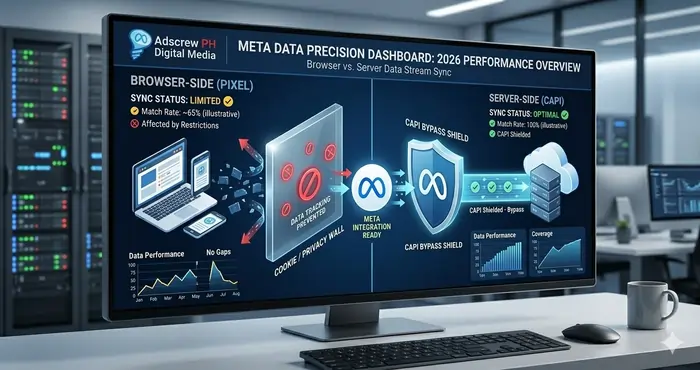
To measure custom event performance correctly, you must have a server‑to‑server connection. Meta’s CAPI bypasses browser‑side ad blockers and privacy restrictions, ensuring your Qualified_Lead and Booked_Call events actually reach the algorithm.
Without CAPI, your Qualified_Lead count will look lower than it actually is, causing you to underfund your best‑performing campaigns.
First‑Party Data & CRM Alignment
Your custom events strategy must include a data bridge to your CRM (like HubSpot, Pipedrive, or Salesforce). This allows you to track Offline Conversions—Closed_Won deals that happen over the phone or via email—and attribute them back to the original Meta click.
For service businesses using instant forms vs landing pages, this feedback loop is the difference between a lead generation tactic and a revenue attribution system.
The Custom Events Blueprint – How to Scale Using Intent Signals
Scaling a service business is a game of event prioritization. The MER vs ROAS framework for e‑commerce has a direct parallel here:
Phase 1: Volume Lock (The 30‑Day Baseline)
Before scaling, establish your “Qualified Lead Volume.” If your business closes 5% of Lead events but 40% of Qualified_Lead events, you know which event to optimize for.
Action: Run a Traffic or Engagement campaign optimized for ViewContent or TimeOnPage. This builds a pool of “warm” users before you ever ask for a form fill.
Phase 2: Vertical Intent Scaling (Pushing Budget)
Increase your Meta spend by 20% every 48 hours. Watch your Lead CPA for stability, but use your Qualified_Lead CPA to decide when to stop.
- If
LeadCPA stays flat butQualified_LeadCPA doubles, your creative is attracting the wrong audience. - If both remain stable, keep pushing.
Phase 3: Revenue Retraining
As you scale, Lead volume will naturally increase. To keep your Qualified_Lead ratio healthy, you must launch new “qualifying creatives”—ads that explicitly ask the “budget” or “timeline” question upfront.
Remember, the goal is to increase Cost Per Closed Deal efficiency, not just lead volume. A 10,000monthwithfivecloseddeals(CAC=2,000) is far worse than an 8,000monthwitheightcloseddeals(CAC=1,000).
KPI Alignment for Service Businesses – From Lead Fee to Revenue
If you are selling a high‑ticket service, here is how to align your custom events with your actual business KPIs:
| Business Goal | Vanity Metric (Avoid) | Custom Event Metric (Track) |
|---|---|---|
| Fill sales pipeline | Cost Per Lead (CPL) | Cost Per Qualified Lead (CPQL) |
| Increase consultation volume | Form completion rate | Booked_Call event rate |
| Lower cost of sale | Lead to Sale ratio | CAC (via Closed_Won event) |
| Scale profitably | Total leads generated | Qualified_Lead volume per creative |
By mapping your custom events to these three stages—Volume, Quality, Revenue—you ensure that you aren’t just paying for 50leadsthatneverpickupthephone.Youarepayingfor2,000 appointments that turn into $50,000 retainers.
20‑Question FAQ: Meta Custom Events for Non-E-commerce Lead Gen
- What is a custom event in Meta Ads?
A custom event is a user‑defined action (e.g.,Qualified_Lead) that you send to Meta beyond the standard 15 event types. - How are custom events different from standard events?
Standard events (Lead,Purchase) are pre‑defined and recognized globally. Custom events allow you to track your unique funnel stages. - Why is the standard
Leadevent dangerous for service businesses?
Because it treats a newsletter signup the same as a $10,000 consultation request, teaching Meta to find cheap clicks instead of qualified buyers. - What custom events should a service business track first?
Qualified_Lead(form with budget/timeline),Booked_Call(calendar confirmation), andClosed_Won(via CRM and CAPI). - How do I send a custom event to Meta?
Via the Meta Pixel (fbq('trackCustom', 'EventName')) or via the Conversions API for server‑side reliability. - What is a
Qualified_Leadevent?
A custom event triggered when a prospect answers specific qualifying questions (budget, authority, need, timeline). - Can I optimize a campaign for a custom event?
Yes. Create a Custom Conversion in Events Manager based on your custom event name, then select it as your optimization goal. - How many custom events can I create?
Up to 200 per ad account, but you can only use 8 Custom Conversions at a time for optimization. - What is a proxy value for a custom event?
An estimated dollar value based on historical close rates. If 10% ofBooked_Callleads close at 10,000,eachcallhasaproxyvalueof1,000. - How do I pass parameters (e.g., budget range) with a custom event?
Include a parameters object in yourfbq()call or CAPI payload:{budget_range: "10k-25k", timeline: "30_days"}. - Do custom events work with Aggregated Event Measurement (AEM)?
Yes, but you must manually add your custom event names to the AEM priority list in Events Manager. Otherwise, they may be dropped. - How do I test if my custom event is firing correctly?
Use the Meta Pixel Helper (Chrome extension) plus the Test Events tab in Events Manager. - Why are my custom events showing “No Event Match Quality”?
You aren’t passing enough user data (email, phone, first name) with the event. Add Advanced Matching parameters. - What is the “Lead Fatigue Trap”?
When your CRM is full of low‑intent leads who never convert, caused by optimizing for the genericLeadevent instead ofQualified_Lead. - How many
Qualified_Leadevents do I need per week to exit learning?
Meta generally requires ~50 optimisation events per week for stable learning. Start with a higher‑funnel custom event if volume is low. - Can I use custom events for retargeting audiences?
Yes. Build an audience of users who triggeredVideo_Complete(75%)but notSchedule_Call, then retarget them with a qualifying offer. - What is the best naming convention for custom events?
[action]_[object]_[qualifier]_v[number]– example:qualified_lead_budget_high_v1. - How does CAPI improve custom event reliability?
CAPI sends events server‑to‑server, bypassing ad blockers, ITP, and browser privacy restrictions that block the Pixel. - What should my first custom event be if I have no data?
ViewContent_PricingorTimeOnPage(90s). These micro‑intent events build a warm audience without requiring a form fill. - How do I know if my custom events strategy is working?
Your Cost Per Qualified Lead (CPQL) decreases while yourQualified_LeadtoClosed_Wonratio stays stable or improves.
Direct Answers
How do you align custom events with business KPIs for a service company?
Map your custom events to funnel stages: TOFU (scroll depth, video start), MOFU (time on page, form start), BOFU (Qualified_Lead, Booked_Call). Then create Custom Conversions for the BOFU events and optimise toward them, using your CRM to pass Closed_Won back via CAPI.
What is the difference between a standard Lead and a Qualified_Lead custom event?
A standard Lead is triggered by any form submission, regardless of quality. A Qualified_Lead custom event includes parameters (budget, authority, timeline) that confirm the prospect has genuine buying intent.
Why is Lead an unreliable optimisation event for high‑ticket services?Lead is unreliable because it does not account for “Lead Quality.” A brand can have a low Cost Per Lead but a high Cost Per Closed Deal if the algorithm learns to find form‑fillers instead of qualified buyers.
Summary: The Final Strategic Takeaway
A custom events framework is the difference between a service business that grows and one that just buys leads. In 2026, the brands that win are the ones that stop looking at the “Green Numbers” in the Ads Manager (low CPL, high form fills) and start looking at the “Gold Numbers” in their CRM (high close rates, low CPQL, positive CAC).
- Measure
Leadto test your offer and creative hooks. - Measure
Qualified_LeadandBooked_Callto find your winning audience segments. - Measure
Closed_Won(via CAPI) to scale your actual revenue.
Remember, in performance marketing for service businesses:
Intent is the strategy. Custom events are the tools.