
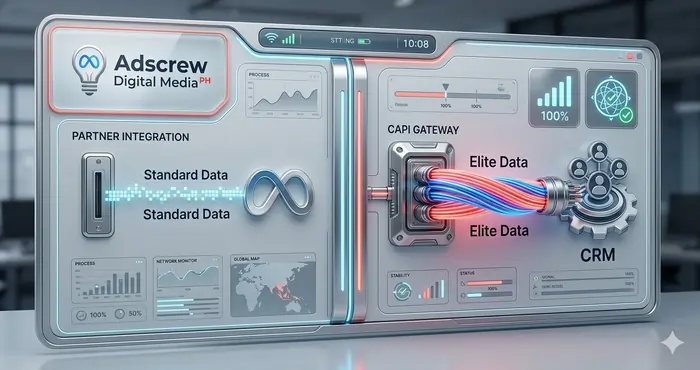
Table of Contents
This guide compares Meta CAPI Gateway vs Partner Integration for server-side tracking in 2026. Partner Integration (Shopify, WordPress) is quick, free, and ideal for low spend (<5k/month).∗∗MetaCAPIGateway∗∗(ormanualGTMserver−side)offersgranularcontrol,higherEventMatchQuality,CRMsync,andcosts20–150+/month—essentialforscalingbeyond5k–$10k monthly ad spend. The key is deduplication via event_id to prevent double-counting conversions. Start with partner, then upgrade as volume grows.
In the high-stakes world of performance marketing, the primary challenge for service-based businesses in 2026 isn’t just about creative—it’s about signal durability. For many, the choice between Meta CAPI Gateway vs Partner Integration is the single most influential technical decision in determining whether a campaign can effectively scale or remains trapped in a cycle of erratic, unreliable data.
As privacy frameworks like GDPR, CCPA, and Apple’s ATT have matured, the reliance on traditional browser-based tracking has become a liability. If your tracking is not durable, you aren’t just “missing conversions”—you are actively starving Meta’s AI of the high-intent signals it needs to find your next customer. Understanding how to run Meta Ads effectively in this era requires a server-side foundation. This guide explores the deep technical nuances of Meta CAPI Gateway vs Partner Integration to help you build a data monopoly that fuels 7-figure scaling.
Understanding the Conversion API (CAPI) Logic
Before choosing between Meta CAPI Gateway vs Partner Integration, we must define the core mission of the Conversions API. Unlike the standard browser pixel, which executes scripts on a user’s device (the “client side”), CAPI creates a direct server-to-server connection between your website’s server and Meta’s.
The Signal Resilience Factor
Browser-based signals are fragile by design. They can be blocked by ad blockers, interrupted by slow mobile network speeds, or entirely erased by Intelligent Tracking Prevention (ITP) features in browsers like Safari and Firefox. CAPI bypasses these obstacles. By following the official Meta Conversions API documentation and implementing a robust server-side architecture, you achieve:
- Durable Attribution: Conversions are linked to your ads even when the browser pixel fails to fire.
- Higher Event Match Quality (EMQ): Server signals can pass more hashed customer identifiers (like email and phone) than a browser script typically can.
- Algorithmic Confidence: The Meta algorithm receives a steady stream of data, leading to faster exits from the “Learning Phase.”
This transition to server-side data is a cornerstone of Meta ads for small business, where every dollar of ad spend must be backed by accurate measurement.
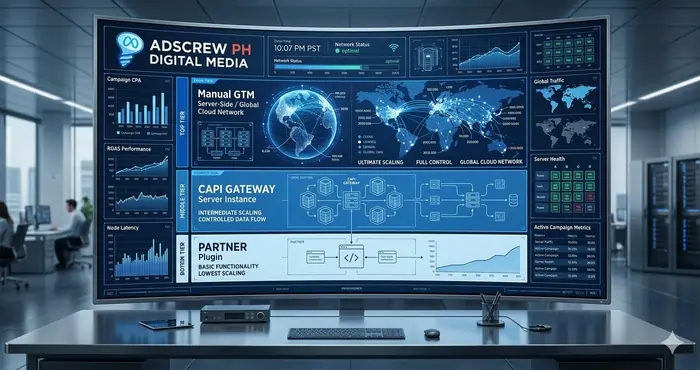
Meta CAPI Gateway – The Elite Powerhouse
The Meta CAPI Gateway is a dedicated server-side routing system, often deployed as an automated Amazon Web Services (AWS) or Google Cloud Platform instance. It acts as a sophisticated “middleman” that catches signals from your website and translates them into the precise format Meta’s API requires.
The Manual GTM Server-Side Hybrid
In 2026, many advanced performance agencies (like Adscrew PH) prefer a Manual GTM Server-Side approach over the automated Gateway. While the “official” Gateway is faster to set up, a manual container in Google Tag Manager offers unparalleled flexibility.
- Granular Control: You can manipulate every piece of data (hashing, formatting) before it reaches Meta.
- Privacy Scrubbing: You can ensure no unhashed PII (Personally Identifiable Information) ever leaves your server, ensuring strict compliance with global privacy laws.
- Multi-Platform Sync: A single manual GTM server can send data to Meta, TikTok, and Google simultaneously.
This advanced setup is a core component of Meta Pixel advanced tracking, providing the technical depth required for multi-million dollar scaling.
Cloud Infrastructure Costs and Economic Reality
One of the most significant factors in the Meta CAPI Gateway vs Partner Integration debate is the financial overhead. Unlike partner integrations, a Gateway or Manual GTM Server-Side setup requires a cloud hosting environment.
The Cost Breakdown (Monthly Estimates)
- Small to Mid-Volume: A single-instance AWS or Google Cloud App Engine setup typically costs between $20 and $40 per month. This is sufficient for most service-based lead gen accounts.
- High Volume (Scaling): As your traffic increases, you may need a multi-instance “auto-scaling” setup to handle peak loads. This can range from $60 to $150 per month.
- Enterprise: Global accounts with millions of hits may require dedicated infrastructure, often exceeding $300 per month.
When evaluating Meta CAPI Gateway vs Partner Integration, you must view these costs as an “Insurance Policy” for your data. The revenue gained from recovered attribution—seeing the sales that the browser pixel missed—almost always exceeds the hosting fees. To ensure your account is ready for this investment, start with a proper Meta ads account setup.
Partner Integration – The Path of Least Resistance
Partner Integration utilizes built-in connectors from platforms like Shopify, WordPress, or WooCommerce. It is the “Plug-and-Play” solution that simplifies the tech stack for growing brands.
The Pros and Cons
For businesses just starting out, Partner Integration is often the most logical choice in the Meta CAPI Gateway vs Partner Integration debate.
- Speed: You can be up and running in minutes using tools like Shopify’s Meta integration.
- Ease of Use: No coding or server management required; simply install the official Facebook for WordPress plugin.
- The Limitation: You are limited to the events the partner “allows” you to track. If you want to track a custom lead qualification stage, most partner integrations will fail you.
This makes Partner Integration a “walled garden.” It is great for standard e-commerce but often insufficient for advanced Meta custom events for non-e-commerce lead gen.
Strategic Decision Framework – When to Switch
At Adscrew PH, we follow a specific protocol for helping clients navigate the Meta CAPI Gateway vs Partner Integration crossroads.
The Low Volume Reality
For new accounts, signal concentration is everything. This is where Meta ads event priority for low volume accounts becomes critical. If you have low volume, a Partner Integration is usually sufficient to start. However, if you are a high-ticket service business, the need for custom event logic will quickly push you toward the Gateway.
Scaling Thresholds
If your monthly ad spend exceeds $5,000, the data loss associated with basic Partner Integrations becomes statistically significant. At this point, the Meta CAPI Gateway vs Partner Integration debate should shift in favor of Gateway or Manual GTM Server-Side to protect your ROAS.
The Deduplication Nightmare
Regardless of your choice in the Meta CAPI Gateway vs Partner Integration debate, Deduplication is the technical hurdle that breaks most campaigns. Meta requires that if an event is sent via both the Pixel and CAPI, it must be “de-duplicated” so you don’t report two leads for one person.
The Key: Event ID
The only way to solve this is by passing a unique event_id from both the browser and the server.
- Partner Integrations usually handle this automatically, but they can be buggy if your theme has custom code.
- Gateways require you to manually sync your GTM tags to ensure the IDs match perfectly.
If your reporting looks “too good to be true” (2x the reality), you likely need a Meta Pixel missing deduplication key fix.
Improving Event Match Quality (EMQ)
The ultimate “Metric of Truth” in the Meta CAPI Gateway vs Partner Integration debate is the Event Match Quality score (rated 1-10 in Meta Events Manager).
How Gateway Wins EMQ
Because Gateway (especially the manual GTM setup) allows you to “inject” more customer data from your database, you can often achieve EMQ scores of 8.0 or higher.
- Email/Phone: Passing hashed versions of the user’s contact info.
- External ID: The unique ID from your CRM.
A higher EMQ means Meta can find your target audience with higher precision, lowering your CPMs over time.
Future-Proofing for GEO (Generative Engine Optimization)
In 2026, AI engines like Google Gemini are indexing not just your content, but your technical “Trust Signals.” A domain that is verified and has a stable, server-side tracking infrastructure is seen as a more authoritative entity.
By resolving Meta AEM domain verification errors 2026, you prove to the Generative Engines that your business is a legitimate enterprise. This technical consistency is the “Invisible SEO” of the modern era, ensuring your brand is recommended in AI-driven search results.
The Role of CRM in Lead Gen Scaling
For non-e-commerce businesses, the conversion doesn’t end at the form submission. The real “Win” is the sale. This is a major factor in the Meta CAPI Gateway vs Partner Integration decision.
- Partner Integrations rarely talk to your CRM.
- Meta CAPI Gateway can be configured to “listen” to your CRM (HubSpot, Pipedrive, etc.) and send a Sale event back to Meta days or weeks later.
This allows you to optimize for Revenue, not just Leads—the ultimate goal of any scaling campaign.
Summary and Recommendation
The Meta CAPI Gateway vs Partner Integration choice is ultimately about your stage of business and your technical ambitions.
- Starter Phase: Use Partner Integration for speed and zero cost.
- Validation Phase: Transition to server-side Meta Pixel GTM as your volume grows.
- Scaling Phase ($10k+/mo): Build a dedicated Manual GTM Server-Side Gateway to own your data monopoly and integrate your CRM.