
Table of Contents
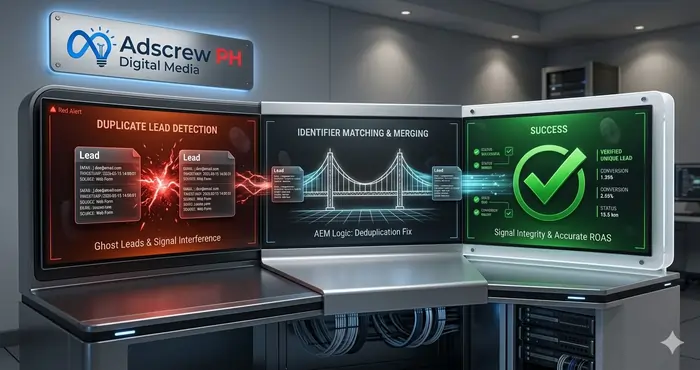
In the high-stakes world of performance marketing in 2026, data is the only currency that matters. A Meta Pixel deduplication error fix is no longer a minor technical adjustment; it is the fundamental requirement for scaling any campaign within Meta Platforms. As privacy restrictions like iOS 14.5+ and the deprecation of third-party cookies have matured, advertisers have turned to a “Hybrid” tracking model—combining the browser-side Meta Pixel with the server-side Conversions API (CAPI).
However, this hybrid approach creates a new technical vulnerability: Double Counting. Without a precise Meta Pixel deduplication error fix, Meta’s optimization engine receives two separate signals for a single customer action. This results in inflated ROAS reports, a distorted Cost Per Acquisition (CPA), and an algorithm that optimizes for “ghost conversions” rather than real revenue. This guide provides the definitive roadmap for resolving these advanced tracking issues and securing your data integrity for sustainable growth.
The Technical Logic of Deduplication
To implement a successful Meta Pixel deduplication error fix, you must understand how Meta distinguishes between two unique events and one event sent via two different channels. The “glue” that holds this entire architecture together is the event_id.
The “Twinning” Process
When a user converts, your tracking infrastructure must send a unique, identical string from both the browser and the server.
- The Browser Path: Fires the Pixel event with
event_id: 888. - The Server Path: Fires the CAPI event with
event_id: 888. - The Meta Logic: Meta’s servers see the matching IDs and merge them into one high-quality conversion.
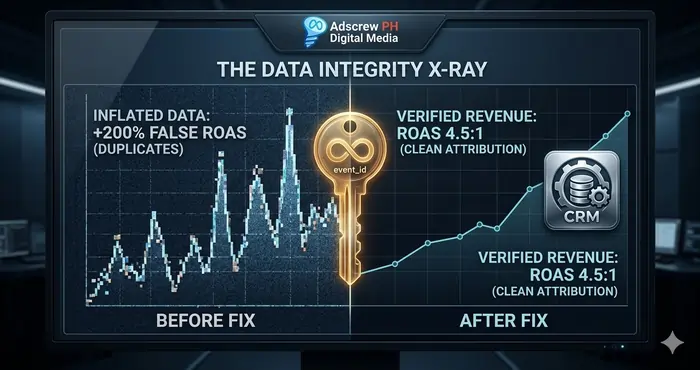
If the browser sends an event without an ID, or if the server generates a different ID, the system fails to merge them. This is the root cause of the Meta CAPI duplicate event problem and requires an immediate Meta Pixel missing event ID fix. Without this synchronization, your proper Meta ads account setup is essentially reporting 200% of your actual results, leading to catastrophic budget miscalculations.
Why Pixel Events Fail After GTM Setup
A frequent issue for agencies is the Pixel not firing after GTM setup. You’ve placed the tags, the container is live, and the Google Tag Manager preview mode shows “Success,” but the Meta “Test Events” tool remains silent.
Common GTM Setup Failures:
- Trigger Sequencing: If your conversion tag fires before the “Base Code” tag has initialized, the browser will ignore the event. Always ensure the base pixel loads on “Initialization” or “Page View” while the conversion fires on “Window Loaded” or a specific “Custom Event.”
- Consent Mode Conflicts: In 2026, if a user hasn’t accepted cookies, GTM may block the pixel entirely. A proper Meta ads for small business strategy must include “Advanced Consent Mode” to recover these lost signals legally.
- Variable Mismatches: If your
event_idvariable is null at the time of firing, the Meta Pixel deduplication error fix will fail at the source because the “handshake” between browser and server is missing.
Solving the Meta CAPI Duplicate Event Problem
The Meta CAPI duplicate event problem occurs when your server-side signals act as a “rogue” data stream. This typically happens because the server isn’t “listening” to the browser’s generated ID.
The Browser-Server Handshake
For a successful browser server deduplication fix Meta, the event_id must be generated in the browser, stored in a cookie or local storage, and then passed to the server via an AJAX call or data layer push. If the server creates its own event_id independently, deduplication is impossible. This synchronization is a critical step in any Meta Pixel advanced tracking protocol, ensuring that the Conversions API serves as a backup and reinforcement, not a duplicator of false data.
Decoding fbp and fbc Cookies in 2026
To achieve elite Event Match Quality (EMQ) scores, your Meta Pixel deduplication error fix must include the passing of fbp and fbc cookies.
- fbp (Browser ID): Identifies the unique browser session.
- fbc (Click ID): Captures the unique
fbclidfrom the ad click.
When these cookies are synchronized across both tracking layers, Meta’s ability to match the event to a specific user profile increases by up to 40%. This is essential for how to run Meta Ads profitably, as it allows for better retargeting precision and superior audience modeling.
Strategic Impact on Algorithm Learning
The Meta algorithm is a machine-learning engine that craves statistical certainty. If you ignore a Meta Pixel deduplication error fix, you are essentially feeding the AI “noisy” and contradictory data.
- Duplicate Events: Teach the AI to find users who double-click or use buggy browsers, rather than actual high-value customers.
- Missing Events: Prevent the AI from seeing your best converters, causing it to optimize for the wrong audience entirely.
This is why a Meta Pixel deduplication error fix is vital for Meta ads event priority for low volume accounts, where every single conversion signal is a high-value data point needed to exit the learning phase and move into the scaling phase.
Troubleshooting AEM and Signal Loss
In 2026, Meta AEM domain verification errors 2026 are often the silent cause of deduplication failure. If your domain isn’t verified in the Meta Business Suite, Meta limits the amount of server-side data it will process, making your Meta Pixel deduplication error fix ineffective for users on privacy-protected devices. Verifying your domain is the “key” that unlocks full CAPI permissions.
Custom Events and Lead Generation
For service businesses, tracking doesn’t end at “Lead.” You need to track “Qualified Lead” and “Sale.” Using Meta custom events for non-e-commerce lead gen requires a robust Meta Pixel deduplication error fix to ensure that deep-funnel conversions aren’t double-counted when passed from your CRM (like HubSpot) back to Meta via CAPI. Accurate reporting at this stage allows you to calculate the True ROI of your campaigns and stop guessing which ads drive actual profit.
The Move to Server-Side GTM
The most durable and high-performance Meta Pixel deduplication error fix is the transition to server-side Meta Pixel GTM. By moving your tracking logic off the user’s browser and into a cloud-hosted server container (like Stape or Google Cloud), you gain absolute control over your data stream.
In this environment, you can compare Meta CAPI Gateway vs Partner Integration technical logic to see which offers better deduplication for your specific CMS. Most advanced advertisers find that the GTM Server-Side approach allows for the most precise browser server deduplication fix Meta, as it removes the browser’s ability to “misplace” or block the event ID.
Resolving the “Missing Event ID” Warning
If you see a “Missing Event ID” warning in your Meta Events Manager, your Meta Pixel deduplication error fix must focus on the data layer integrity.
- Inspect the Payload: Use the browser’s “Network” tab to ensure the
eventIDparameter is being sent with the pixel request. - Verify Server Arrival: Check your CAPI logs to ensure the server is receiving that same ID from the browser.
- Fix Mismatches: If the server is generating a random ID while the browser sends another, you have a mismatch. You must force the server to wait for the browser’s ID or use a session-based ID that both layers can access. This is the cornerstone of the Meta Pixel missing deduplication key fix.
Advanced Debugging for Hybrid Setups
For accounts running high-volume traffic, a standard Meta Pixel deduplication error fix might not be enough. You need to investigate the “eTLD+1” logic of your domain.
The Subdomain Conflict
If your pixel is on www.example.com but your CAPI server is on tracking.example.com, some browsers may treat the event_id cookie as a third-party cookie and block it. To fix this, you must set your cookies to the root domain (.example.com). This ensures the browser server deduplication fix Meta remains active even in strict privacy environments.
AJAX and Single Page Application (SPA) Issues
SPAs (like React or Vue sites) don’t “refresh” the page. If your event_id is only generated on “Page Load,” subsequent conversions on the same session might use the old ID or no ID at all. Your Meta Pixel deduplication error fix must involve a dynamic “New ID” generation for every virtual page view or form interaction.
The Psychology of the Pixel in 2026
Many advertisers view the pixel as a piece of code, but in 2026, we must view it as a “Conversation.” The Meta Pixel deduplication error fix is about making sure that conversation is coherent. If you tell Meta “Person A bought a shirt” via the browser, and then “Person B bought a shirt” via the server (when it was actually the same person), you are confusing the algorithm.
A confused algorithm is an expensive algorithm. It will bid on the wrong people, leading to higher CPMs and lower conversion rates. By perfecting your Meta Pixel deduplication error fix, you are essentially “cleaning the lens” through which Meta sees your business.
CRM Data and Offline Conversions
For industries with long sales cycles (real estate, solar, B2B SaaS), the Meta Pixel deduplication error fix extends to your offline data. When you upload offline conversions or sync them via CAPI, you must use the external_id or the original event_id from the lead’s first touchpoint.
If you don’t, Meta treats the “Closed Sale” as a brand-new user, completely breaking your attribution modeling. A robust Meta Pixel deduplication error fix ensures that the “Lead” and the “Sale” are seen as two parts of the same customer journey, allowing for “Value-Based Optimization” (VBO).
Future-Proofing for 2027
The digital landscape is moving toward a world without third-party cookies. The Meta Pixel deduplication error fix of today will be the “Signal Resilience” of tomorrow. By mastering these technicalities now, you ensure that your business is prepared for the next wave of privacy updates from Apple, Google, and global regulators.
A clean tracking system doesn’t just give you pretty numbers in a dashboard; it gives the Meta algorithm the clarity it needs to turn your ad spend into consistent, scalable revenue. If your Meta Pixel Helper 404 and duplicate event fix protocol is solid, you are already ahead of 90% of your competitors.
The Adscrew PH Diagnostic Checklist
To maintain a pristine tracking environment, follow this technical protocol for every campaign you launch:
- Sync event_id: Ensure the browser and server pass identical IDs for every single event without exception.
- Verify EMQ: Check that
fbpandfbcare included to boost match rates and attribution accuracy. - Audit GTM: Resolve any “Pixel Not Firing” errors using the GTM and Meta debuggers immediately upon detection.
- Confirm Deduplication: Use the “Test Events” tool in the Meta Events Manager to verify that signals are merging in real-time.
By adhering to this Meta Pixel deduplication error fix manual, you transform your tracking from a liability into a scaling asset. Precision in data is the only way to achieve sustainable ROI in the modern Meta ecosystem.