
Table of Contents
Summary: Redundant Meta Ad Account Structure for High Risk
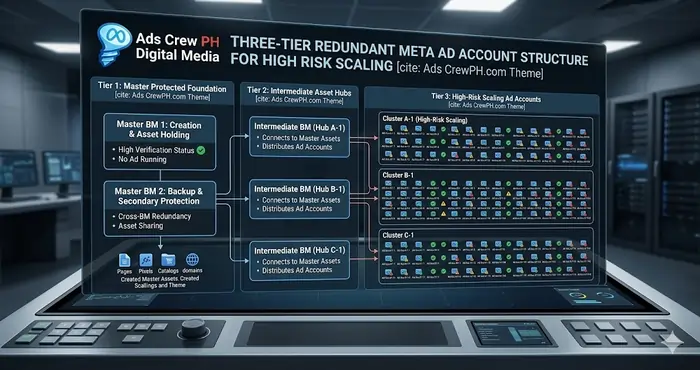
In 2026, a Redundant Meta Ad Account Structure for High Risk is no longer optional—it’s mandatory revenue insurance. This 3-Tier Redundancy Model distributes risk across a Primary Scaling Account (60-75% of budget), a Secondary Warm Backup (20-30% already running), and an Emergency Containment Account (5-10%). Key technical pillars include Asset Holding Portfolio for Master Pixel sharing (prevents chain-infection bans), Domain Verification redundancy, Conversions API (CAPI) continuity, and financial role separation with unique virtual payment methods. Without this framework, a single AI-driven policy flag can trigger spend velocity reviews or automated enforcement, causing weeks of downtime and millions in lost revenue. Implement the 30-Day Warm-Up SOP for backup accounts and use a Creative Sandbox to test risky angles away from your primary scaling layer. For high-spend advertisers in sensitive verticals (health, supplements, aggressive scaling), redundancy transforms fragility into operational maturity—ensuring lead flow never stops.
Common Questions This Article Answers
“What is a redundant Meta ad account structure and why do I need it in 2026?”
“How do I set up backup ad accounts without triggering Meta’s bans?”
*”What is the 3-Tier Redundancy Model for high-risk advertisers?”*
“How do I share a pixel across multiple ad accounts without getting flagged?”
*”What is the 30-day warm-up schedule for backup accounts?”*
“How does finance role separation protect my ad accounts from hackers?”
Introduction: The Invisible Tax on High-Spend Advertisers
If you operate in aggressive scaling environments, high-spend accounts, or sensitive verticals, relying on a single ad account is operational negligence. In the high-stakes world of performance marketing in 2026, the cost of a shutdown isn’t just the lost ad spend; it’s the erosion of pixel data, the loss of “Learning Phase” momentum, and the sudden drop in lead flow that can paralyze a sales team.
A Redundant meta ad account structure for high risk is the difference between a temporary disruption and total revenue collapse. For the professional media buyer, the question isn’t if an account will be flagged, but when. Meta’s Andromeda AI now processes billions of signals per second, often prioritizing “Safety First” (flagging now, asking questions later) to protect user experience. To understand how these automated systems categorize risk, you can review the Meta Advertising Standards, which serve as the foundation for AI enforcement.
In today’s Meta ecosystem:
- Automated enforcement is stricter and faster than ever.
- Payment systems flag irregularities (like mismatched billing addresses) in milliseconds.
- Spend velocity triggers “Integrity Reviews” that can pause even compliant accounts.
- Policy misinterpretations by AI can disable accounts instantly.
Professional advertisers do not wait for a restriction to happen. They engineer structural protection in advance. This guide breaks down the exact framework agencies use to protect six‑figure monthly ad operations using a properly designed Redundant meta ad account structure for high risk.
Why Is Redundancy a Growth Multiplier, Not Just a Safety Net?
Direct answer: Redundancy lets you scale aggressively without fear. You can push risky creatives in a “Creative Sandbox” while keeping your primary account clean. If one account gets flagged, you switch to a pre‑warmed backup within hours – not weeks. That’s not defensive; that’s a competitive advantage.
Many advertisers believe redundancy is a purely defensive play – a “break glass in case of emergency” tactic. In reality, a properly implemented Redundant meta ad account structure for high risk is a massive growth lever. It enables:
- Aggressively Scaling: You can push boundaries on one account while keeping the “Primary” account safe and stable.
- Risk Compartmentalization: If one vertical or creative angle is “risky,” it stays in a sandbox, protecting your entire proper Meta Ads account setup.
- Budget Experimentation: Test massive budget jumps on secondary accounts without systemic exposure.
- Recovery Speed: Move from “Disabled” to “Active” within 24–48 hours instead of weeks.
- Client Confidence: In volatile verticals, your ability to maintain uptime is your greatest selling point as an agency.
Without structural redundancy, your business has a single point of failure. That is not scaling. That is fragility. This is why a Meta Business Manager setup for agency scaling must include redundancy at the core of its architecture. For agencies looking to manage high volumes of data across these redundant layers, tools like Supermetrics for Meta Ads can help centralize reporting.
What Are the 2026 Meta Risk Architecture Layers You Need to Understand?
Direct answer: Meta enforces through three layers: Automated Policy Detection (scans ad copy and images), Spend Velocity Monitoring (flags sudden budget spikes), and Payment Integrity Systems (detects shared credit cards across portfolios). Each layer can trigger a freeze – redundancy helps you survive all three.
To build a high‑level Redundant meta ad account structure for high risk, you must understand the layers of Meta’s enforcement.
Layer 1: Automated Policy Detection (The First Filter)
Triggers include financial outcome claims, “before and after” health comparisons, and sensitive audience assumptions. These are often caught by “Text-in-Image” AI before a human ever sees the ad. You can cross‑reference these triggers with WordStream’s Guide to Ad Disapprovals to identify common pitfalls.
Layer 2: Spend Velocity Monitoring
A sudden jump from 260/day∗∗to∗∗260/day∗∗to∗∗2,600/day will trigger a “velocity review.” Meta wants to ensure you aren’t using a stolen credit card. High spend velocity without historical trust increases the probability of a disable.
Layer 3: Payment Integrity Systems
Sharing one credit card across 5+ Business Portfolios is a “Chain Infection” risk. If one portfolio is banned for policy, Meta may “auto-ban” every other portfolio sharing that same card. This is why payment redundancy is a mandatory pillar of a Redundant meta ad account structure for high risk. To safeguard these transactions, using virtual business cards from providers like Revolut Business is often recommended by performance agencies.
What Is the 3-Tier Redundancy Model (Agency Blueprint)?
Direct answer: The 3‑Tier model splits your budget: Tier 1 (60‑75%) is your primary scaling account with safe creatives. Tier 2 (20‑30%) is a warm backup already running low‑spend campaigns. Tier 3 (5‑10%) is an emergency containment account with minimal spend to keep payment signals alive.
This is the exact model we implement at Adscrew PH for our highest‑spending clients.
Tier 1: The Primary Scaling Account (60‑75% of Budget)
This is your “Golden Child.” It is a fully verified Business Portfolio with a stable pixel history of at least 90 days. We use strictly compliant, “safe” creatives here to build long‑term platform trust.
Tier 2: The Secondary Warm Backup (20‑30% of Budget)
This account is already running! It isn’t sitting idle. It runs low‑to‑mid spend on your best‑performing, proven creatives. If Tier 1 goes down, this account is already “warmed up” and ready to absorb the full budget. This is a critical step in Meta Ads for small business scaling.
Tier 3: The Emergency Containment Account (5‑10% of Budget)
This is a separate Business Portfolio entirely, often managed by a different Admin. It keeps a tiny “maintenance spend” alive ($4/day) just to keep the “Payment Signal” active with Meta.
How Does Finance Role Separation Protect Your Ad Accounts?
Direct answer: In 2026, Meta allows a specific “Finance” role that can only see billing, not campaigns. By separating media buyers from finance, even if a buyer’s profile is hacked, the attacker cannot change payment methods or see your credit card. Use virtual cards with unique numbers per account to prevent “Cross‑Portfolio Infection.”
In a Redundant meta ad account structure for high risk, you must decouple your Media Buying team from your Finance data.
Threshold Management: Set your payment thresholds low initially. A history of 100+ small, successful payments builds more trust than one large monthly payment.
The “Finance Manager” Strategy: In 2026, Meta allows for a specific “Finance” role that can only see billing. By separating this, you ensure that even if a Media Buyer’s personal profile is compromised, the hacker cannot change the payment method or see the full credit card details. This separation is a vital part of Meta ads permission levels for external partners. Agencies often use Meta Work Accounts to manage these distinct roles without tethering them to personal profiles.
Avoid “Card Sharing”: Use virtual cards with unique numbers for each Ad Account. This prevents “Cross‑Portfolio Infection.”

How to Share Pixels and Domains Without Getting “Circumventing Systems” Flags?
Direct answer: Create a “Master Pixel” in a separate Asset Holding Portfolio. Share that pixel as a Partner to your Tier 1, Tier 2, and Tier 3 accounts. Verify your domain once in the Holding Portfolio, then assign it as a Partner to backup accounts. This keeps your pixel safe even if a scaling account is banned.
The biggest mistake advertisers make is “Hard-Linking” assets in a way that looks like they are trying to bypass a ban. To stay compliant while maintaining a Redundant meta ad account structure for high risk, follow these steps:
Technical Step 1: The “Master Pixel” Hub
Create your Pixel (Dataset) in a separate “Asset Holding” Business Portfolio. Share that pixel with your Scaling, Backup, and Emergency accounts as a “Partner.”
- Why? If a “Scaling” Ad Account is banned, the Pixel remains safe in the “Holding” Portfolio.
Technical Step 2: Domain Verification Redundancy
Only one Business Portfolio can “own” a domain. However, that owner can “Share” the domain with other portfolios.
- Verify your domain in your “Asset Holding” Portfolio.
- Go to Brand Safety > Domains > Assign Partners.
- Enter the Business ID of your Backup account.
Technical Step 3: Conversions API (CAPI) Continuity
Ensure your CAPI (Server‑Side Tracking) is sending data to the Master Pixel ID. This ensures that no matter which Ad Account is active, the Tracking, Analytics & Attribution data is uninterrupted. For advanced technical implementation, DataAlly’s CAPI guide provides a comprehensive walkthrough.
Case Study: How Did an E-Commerce Supplement Brand Survive a Sudden Ban?
A supplement brand spending $155,000/month had their primary account disabled by Andromeda AI over a custom testimonial video. Without redundancy, they would have lost $55,000/month had their primary account been disabled by Andromeda AI over a custom testimonial video. Without redundancy, they would have lost $57,000 in revenue over 11 days. With a 3‑Tier Redundant Structure, they shifted budget to their Tier 2 backup within 4 hours and contained losses to just $7,800.
Industry: Health/Supplements
Monthly Spend: $155,000
Problem: Primary account suddenly disabled after Andromeda AI flagged a “Benefit Claim” in a customer testimonial video.
Without Redundancy:
- Downtime: 11 days (waiting for manual review).
- Projected Loss: $57,000 in missed revenue.
With a Redundant Meta Ad Account Structure for High Risk:
- Action: Budget shifted to the “Tier 2” Backup account (already running at $520/day) within 4 hours.
- Result: Scale achieved on the backup in 48 hours. Total revenue loss contained to $7,800.
- The Win: The client never stopped receiving leads. This proves that how to run Meta Ads successfully is about infrastructure, not just creative.
What Is the 30-Day Warm-Up SOP for Backup Accounts?
A cold account is a risky account. Follow this 30‑day trust‑building schedule: Days 1‑7 run Engagement at $4/day.Days 8‑14 run Landing Page Views at $4/day .Days 8‑14 run Landing Page Views at $9/day. Days 15‑30 run Low‑Barrier Conversions (Add to Cart or Lead Form). This proves to Meta you’re legitimate.
A “Cold” account is a “Risky” account. To integrate an account into your Redundant meta ad account structure for high risk, you must follow this 30‑day “Trust Building” schedule:
- Days 1–7: High‑Value Post Engagement. Boost a “Helpful Tip” post from your page. Spend $4/day. Build a “Social Signal.”
- Days 8–14: Landing Page View campaigns. Send traffic to an “About Us” or “Blog” page. Spend $9/day. Build a “Destination Trust” signal.
- Days 15–30: Low‑Barrier Conversions (Add to Cart or Lead Form). This proves to Meta that you have a functional proper Meta Ads account setup. To align this warm‑up with official platform education, refer to the Meta Blueprint Training modules on account health.
What Is the “Creative Sandbox” for Risk Distribution?
Do not launch risky creatives in your primary account. Test new, aggressive angles in your Tier 3 Emergency or a dedicated Testing Account. Only move a creative to your primary scaling layer after it has run safely for 7+ days without flags. This keeps your main account clean and trusted.
- Test new, unproven creative angles in your Tier 3 Emergency or a dedicated “Testing Account.”
- Only once a creative has been “Safe‑Vetted” by the AI (running for 7+ days without flags) do you move it into your Redundant meta ad account structure for high risk primary scaling layer. Performance tools like Metricool can help monitor these tests in real‑time to detect early warning signs.
Key Takeaways
- Never rely on a single ad account. Meta’s Andromeda AI can disable even compliant accounts instantly. A 3-Tier Redundancy Model (Primary, Warm Backup, Emergency) ensures your lead flow never stops.
- Keep your backup accounts already running – even at low spend (4–9/day). A “warm” account can absorb your full budget within hours, not weeks.
- Separate your pixel and payment methods. Use an Asset Holding Portfolio for your Master Pixel and unique virtual cards per account. This prevents chain‑infection bans if one account gets flagged.
- Test risky creatives in a “Creative Sandbox” (Tier 3) – not your primary account. Only move safe, vetted creatives to your main scaling layer after 7+ days without flags.
20-Question FAQ: Redundant Meta Ad Account Structure for High Risk
- What is a redundant Meta ad account structure?
A setup with multiple ad accounts (Primary, Backup, Emergency) that share the same pixel and domain, allowing you to switch spending instantly if one account gets disabled. - Why do I need redundancy in 2026?
Meta’s Andromeda AI enforces policies aggressively and can disable compliant accounts by mistake. Redundancy ensures your lead flow never stops. - How many accounts do I need for proper redundancy?
At least three: Primary (60‑75% of budget), Warm Backup (20‑30%), and Emergency Containment (5‑10%). - What is a “Master Pixel” Hub?
A separate Business Portfolio that owns your pixel. You share this pixel as a Partner to all your ad accounts – if one account is banned, the pixel stays safe. - Can I use the same credit card for all three tiers?
No. That creates a “Chain Infection” risk. Use unique virtual cards (e.g., Revolut, GCash AMEX) for each ad account. - What is spend velocity monitoring?
Meta’s AI flags sudden budget jumps (e.g., from 260/dayto2,600/day) as suspicious. Redundancy lets you spread increases across multiple accounts. - How long does it take to switch from a disabled primary to a backup?
With a pre‑warmed backup, 2‑4 hours. Without redundancy, 7‑14 days. - What is the “Creative Sandbox”?
A low‑risk testing ground (usually Tier 3 or a separate testing account) where you launch aggressive or unproven creatives. Only safe‑vetted creatives move to the primary account. - How do I share a domain across multiple Business Portfolios?
Verify the domain in your Asset Holding Portfolio, then go to Brand Safety > Domains > Assign Partners and add the Business IDs of your backup accounts. - What happens to my CAPI if I switch ad accounts?
Nothing – as long as your CAPI sends events to the Master Pixel ID (not the ad account ID). The pixel remains constant. - Can I run the same pixel on multiple ad accounts?
Yes. Share the pixel as a Partner to each account. This is compliant and prevents data fragmentation. - What is the “Finance Manager” role?
A Meta role that only sees billing information – not campaigns. Separating finance from media buyers protects your payment methods if a buyer’s account is hacked. - How do I warm up a brand new backup account?
Follow the 30‑day schedule: Days 1‑7 Engagement (4/day),Days8‑14LandingPageViews(9/day), Days 15‑30 Low‑Barrier Conversions. - Why does Meta freeze accounts with high spend velocity?
To prevent fraud (stolen credit cards). A sudden spike without historical trust triggers an automatic integrity review. - Can an agency use this 3‑Tier model for multiple clients?
Yes. Each client should have their own Asset Holding Portfolio, with the agency granted Partner access to all three tiers. - What is a “Chain Infection” ban?
When Meta bans multiple Business Portfolios because they share the same payment method, domain, or pixel. Redundancy breaks these links. - How do I test a risky creative without endangering my primary account?
Launch it in your Tier 3 Emergency account or a dedicated testing account. If it runs for 7+ days without flags, it’s safe to move to Tier 1. - What metrics should I monitor for backup account health?
Payment success rate, ad approval speed, and frequency of “integrity checks.” A healthy backup should have no payment failures in the last 30 days. - Does redundancy affect my learning phase?
No – because you share the same pixel across accounts, the pixel’s history remains intact. The learning phase is attached to the pixel, not the ad account. - Where can I learn more about Meta ad account redundancy?
Start with Meta’s Business Help Center and our Meta Business Manager Setup for Agency Scaling guide.
Complete Meta Ads Redundancy Ecosystem
This guide is part of a complete ecosystem. For deeper dives into each component, explore:
- Proper Meta Ads Account Setup (Pillar Guide) → Foundation for new advertisers – start here.
- Meta Business Manager Setup for Agency Scaling → Hub‑and‑Spoke model for agencies.
- Meta Ads Permission Levels for External Partners → Secure access management.
- Meta Business Verification Without Official Documents → Signal hardening for unverified entities.
- Meta Business Manager 2FA Bypass Prevention → Hardware security keys.
Conclusion: Redundancy Is Revenue Insurance
A Redundant meta ad account structure for high risk is no longer optional for serious advertisers – it is a mandatory revenue insurance system. It is the hallmark of operational maturity. In an ecosystem where AI makes the rules, structural diversity is your only protection against the “Single Point of Failure.”
Build your backup before you need it. Harden your payment signals today. Ensure your proper Meta Ads account setup includes a tiered recovery plan. At Adscrew PH, we believe that scaling isn’t just about spending more – it’s about surviving long enough to win. For a visual summary of these 2026 strategies, you can watch the Meta Ads for Small Business 2026 Tutorial.
Final Checklist for Adscrew PH Redundancy
Payment methods are separate and unique per portfolio.
Tier 2 Backup account is currently spending at least 15% of total budget.
Master Pixel is shared from an “Asset Holding” Portfolio.
All Admins have 2FA and verified personal identities.