
Table of Contents
In 2026, the defining choice between Traffic vs Conversion campaigns on Meta Ads determines whether you pay for casual window shoppers or verified buyers. Traffic campaigns optimize for cheap clicks and landing page views, filling your funnel with low-intent “clickers” who rarely purchase—leading to the infamous warm audience trap, where retargeting these users fails because Meta’s Andromeda engine delivered exactly what you asked for: curiosity, not buying intent. Conversion campaigns, by contrast, bid for high-value auctions targeting users with a proven history of purchases or lead completions, delivering superior ROAS. Use Traffic only for top-of-funnel content awareness, pixel seeding, or technical testing; always use Conversion objectives (Sales, Leads) for revenue, e-commerce (especially Catalog Sales/DPA), and scaling via horizontal/vertical budget increments. If your traffic campaign isn’t converting, switch to Conversions immediately. The final verdict: clicks are vanity, conversions are business—escape the cheap-traffic trap and let Meta’s AI optimize for real outcomes.
In the high-stakes digital economy of 2026, where Meta’s Andromeda Ad Delivery Engine dictates the rise and fall of global brands, the most pivotal decision you will make happens in the first sixty seconds of campaign creation. The debate over traffic vs conversion campaigns Meta ads is no longer just a technicality; it is a fundamental choice of business philosophy. Are you paying for digital window shoppers, or are you investing in verified buyers?
If you misunderstand this distinction, you aren’t just wasting money—you are actively training Meta’s AI to ignore your best customers. This pillar guide provides the deep-tissue strategic and technical breakdown required to master the traffic vs conversion Facebook ads strategy and build a scalable ROAS machine.
What Is the Difference Between Traffic and Conversion Campaigns?
The primary difference in traffic vs conversion campaigns Meta ads is the delivery instruction sent to the Meta AI. A traffic campaign optimizes for Landing Page Views or Link Clicks, seeking out users who click frequently but rarely complete a purchase. A conversion campaign utilizes the broader Meta Ads campaign objective guide to find high-intent users likely to complete specific actions like a Lead or Purchase.
While traffic is often cheaper per click, conversion campaigns drive significantly higher ROAS because they prioritize business outcomes over vanity metrics. The common question, “should I use traffic or conversion ads?” almost always favors conversions when revenue is the goal.
The Andromeda Engine – Decoding How Meta Ads Optimize for Conversions
In 2026, Meta’s algorithm has evolved into a predictive powerhouse. When you choose between traffic vs conversion campaigns Meta ads, you are essentially selecting which “Cluster” of humanity you want to reach.
The Logic of the Traffic Objective
When you select Traffic, you are telling the Andromeda engine to find “Clicky” people. These are users whose historical data shows a high probability of interacting with an ad but a low probability of spending money.
- Auction Behavior: Meta enters you into the most affordable, high-volume auctions.
- User Profile: These people often have “infinite tabs” open; they consume content but rarely cross the finish line of a checkout page.
The Logic of the Conversion Objective
When you select Conversions, the AI shifts its focus to “Intent-Driven” users. It analyzes users who have a verified track record of completing high-value actions on other platforms. This is how the system achieves conversion optimization Meta ads performance.
- Auction Behavior: You are placed in highly competitive, high-intent auctions where you are bidding against other brands for the 1% of users ready to buy now.
- User Profile: These are decisive buyers who value their time and only click when they have a genuine interest in a solution or product.
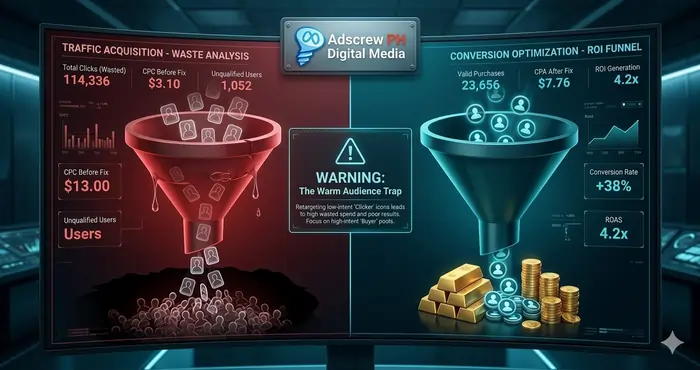
The “Warm Audience Trap” in Meta Ads
The warm audience trap in Meta ads is a logical fallacy that destroys millions in ad spend every year. It is the single biggest reason for a low conversion rate Facebook ads scenario.
The Anatomy of the Trap
The trap follows a predictable, yet destructive path:
- The “Cheap” Start: An advertiser runs a traffic campaign to a cold audience. The CPA vs CPC marketing looks great initially because the CPC is low ($0.12).
- The Retargeting Fallacy: The advertiser creates a Custom Audience of “Website Visitors” from that traffic. They assume this audience is “warm” and ready to buy.
- The Conversion Deadlock: They launch a conversion campaign targeting this “warm” audience. The results are abysmal.
Why the Trap Exists
Meta’s algorithm delivered exactly what you asked for: Clickers. By optimizing for traffic, you filled your funnel with users who have a high historical CTR but zero historical purchase intent. You haven’t built a “warm” audience; you’ve built a “curious” audience. This is why traffic campaigns don’t convert—they are built on a foundation of low-intent signals.
Difference Between Cold and Warm Audiences Meta Ads
To escape the trap, you must understand the difference between cold and warm audiences Meta ads within the context of audience intent targeting.
- Cold Audiences (Top of Funnel): These users are unaware of your brand. In a funnel-based advertising model, this is the Awareness stage.
- Warm Audiences (Middle of Funnel): These users have interacted with your brand. However, their “warmth” is dictated by the quality of that interaction. A user who watched 75% of a product demo is “warmer” than a user who clicked a “See More” link on a traffic ad and bounced in 2 seconds.
Using a retargeting strategy Facebook ads approach on low-intent traffic is the fastest way to lower cost per acquisition Facebook ads efficiency.
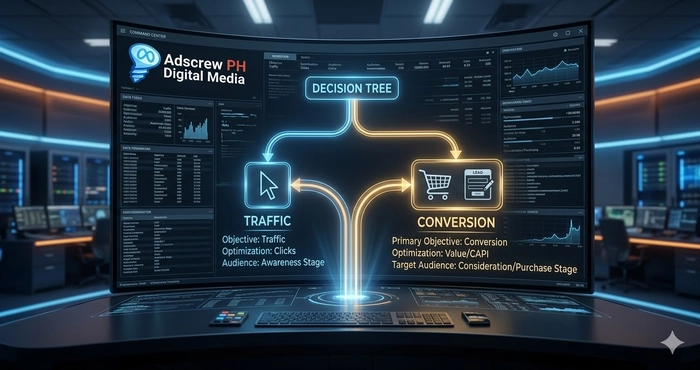
Decision Matrix – When to Use Traffic vs Conversion Campaigns
Many marketers ask: When to use traffic vs conversion campaigns? Here is the strategic decision tree for 2026.
Use Traffic Campaigns If:
- Top-of-Funnel Content Consumption: You want people to read a long-form guide to build authority.
- Pixel Seeding: You have a brand-new website and need initial visits to help your Meta pixel tracking identify base-level traffic patterns.
- Technical Testing: You are testing landing page conversion rate variables (A/B testing) and need a high volume of users quickly to see how they interact with elements.
Use Conversion Campaigns If:
- Direct Sales: You are selling a product or service. This is the best campaign objective for sales Meta ads.
- Lead Generation: You need qualified prospects.
- Scaling: You are ready to improve ROAS Meta ads and want to find the most valuable segments of your audience.
Traffic vs Conversion Facebook Ads Strategy for E-commerce
For e-commerce brands, the traffic vs conversion campaigns Meta ads choice is a life-or-death decision for the store’s profitability.
The Sales Objective vs. Catalog Sales
If you have a massive inventory, the choice between Sales Objective vs Catalog Sales for Scaling is your primary lever. Catalog Sales (Dynamic Product Ads) utilize Meta’s deep learning to show products based on a user’s specific browsing history, offering a level of conversion optimization Meta ads that a generic traffic ad simply cannot match.
Why My Traffic Campaign Is Not Converting for My Store?
If you are seeing thousands of visitors but zero sales, you are in the “Clicker Auction.” The Andromeda engine is serving your ads to people who love to “Add to Cart” as a hobby but never intend to enter a credit card number. This is why my traffic campaign is not converting—it’s hitting the wrong behavioral cluster.
Ad Funnel Stages: Awareness, Consideration, and Conversion
To build high converting Facebook ads campaigns, you must respect the ad funnel stages awareness consideration conversion.
- Awareness (TOFU): Use Engagement or Awareness objectives. Focus on “ThruPlays” for videos to qualify interest.
- Consideration (MOFU): This is where you might test a traffic vs conversion Facebook ads strategy. However, “Soft” conversions (like Add to Cart) are generally superior to Traffic clicks.
- Conversion (BOFU): Use the Sales objective with Meta value optimization strategy to target the highest-value buyers in your retargeting pool.
Lead Generation – How to Choose Meta Ads Objective
For service-based businesses, the question of how to choose Meta ads objective often comes down to lead quality.
If you send traffic to a site, you may get a low landing page conversion rate. If you use conversion optimization Meta ads targeting a specific form submission, the quality improves. To further refine this, you must weigh the pros and cons of Instant Forms vs Landing Page Lead Quality.
A traffic vs conversion campaigns Meta ads strategy for high-ticket services should almost always favor conversions, as the cost of a “junk lead” from a traffic campaign is too high for a professional sales team to manage.
How to Fix Low Conversion Rate Facebook Ads
If you are currently struggling with low conversion rate Facebook ads, follow this 3-step diagnostic:
- Audit the Objective: Are you using Traffic? If yes, that is why your traffic campaign is not converting. Switch to Conversions immediately.
- Verify Meta Pixel Tracking: Ensure your events are firing correctly and that you have no deduplication errors.
- Check Signal Density: If your conversion campaign is “Learning Limited,” it means you aren’t getting 50 events per week. Instead of switching back to Traffic, move your conversion goal “up-funnel” (e.g., from Purchase to Add to Cart).
How to Scale Meta Ads Conversion Campaigns
When you are ready to implement a Meta ads scaling strategy, the conversion objective is your only vehicle.
Horizontal vs. Vertical Scaling
- Vertical Scaling: Increasing the budget of a winning ad set by 15-20% every 48 hours. This works best when the Meta ads campaign objective guide logic has stabilized the learning phase.
- Horizontal Scaling: Launching the winning creative into new audiences or Advantage+ Shopping Campaigns (ASC).
To successfully scale Meta ads conversion campaigns, you must ensure your KPI alignment is focused on the CPA vs CPC marketing balance. As you scale, your CPC will likely rise—don’t panic. If your ROAS remains stable, the higher-cost traffic is worth the premium.
Performance Metrics – Improve ROAS Meta Ads in 2026
The final secret to the traffic vs conversion campaigns Meta ads debate is the concept of “Value.” In 2026, simply getting a purchase isn’t enough; you need the right purchase.
By using Meta Value Optimization Strategy, you move beyond simple conversion tracking and into the realm of profit-maximization. This tells the Andromeda engine to seek out users who have a high “LTV” (Lifetime Value) potential. This is a level of sophistication that a traffic vs conversion Facebook ads strategy built on clicks will never achieve.
20-Question FAQ: Traffic vs Conversion Campaigns Meta Ads
- Which is better: traffic or conversion campaign? Conversion is superior for revenue; Traffic is best for content awareness.
- Why traffic campaigns don’t convert? Because they optimize for clicks, not buying intent.
- Does Meta pixel tracking affect traffic ads? It helps track data, but Meta doesn’t use that data to optimize traffic ads for sales.
- How Meta ads optimize for conversions? By analyzing historical “Buyer” clusters and targeting users within them.
- What is the warm audience trap in Meta ads? Building retargeting pools from low-intent clickers who won’t buy.
- Should I use traffic or conversion ads for a new site? Use Traffic for a few days to gather data, then switch to Conversions.
- How to choose Meta ads objective? Match the objective to your exact business outcome (Lead, Sale, or View).
- What is the best campaign objective for sales Meta ads? The Sales objective (formerly Conversions).
- Why my traffic campaign is not converting? You are likely reaching the “Clicker” cluster instead of the “Buyer” cluster.
- How to fix low conversion rate Facebook ads? Switch to a conversion objective and improve your creative-to-audience match.
- What is CPA vs CPC marketing? CPC is cost per click; CPA is cost per actual business result (the one that matters).
- Is the traffic objective good for Amazon sellers? Yes, because you often cannot track sales on Amazon’s platform directly.
- How to scale Meta ads conversion campaigns? Gradually increase budgets on winning creatives while maintaining ROAS.
- What are the ad funnel stages awareness consideration conversion? The journey from a user discovering you to becoming a paying customer.
- Does the Andromeda engine affect my ads? Yes, it is the AI that determines who sees your ad based on your chosen objective.
- Why is my CPM higher on conversion ads? Because you are bidding for a more valuable, high-intent audience.
- Can I use traffic for retargeting? You can, but it’s the “Warm Audience Trap.” Use Conversions instead.
- How does landing page conversion rate affect my ads? A poor page will kill even the best conversion campaign.
- What is the difference between cold and warm audiences Meta ads? Cold have never seen you; Warm have interacted with you.
- Should I hire Adscrew PH for my tracking? If you are spending over $2,000/month and your data is messy, a technical audit is mandatory.
Summary: The Final Verdict on Traffic vs Conversion Campaigns Meta Ads
The choice between traffic vs conversion campaigns Meta ads determines the future of your ad account. Clicks are a vanity metric; conversions are a business metric. If you want to improve ROAS Meta ads and achieve a lower cost per acquisition Facebook ads environment, you must stop treating Meta as a billboard and start treating it as a revenue engine.
Don’t fall for the trap of cheap traffic. Focus on intent, build your funnel-based advertising correctly, and use the best campaign objective for sales Meta ads to scale your business into 2027 and beyond.