

Table of Contents
What Is the Best Way to Define Meta Ads Campaign Objectives?
The best way to define Meta Ads campaign objectives is to work backward from your core business outcome and match it to the specific user behavior Meta’s AI can predict. If your goal is brand recall, choose Awareness. If you need high-intent traffic to a blog or product page, choose Traffic. However, if you require a tangible action like a lead or a purchase, you must select Leads or Sales. Meta’s algorithm actively filters the auction pool to find users most likely to take the specific action you’ve requested. Selecting a misaligned objective leads to “Vanity Metrics,” where clicks are high but revenue is non-existent.
In the hyper-automated landscape of 2026, the success of your advertising is no longer determined solely by your creative or your audience targeting. Instead, the most critical decision happens at the very first step of the setup process. Understanding how to define Meta Ads campaign objectives is the foundational skill that separates elite media buyers from those simply “boosting” posts and hoping for a miracle.
Choosing your objective is not just a setting; it is a direct instruction to Meta’s multi-billion dollar machine-learning engine, now powered by the Andromeda Ad Delivery Engine. When you select an objective, you are telling the AI which human behaviors to value and which historical data points to prioritize. If your instruction is fuzzy, your results will be inconsistent. This guide provides the 2026 strategic framework required to align your business goals with Meta’s delivery logic.
The Andromeda Era – Why Objectives Matter More in 2026
Since the global rollout of the Andromeda engine in late 2025, Meta has moved away from manual “interest” targeting and toward Signal-First Marketing. In this new era, your Meta Ads campaign objectives act as the primary directive for the AI.
When you select an objective, Meta immediately modifies:
- Auction Selection: It determines which competitive auctions you enter—the “Buyers” auction for Sales or the “Engagement” auction for social proof.
- Signal Weighting: It tells the AI to prioritize users who have a historical pattern of completing that specific action.
- Learning Stabilization: It defines what “success” looks like, allowing the system to exit the learning phase faster and enter the “Efficiency Zone.”
A campaign optimized for “Traffic” and a campaign optimized for “Sales” can target the exact same audience with the exact same budget—but the Sales objective will seek out the 2% of that audience currently in a buying window, while Traffic will find the 10% who click on everything but rarely check out.
Decoding the 6 Core Meta Ads Campaign Objectives (ODAX)
1. Awareness
Goal: Reach the largest number of people likely to remember your brand. In 2026, this objective is utilized by “Authority Builders” who want to penetrate new markets. It is perfect for local businesses, such as a medical clinic or a garage door service, entering a new city.
- Success Metric: Estimated Ad Recall Lift (EARL) and CPM.
- When to use: Brand launches, rebranding, or video-heavy “top-of-funnel” (TOFU) awareness.
2. Traffic
Goal: Send people to a destination, such as your website, app, or Facebook event. While clicks are the primary metric here, Meta now uses Contextual AI Search signals to find users likely to consume content.
- Success Metric: Landing Page Views (LPV).
- When to use: Blog post promotion, content consumption, or warming up a pixel before a Sales launch.
3. Engagement
Goal: Get more messages, video views, post engagement, or page likes. This is the “Social Proof” objective. In 2026, the Andromeda engine evaluates creative first; an engagement-heavy ad helps the AI understand which “performance clusters” of users find your message relevant.
- Success Metric: Video Views (thru-play) or Messaging Conversations.
- When to use: Distributing UGC-style testimonials or starting conversations on WhatsApp.
4. Leads
Goal: Collect leads for your business or brand via instant forms, messages, or calls. This is the gold standard for service industries. You must decide between Meta Instant Forms vs Landing Page Lead Quality. While instant forms reduce friction, landing pages often capture higher-intent signals.
Meta’s Outcome-Driven Ad Experiences (ODAX) model has simplified the setup process into six streamlined categories. Each of these Meta Ads campaign objectives is designed for a specific stage of the customer journey.
- Success Metric: Cost Per Lead (CPL).
- When to use: High-ticket services, newsletter signups, or quote requests.
5. App Promotion
Goal: Get more people to install your app and continue using it. Meta uses predictive modeling to find users who aren’t just “installers” but “active users.”
- Success Metric: App Installs or App Events.
- When to use: New app launches or re-engaging dormant users.
6. Sales
Goal: Find people likely to purchase your goods or services. This is the most competitive objective. For e-commerce brands, deciding between Meta Sales Objective vs Catalog Sales for Scaling is vital. Catalog sales are better for dynamic retargeting, while standard Sales campaigns are often better for “Hero Product” scaling.
- Success Metric: ROAS (Return on Ad Spend) and Purchase Volume.
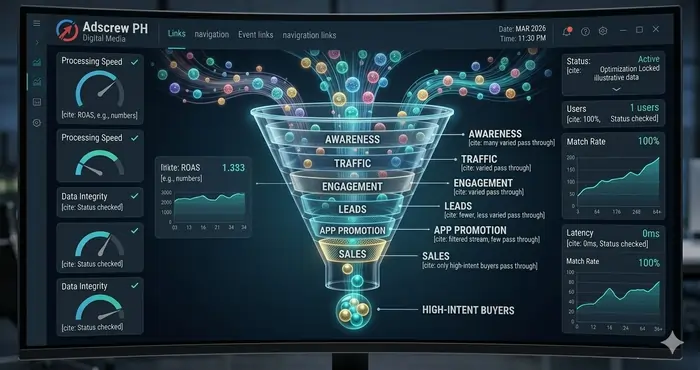
Expert Decision Tree – Matching Objectives to Funnel Stages
Success in 2026 requires a “Stage-Specific” approach to Meta Ads campaign objectives.
TOFU: Cold Audience (The Discovery Layer)
At this stage, your audience has zero awareness. Your goal is attention.
- Best Objectives: Awareness, Engagement, or Video Views.
- Strategic Goal: Lowering the barrier to entry and populating your retargeting pools.
MOFU: Warm Audience (The Consideration Layer)
These users have engaged but haven’t committed.
- Best Objectives: Traffic or Leads.
- The Trap: Avoid staying in the “Traffic” objective too long. Check our guide on Traffic vs Conversion Campaign Meta Ads to see when to pivot.
BOFU: Hot Audience (The Conversion Layer)
Users who have abandoned carts or visited your pricing page.
- Best Objectives: Sales or Leads.
- Strategic Goal: Finalizing the transaction. For service providers, this often involves the Meta Ads Funnel Structure for High Ticket Services.
The Strategic Logic of Industry-Specific Frameworks
Different industries require varying Meta Ads campaign objectives to thrive. There is no “one-size-fits-all” button in 2026.
For E-commerce: The ROAS Powerhouse
E-commerce businesses live and die by the Sales objective. However, the nuance lies in the data source. If you have a large inventory, Catalog Sales (using Advantage+ Creative) allows Meta to dynamically show products users have already viewed. If you are launching a single “Hero Product,” a standard Sales objective with a custom landing page often yields better creative control.
For B2B & Service Businesses: The Lead Quality Balance
For B2B, the primary challenge is lead quality. If you find your sales team is overwhelmed with “junk” leads, shifting from Leads (Instant Forms) to Leads (Conversions on Landing Page) adds the necessary friction to qualify the user. Furthermore, ensure your proper Meta ads account setup includes deep-funnel conversion events like “Qualified Lead” or “Scheduled Call” to help the AI find higher-value individuals.
For Local Businesses: The Geo-Awareness Advantage
Local businesses (clinics, lawyers, plumbers) should use Awareness and Engagement to build “Local Fame.” Once a user has interacted with a video showing your team or location, they can be moved to a Leads objective for an appointment or quote.
Technical Requirements – Signal Strength & Tracking
Selecting the right Meta Ads campaign objectives is only half the battle. Your objective is only as good as the data feeding it. In 2026, the mandatory technical foundation is the Conversions API (CAPI).
- Pixel Health: Ensure your Google Tag Manager setup is firing without errors.
- Deduplication: Use the Meta Pixel Deduplication Error Fix to prevent reporting inflation.
- Event Match Quality (EMQ): A high EMQ score tells Meta exactly who your buyers are, allowing the Sales objective to optimize with surgical precision.
Without these, your campaign will likely hit a “Learning Limited” wall, causing your CPA to spike.
The Psychology of the 2026 Objective Selection
Many advertisers view the six Meta Ads campaign objectives as simple choices, but they are actually psychological profiles.
- The “Window Shopper”: Often found in Traffic campaigns.
- The “Engager”: Someone who loves to like, comment, and share but rarely checks out. Found in Engagement campaigns.
- The “Decisive Buyer”: High-intent users who complete the checkout process. Only found in Sales and Leads auctions.
If you optimize for the “Window Shopper” but expect “Decisive Buyer” results, you are fighting against Meta’s delivery algorithm. To achieve elite ROI, you must align your Meta Ads campaign objectives with the exact behavioral profile of your ideal customer.
Advanced Objective Layering Strategy
Professional media buyers often do not use one objective permanently. They layer Meta Ads campaign objectives by stage. This “Full Funnel” approach ensures that you are constantly feeding the bottom of your funnel with fresh, high-quality data.
Example Layered Structure:
- Layer 1 (Awareness): Video ads to introduce the brand to a cold audience.
- Layer 2 (Traffic): Retargeting video viewers with educational blog posts.
- Layer 3 (Leads/Sales): Retargeting website visitors with a direct offer or lead magnet.
This layering creates a “Signal Loop” that helps Meta’s AI understand the customer journey from the first touchpoint to the final conversion.
When to Shift Into Value Optimization
Once your conversion volume becomes stable (ideally 50+ purchases per week), simple Sales optimization may limit your growth. At this point, you can shift into Value Optimization.
Instead of asking Meta for “the most buyers possible,” you are asking for “the buyers likely to spend the most money.” This is particularly powerful for e-commerce brands with a wide range of Average Order Values (AOV). Learn more in our Meta Value Optimization Strategy.
The 2-Campaign Account Structure (Sandbox vs. Scaling)
In 2026, the most resilient account structure uses only two main campaigns to provide the AI with the maximum amount of data “liquidity.”
- The Sandbox Campaign (ABO): This is your testing ground. You use a small percentage of your budget (~20%) to test new creative angles under the Leads or Sales objective.
- The Scaling Campaign (CBO/Advantage+): Once a creative is proven in the Sandbox, it is moved here. This campaign utilizes the Advantage+ Shopping Campaign (ASC) structure to find buyers across all of Meta’s surfaces (Reels, Stories, Feed).
By keeping your Meta Ads campaign objectives consistent between these two campaigns, you allow the algorithm to compound its learning rather than resetting every time you launch a new ad.
Troubleshooting Objective Selection Failures
If your results are poor, it’s often because your Meta Ads campaign objectives are misaligned with your offer.
- High CPC, No Leads: Your offer might be too high-friction for the chosen objective. Try a “shallower” conversion event.
- Low CPC, No Sales: You are likely in the “Traffic” trap, attracting click-happy users who have no intent to buy.
- Unstable CPA: You might be in “Learning Limited” because your objective doesn’t have enough event density. Check our Meta Ads KPI Alignment Strategy to see if your target metrics are realistic.
20-Question FAQ: Mastering Meta Ads Campaign Objectives
- What is the most common mistake in objective selection? Choosing Traffic when you want Sales because clicks are “cheaper.” Clicks are a vanity metric if they don’t lead to the core business goal.
- Does the objective affect my CPM? Yes, Sales objectives usually have higher CPMs because the audience is more valuable and the auction is more competitive.
- When should I use Awareness? For brand launches, building local authority, or ensuring your message reaches the maximum number of unique people.
- Can I change an objective after the campaign is live? No, you must create a new campaign to change the primary directive.
- How many events does Meta need to optimize? Ideally ~50 conversions per week per ad set to fully exit the learning phase.
- Is Traffic good for Retargeting? No, Sales or Leads are usually better for closing warm audiences as they prioritize intent.
- What is the ODAX model? It stands for Outcome-Driven Ad Experiences, Meta’s simplified six-objective structure.
- Should I use Engagement for social proof? Yes, it helps build “likes” and comments which can be leveraged later in Sales ads to build trust.
- What is the best objective for B2B? Usually Leads, either via Instant Forms for volume or a Landing Page for quality.
- Does objective selection impact creative delivery? Yes, Meta will show different versions of your ad to different people based on their likelihood to convert for that specific objective.
- What is Value Optimization? An advanced Sales setting that finds users likely to spend the most money per transaction.
- Is “App Promotion” only for installs? No, it also covers in-app actions like subscriptions or purchases.
- What is the difference between Reach and Impressions? Reach is unique people; Impressions is total views. Awareness focuses on Reach.
- How do I align objectives with my KPIs? Map your business goal to the closest available behavior in Meta’s system.
- Why is my Lead objective getting “Junk Leads”? Likely due to low friction; try adding a custom qualifying question to your form or moving to a landing page.
- Is Interest Targeting dead in 2026? Not dead, but secondary to creative and objective-driven delivery instructions.
- Can I use the Sales objective for a newsletter? You can if you track the “Signup” as a conversion event, though Leads might be more efficient.
- What happens if I never hit 50 conversions? You may stay in “Learning Limited,” which often requires moving to a “shallower” objective like Traffic or Add to Cart.
- Does the 2% UK location fee apply to all objectives? Yes, it is a flat fee based on ad delivery in the UK.
- Should I hire an agency like Adscrew PH? If your tracking is broken and your Meta Ads campaign objectives are misaligned, a technical audit is highly recommended to save on wasted spend.
Summary: The Adscrew PH Strategic Blueprint
Campaign objectives are the “steering wheel” of your Meta Ads account. In 2026, the strategy is simple: Less manual tweaking, more high-quality signal.
- Define your KPI first. ROAS? CPL? Message volume?
- Choose the closest objective. Don’t “warm up” with Awareness if you have the budget to go straight for Sales.
- Layer your objectives. Use Awareness to feed the funnel, Traffic to warm the audience, and Sales to close the loop.
- Align with KPIs. Never judge a Traffic campaign by its ROAS, and never judge a Sales campaign by its CPC.