

Table of Contents
Overview
The difference between traffic vs conversion ads comes down to one thing: what you’re telling Meta to optimize for. A traffic campaign tells Meta to find people who click on ads – cheap clicks, but rarely buyers. The Sales objective tells Meta to find people who actually purchase. The Leads objective tells Meta to find people who fill out forms. In 2026, Meta’s average CPC for traffic is $0.70 with a 1.71% CTR, while Sales/Leads campaigns carry higher CPMs—averaging $25 compared to $10 for traffic—because they target high-intent users actively in a buying mindset. The bottom line? Traffic campaigns are for content distribution and building retargeting pools. Sales and Leads objectives are for revenue. Pick the wrong one and you’ll get plenty of cheap traffic that never converts into actual revenue. This guide breaks down exactly when to use each – so you stop burning budget and start making sales.
Common Questions This Article Answers
“What is the difference between traffic and conversion campaigns on Meta Ads?”
“When should I use a traffic campaign vs a sales campaign?”
“Why are my traffic campaigns not converting on Meta Ads?”
“Which Meta Ads objective is better for sales: traffic or conversions?”
“Does the traffic objective on Facebook ever lead to sales?”
“Why does Meta charge higher CPM for conversion campaigns?”
“What is Meta’s Advantage+ Shopping Campaign and how does it change things?”
Let me ask you something.
Have you ever set up a Facebook ad, watched the clicks roll in, and felt like a genius?
Then you checked your bank account at the end of the month and realized… nothing actually sold?
I’ve been there. More times than I care to admit.
When you’re new to Meta Ads, the Traffic objective looks so tempting. Cheap clicks. Easy setup. No complicated pixel tracking required. It feels like you’re getting a deal.
But here’s the thing about cheap clicks: they’re cheap for a reason.
In this guide, I’ll walk you through the traffic vs conversion ads debate once and for all. You’ll learn exactly what each objective does, when to use them, and why your traffic campaign isn’t converting – plus exactly how to fix it.
For the foundational framework, check out our main pillar guide: how to run Meta Ads.
Key Takeaways
- Traffic campaigns optimize for clicks – not buyers. Meta finds people who click on ads, not people who buy. That’s why they’re cheap ($0.70 CPC) but rarely generate revenue.
- The Sales and Leads objectives optimize for actual revenue. Higher CPM ($25 vs $10) but significantly better ROAS because they target high-intent users actively in a buying mindset.
- Traffic campaigns have their place. Use them for top-of-funnel content distribution, blog post promotion, and building retargeting pools.
- Never use traffic for sales. If you want revenue, use the Sales or Leads objective. Otherwise, you’ll get plenty of cheap traffic that never converts.
- Meta’s Advantage+ Shopping Campaigns now automate the funnel. They mix prospecting and retargeting dynamically, often outperforming manual setups.
What’s the Real Difference Between Traffic and Sales/Leads Campaigns?
When you set your campaign to Traffic, Meta looks for people who click links often. These are people with a high historical click-through rate. They’re curious. They click on everything. But they rarely convert.
When you set your campaign to Sales (what used to be called the Conversions objective), Meta looks for people who have a history of buying things online. These are people with purchase intent. They don’t click on everything – but when they do click, they’re much more likely to buy.
The Leads objective works similarly, but instead of purchases, Meta finds people who have a history of filling out forms, signing up for newsletters, or booking calls.
Here’s the kicker: Meta’s algorithm optimizes for whatever objective you select. So picking “Traffic” when you want sales means the algorithm finds you cheap clicks from people who never buy.
It’s not complicated. You’re just telling Meta the wrong thing to look for.
As one industry expert put it: “If you choose a Traffic objective, Meta will target people most likely to click, not necessarily convert”. That’s the entire problem in one sentence.
A Quick Note on Terminology (For Returning Advertisers)
If you’ve been away from Meta Ads for a while, you might be confused.
What used to be called “Conversion Campaigns” is now split into two distinct objectives:
- The Sales Objective: Optimizes for purchases. Use this for e-commerce, product sales, or any transaction-based business.
- The Leads Objective: Optimizes for form fills, sign-ups, or booked calls. Use this for service businesses, coaching, or list-building.
The old “Conversions” label was a catch-all. Under Meta’s ODAX framework, advertisers now work with six streamlined objectives: Sales, Leads, Engagement, App Promotion, Traffic, and Awareness. So when I say “conversion campaign” in this article, I’m referring to both the Sales and Leads objectives – the ones that actually drive business outcomes. For a deeper dive into the ODAX framework, check out Meta’s official documentation on campaign objectives.
The Numbers Don’t Lie: Traffic vs Sales/Leads Campaign Costs
Let’s talk real money.
Across all industries, traffic campaigns average a cost per click of $0.70 and a click-through rate of 1.71%.
That’s cheap. Really cheap.
But here’s where it gets interesting. Meta traffic converts at about 0.5-1.5% compared to Google’s 2-4%. Why? Because social visitors click from curiosity, not purchase intent.
Meanwhile, Sales and Leads campaigns average a CPM of **$25** compared to $10 for traffic. That’s more than double the cost per thousand impressions.
So why would anyone choose Sales or Leads objectives?
Because they work.
The people seeing your Sales campaigns are actively in a buying mindset. They’re not just curious. They’re ready to purchase. And that makes all the difference.
Per click, Meta ($0.70 traffic CPC) is far cheaper than Google Search ($5.42). But per conversion, the gap narrows sharply – Google’s 8.18% conversion rate versus Meta’s 1.57%. So your cost per outcome depends on your funnel, not the click price.
Cheap clicks don’t mean cheap customers.
Why Your Traffic Campaign Isn’t Converting (The Ugly Truth)
Your traffic campaign isn’t converting because it’s optimized for clicks, not purchases. Meta is delivering exactly what you asked for: people who click on ads. You never told it to find buyers.
I see this mistake all the time.
A business owner launches a traffic campaign. They get thousands of clicks. They’re excited.
Then they check their sales.
Zero.
Here’s what happened: you told Meta to find clickers, not buyers.
Meta’s algorithm delivered exactly what you asked for. It found people with a high historical click-through rate. These people click on everything – but they rarely buy.
As one advertiser put it: “If your goal is revenue and sales, always go for Conversions only”. Traffic campaigns are for blog posts, not revenue.
The other problem? Traffic campaigns are easy to set up. They don’t require a pixel or conversion tracking. So beginners use them because they’re simple. But that simplicity comes at a cost: no revenue.
If you’re selling a product, the Sales objective tells Meta to optimize for purchases, not clicks or likes. If you’re building a list, the Leads objective tells it to chase form fills. Pick the wrong objective and you’ll get plenty of cheap traffic that never converts into actual revenue.
When Should You Actually Use a Traffic Campaign?
Use traffic campaigns for content distribution, blog post promotion, building retargeting pools, and top-of-funnel cold prospecting where you want to send people to a content page. Never for lead generation or sales.
Okay, so traffic campaigns aren’t for sales. But they’re not useless either.
Here’s when to use a traffic campaign:
1. Content Distribution. You have a blog post, a video, or a piece of content you want people to see. Traffic campaigns are perfect for this.
2. Building Retargeting Pools. You want to drive visitors to your funnel at the lowest cost possible to build a retargeting audience. Then you retarget them with Sales or Leads campaigns later.
3. Top-of-Funnel Awareness. You’re running cold traffic to a content page or blog post. No sales pressure – just getting people in the door.
4. Retargeting. Some advertisers find that traffic ads can actually outperform conversion ads when it comes to retargeting.
But here’s the rule: never use traffic for lead generation or sales. Switch to Sales or Leads campaigns for business outcomes even at higher CPC.
As one expert put it, traffic campaigns are “useful only for top-of-funnel cold prospecting”. That’s it.
For a deeper dive into cold traffic strategies, check out our guide on cold traffic campaign strategies and broad targeting best practices for cold traffic.
When Should You Use the Sales or Leads Objective?
Use Sales or Leads whenever your goal is revenue – purchases, form fills, or any action that directly impacts your business. Meta finds people who actually take the action you want.
If you want to make money, use the Sales or Leads objective.
Period.
Here’s what each objective does:
- Traffic: Meta finds people who click links.
- Leads: Meta finds people who fill forms or send messages.
- Sales: Meta finds people who buy.
If you’re selling a product, choose Sales. If you’re building an email list, choose Leads. If you’re a service business booking calls, choose Leads or Sales.
Don’t choose Traffic and hope for the best. Hope is not a strategy.
A Sales campaign targeting cold traffic without a top or mid funnel behind it is expensive and inefficient. But with a functioning funnel feeding it, it becomes your most efficient spend.
That’s the key: traffic campaigns feed your funnel. Sales and Leads campaigns harvest it.
For service-based businesses, mastering the funnel is even more critical. Read our guide on audience layering for service-based meta ads to learn how to build audiences that convert.
The Funnel in the Age of AI: How Advantage+ Changes Everything
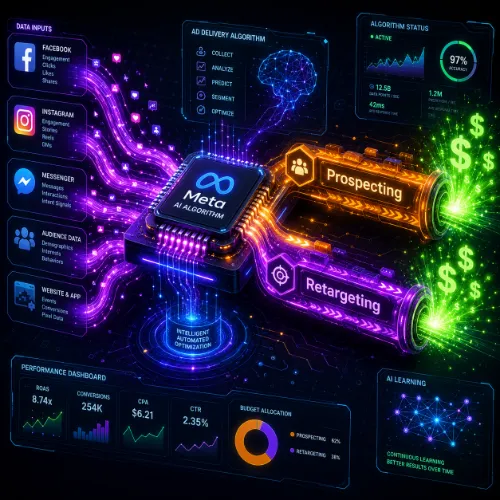
Meta’s Advantage+ Shopping Campaigns now largely automate the manual funnel process. They dynamically mix prospecting and retargeting budgets, often outperforming traditional manual setups.
Here’s where things get interesting.
In the old days, the traffic vs conversion ads strategy was simple: run traffic campaigns to build awareness, then retarget those visitors with conversion campaigns.
That still works. It’s a proven strategy.
But in 2026, Meta has introduced Advantage+ Shopping Campaigns – and they change the game.
What is Advantage+ Shopping Campaigns?
It’s Meta’s AI-driven campaign type that automatically handles prospecting, retargeting, and creative optimization in one place. You give it your product catalog, your budget, and your pixel data – and Meta does the rest.
How does it affect the traffic vs conversion decision?
With Advantage+, Meta automatically splits your budget between prospecting (finding new customers) and retargeting (converting warm audiences). It uses machine learning to decide which audiences to target and which creatives to show them.
The result?
Manual funneling – traffic campaigns feeding Sales campaigns – is still great for control. But Advantage+ often outperforms manual setups because Meta’s AI can make real-time decisions faster than any human media buyer.
So which should you use?
- Advantage+ Shopping Campaigns: Best for e-commerce with product catalogs and at least 25-50+ sales per week. Let Meta’s AI do the work.
- Manual Funneling: Best for service businesses, high-ticket items, or advertisers who want full control over audience segmentation.
- Hybrid Approach: Run an Advantage+ campaign for prospecting and a manual Sales campaign for retargeting.
As one expert notes: “Advantage+ Shopping Campaigns are a powerful tool for scaling e-commerce brands, but they need sufficient conversion data to outperform manual campaigns”.
For more on building audiences that feed these campaigns, check out our pillar guide: how to build high-converting audiences.
Common Mistakes When Choosing Traffic vs Sales/Leads Objectives
The biggest mistakes are: using traffic for sales, switching too early from Sales to traffic without enough data, not giving Sales campaigns enough budget to exit the learning phase, and ignoring Advantage+ Shopping Campaigns entirely.
Here’s what I see going wrong most often:
Mistake #1: Using Traffic for Sales. This is the most common mistake. You want revenue, but you choose the traffic objective because it’s cheaper. The result? Cheap clicks, zero sales.
Mistake #2: Switching Too Early. You launch a Sales campaign, don’t get immediate results, panic, and switch back to traffic. But Sales campaigns need time. Each ad set needs around 50 conversion events per week to exit the learning phase. If your budget is spread too thin, your ads may never reach this threshold.
Mistake #3: Not Enough Budget. Sales campaigns need budget to find the right people. If you’re spending $5/day on a Sales campaign, you’re not giving Meta enough data to optimize.
Mistake #4: No Funnel. You jump straight to a Sales campaign with cold traffic. No awareness. No engagement. Just ads asking for sales from people who’ve never heard of you. It’s expensive and inefficient.
Mistake #5: Ignoring Advantage+. You’re stuck in the old way of doing things while Meta’s AI has moved on. Test Advantage+ Shopping Campaigns alongside your manual efforts.
For a deeper look at the difference between traffic and conversion objectives, read our related guide on traffic and conversion campaign comparison.
Real-World Example: Traffic vs Sales Objective Side-by-Side
A client running a traffic campaign got 2,000 clicks at $0.50 each but zero sales. After switching to the Sales objective, they got 200 clicks at $2.50 each and 15 sales. The Sales campaign cost more per click but generated actual revenue.
Let me share a real example from one of my clients.
They were selling a $97 online course. They started with a traffic campaign.
Traffic Campaign Results:
- Spend: $1,000
- Clicks: 2,000 ($0.50 CPC)
- Sales: 0
- Revenue: $0
They were thrilled with the cheap clicks. But thrilled doesn’t pay the bills.
We switched to a Sales objective campaign with the same creative and budget.
Sales Campaign Results:
- Spend: $1,000
- Clicks: 400 ($2.50 CPC)
- Sales: 15
- Revenue: $1,455
The Sales campaign cost 5x more per click. But it generated actual revenue. The traffic campaign cost less but made nothing.
Which campaign would you rather run?
That’s the traffic vs conversion ads difference in a nutshell. Cheap clicks are worthless if they don’t convert.
How to Fix Your Traffic Campaign If It’s Not Converting
If your traffic campaign isn’t converting, switch to the Sales or Leads objective immediately. If you’re not ready for Sales/Leads yet, add a retargeting layer – use traffic to build a pool, then retarget those visitors with Sales or Leads campaigns.
If you’re currently running a traffic campaign and it’s not converting, here’s how to fix it:
Option 1: Switch to Sales or Leads. This is the simplest fix. Duplicate your campaign, change the objective to Sales or Leads, and run it alongside your traffic campaign. Let them compete. See which one wins.
Option 2: Add a Retargeting Layer. Use your traffic campaign to drive visitors to your site. Then create a retargeting campaign with the Sales or Leads objective to target those visitors. Traffic campaigns are great for building retargeting pools.
Option 3: Improve Your Landing Page. Sometimes the problem isn’t the campaign objective – it’s the landing page. If your traffic campaign is driving clicks but no conversions, check your landing page conversion rate. Meta traffic converts at 0.5-1.5%. If your page is below that, fix it.
Option 4: Check Your Creative. Is your ad matching your landing page? If your ad promises one thing and your page delivers another, people will bounce. Make sure your creative and landing page are aligned.
Option 5: Test Advantage+ Shopping Campaigns. If you’re an e-commerce brand, let Meta’s AI do the heavy lifting. Advantage+ automatically balances prospecting and retargeting, often outperforming manual setups.
For more on cleaning up your retargeting, read our guide on how to exclude low-intent engagers from retargeting and our audience exclusion strategy for multiple ad sets.
20-Question FAQ: Traffic vs Conversion Ads
- What is the difference between traffic and conversion campaigns on Meta Ads? Traffic campaigns optimize for link clicks – Meta finds people who click on ads. Sales and Leads campaigns optimize for purchases or form fills – Meta finds people who take the action you want.
- When should I use a traffic campaign vs a sales campaign? Use traffic for content distribution and building retargeting pools. Use Sales for product purchases and Leads for form fills or booked calls.
- Why are my traffic campaigns not converting on Meta Ads? Because you’re optimizing for clicks, not purchases. Meta is delivering exactly what you asked for: people who click.
- Which Meta Ads objective is better for sales: traffic or conversions? Sales objective (formerly Conversions). Always. Traffic campaigns are for traffic, not sales.
- Does the traffic objective on Facebook ever lead to sales? Rarely. Traffic campaigns can feed your funnel, but the actual sales usually come from retargeting or Sales campaigns.
- Why does Meta charge higher CPM for Sales and Leads campaigns? Because they target high-intent users actively in a buying mindset. Those users are more valuable, so the auction is more competitive.
- What’s the average CPC for a traffic campaign? Across all industries, traffic campaigns average $0.70 CPC.
- What’s the average CTR for a traffic campaign? Traffic campaigns average a 1.71% click-through rate.
- How much does a Sales campaign cost? Sales campaigns average a CPM of $25 compared to $10 for traffic.
- Can I use a traffic campaign for lead generation? No. Traffic campaigns are for traffic. Use the Leads objective for lead generation.
- What’s the conversion rate for Meta traffic? Meta traffic converts at about 0.5-1.5%. This is lower than Google’s 2-4% because social visitors click from curiosity, not purchase intent.
- How long should I run a Sales campaign before judging it? Give it at least 7-10 days and 50 conversions per ad set to exit the learning phase.
- Can I run traffic and Sales campaigns at the same time? Yes. Use traffic at the top of your funnel and Sales at the bottom.
- What’s the difference between CPC and CPM? CPC is cost per click – what you pay when someone clicks. CPM is cost per thousand impressions – what you pay for visibility.
- How do I build a retargeting pool with traffic campaigns? Run a traffic campaign to drive visitors to your site. Then create a custom audience of website visitors and retarget them with Sales campaigns.
- Is it ever okay to use traffic for e-commerce? Only for content distribution or building retargeting pools. Never for direct sales.
- What’s the “learning phase” for Sales campaigns? It’s the period where Meta collects data on your ads and audiences before it fully optimizes ad delivery. Each ad set needs around 50 conversion events per week.
- Should I use traffic or engagement for brand awareness? Neither. Use the Awareness objective for brand awareness, Traffic for clicks, and Engagement for interactions.
- What is Advantage+ Shopping Campaigns? Meta’s AI-driven campaign type that automatically handles prospecting, retargeting, and creative optimization in one place. Best for e-commerce with product catalogs.
- Where can I learn more about Meta Ads campaign objectives? Check out Meta’s official documentation, WordStream’s benchmarks, and our pillar guide on how to run Meta Ads.
Final Thoughts
Here’s the truth about traffic vs conversion ads:
Traffic campaigns are not the enemy. They have a place in your strategy – content distribution, brand awareness, building retargeting pools. But they are not a replacement for Sales or Leads campaigns.
If you want revenue, use the Sales or Leads objective. Period.
Stop chasing cheap clicks. Start chasing customers.
The algorithm optimizes for whatever you tell it to optimize for. Tell it to find clicks, and it’ll find you clickers. Tell it to find buyers, and it’ll find you buyers.
It’s that simple.
Need help setting up your Meta Ads campaigns or figuring out which objective is right for your business? Reach out to Adscrew PH. We’ve been running Meta Ads for over nine years, and we’d love to help you stop wasting money on traffic that doesn’t convert.