
Table of Contents
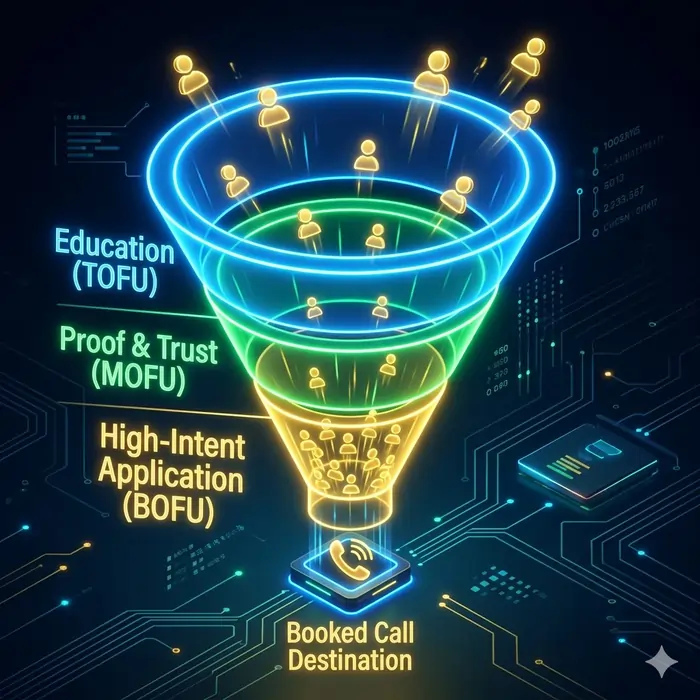
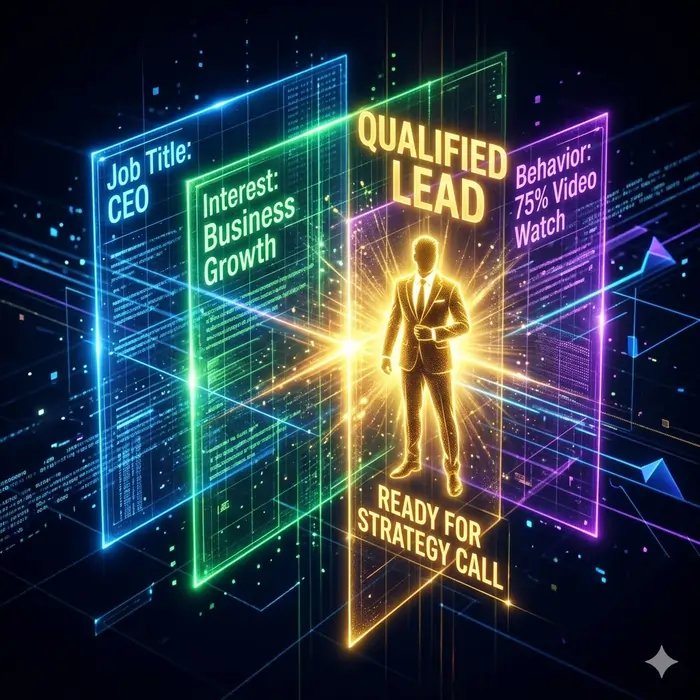
Structuring TOFU, MOFU, BOFU audience segmentation for services requires a different approach than e‑commerce. For service‑based businesses, audience layering for service-based meta ads involves stacking job titles, interests, and behavioral signals at each funnel stage. TOFU (Top of Funnel) targets cold prospects with broad layering (e.g., job title + industry interest). MOFU (Middle of Funnel) retargets engagers with deeper layering (e.g., visited service page + watched 75% video). BOFU (Bottom of Funnel) uses high‑intent custom audiences (e.g., form fillers, calendar clicks). This guide gives you a complete framework to segment service audiences profitably.
Common Questions This Article Answers
“How do I structure TOFU, MOFU, BOFU for service business Meta Ads?”
“What is audience layering for service-based meta ads?”
“How do I target cold traffic for high‑ticket services?”
“What’s the difference between service and e‑commerce audience funnels?”
“How do I move someone from MOFU to BOFU without being pushy?”
“What retargeting windows work for service businesses?”
Let me be real with you.
Selling a service is not the same as selling a t‑shirt.
E‑commerce has an “Add to Cart” button. You have a “Book a Call” button – and that’s way scarier for most people.
Service purchases are high‑consideration. Your prospect doesn’t decide in 5 seconds. They need trust, proof, and a relationship before they hand over money.
That means your TOFU, MOFU, BOFU audience segmentation needs to be built differently.
No product catalogs. No “Viewed Product” retargeting. Just human psychology and smart layering.
In this guide, I’ll walk you through audience layering for service-based meta ads – from cold strangers to booked calls. You’ll learn exactly how to build each funnel stage so your ad spend attracts qualified leads, not tire‑kickers.
For the foundational framework, check out our main pillar guide: how to run Meta Ads.
Why Service Businesses Need a Different Funnel Structure
Service purchases involve high risk and long consideration. Unlike products, you can’t rely on impulse buys. Your funnel needs to educate, build authority, and qualify intent at every stage – not just push for a lead form.
Think about your own behavior.
When you hire an accountant, a coach, or an agency, do you click the first ad and book immediately? No. You watch videos, read case studies, check their social media, maybe download a guide.
That’s the service buyer journey.
E‑commerce funnels are often “see ad → click → buy.” Service funnels are “see ad → engage → trust → consider → qualify → book.”
That’s why audience layering for service-based meta ads is so powerful. You stack signals to move people down the funnel without being pushy.
As AI Advantage Agency notes in their 2026 guide, service businesses that treat Meta ads like product ads will waste budget. The ones that build campaigns around trust, proof, and a clear conversion path consistently outperform their market.
For a complete guide on building any audience from scratch, see our pillar content: how to build high-converting audiences.
Understanding TOFU, MOFU, BOFU for Services (Quick Refresher)
TOFU (Top of Funnel) is cold prospects unaware of you. MOFU (Middle of Funnel) is people who know you but aren’t ready. BOFU (Bottom of Funnel) is high‑intent prospects ready to book or buy.
Here’s the simple version:
| Funnel Stage | Audience Awareness | Your Goal | Example Action |
|---|---|---|---|
| TOFU | Never heard of you | Get attention, build trust | Video view, blog read |
| MOFU | Know you, considering | Nurture, educate, qualify | Case study download, webinar |
| BOFU | Ready to decide | Convert to booked call | Application form, scheduling |
Service funnels can take weeks or months. That’s normal. Don’t rush it.
For more on how to align your funnel with KPIs, read our guide on meta ads kpi alignment strategy.
Step 1: TOFU – Layering for Cold Awareness
For TOFU, use broad layering (job title + industry interest + behavioral signal) to reach cold prospects. Optimize for video views or engagement – not leads. Build authority before asking for anything.
Your TOFU audience is cold. They don’t know you. They don’t trust you.
So don’t sell. Educate.
Example TOFU layering for a business coach:
- Job Title: “Business Owner” OR “Founder” OR “CEO”
- Interest: “Small Business” OR “Entrepreneurship” OR “Scaling”
- Behavior: “Active on LinkedIn” or “Engaged with business content”
Example TOFU layering for a real estate agent:
- Job Title: “OFW” OR “Expat” OR “Young Professional”
- Interest: “Property Investment” OR “Real Estate Philippines”
- Location: Specific cities or regions
What to optimize for: ThruPlays (video views), post engagement, or landing page views. Not leads. You’re just introducing yourself.
Pro tip: Use video. Service buyers need to see your face, hear your voice, and feel your expertise. A 2‑minute “3 mistakes to avoid” video works better than any carousel.
According to WordStream’s 2026 Facebook Ads trends, clean data, stand-out creative, and responsible use of AI – especially for smarter targeting – are the three key components to focus on for better results.
For cold traffic strategies, see our guide on broad targeting best practices for cold traffic.
Step 2: MOFU – Retargeting Engagers with Intent Layering
MOFU audiences come from TOFU engagers (e.g., 75% video viewers). Layer them with additional signals like “visited service page” or “watched case study.” Offer lead magnets – not sales calls.
The biggest mistake service businesses make? Jumping from TOFU straight to “Book a Call.”
That’s like proposing on the first date.
Instead, create an engagement‑based MOFU audience:
Your MOFU audience source:
- Watched 75%+ of your TOFU video
- Liked, commented, or shared your post
- Visited your “About” or “Services” page (use website custom audiences)
Then layer in custom exclusions:
- Exclude people who already booked (BOFU)
- Exclude low‑intent engagers (3‑second views, accidental likes)
MOFU offer examples:
- Free guide or checklist (“5 Questions to Ask Before Hiring a Coach”)
- Webinar or live training
- Case study PDF
- ROI calculator
As IMPRiNT points out in their B2B lead gen guide, a strong lead magnet (whitepaper, free audit, demo, or industry report) combined with qualifying questions inside the form helps filter out low‑intent leads.
For a complete walkthrough on cleaning your retargeting pool, see our guide on how to exclude low-intent engagers from retargeting.
Step 3: BOFU – High‑Intent Segmentation for Booked Calls
BOFU audiences are people who have taken a high‑intent action – like downloading a lead magnet, visiting the pricing page, or watching a webinar. Exclude anyone who hasn’t shown serious interest.
Now we’re talking.
BOFU is not for everyone. It’s for the 5‑10% of your audience who are actually ready.
High‑intent BOFU signals:
- Downloaded your lead magnet (especially if it was long‑form)
- Watched your webinar replay (75%+)
- Visited your pricing page 2+ times
- Submitted a low‑friction form (e.g., “Get the PDF”)
BOFU offer:
“Book a Free Strategy Call” or “Apply for a Discovery Session”
But here’s the key: add friction. Use a 5‑10 question application form. That scares off tire‑kickers and leaves only serious prospects.
BOFU layering example:
- Custom audience: “Visited pricing page last 7 days”
- Exclude: Already booked a call (use CRM data)
To learn how to sync your CRM with Meta for offline conversions, read our guide on how to match Facebook pixel data with CRM leads.
The Power of Audience Layering for Service-Based Meta Ads – Example
Layering combines multiple signals to build intent without needing huge audience volume. Example: “Job title: Marketing Director” + “Interest: Agency” + “Behavior: Clicked recent ad” = a highly qualified MOFU prospect.
Let me give you a real example.
Service: High‑ticket consulting ($5,000+)
TOFU layering:
- Job titles: CEO, Founder, Owner
- Interests: Business growth, scaling, leadership
- Behaviors: Engaged with business pages
Result: 15,000 reach, 400 video views (75%+).
MOFU layering:
- Retarget 75% video viewers
- Add: Visited “Case Studies” page
- Exclude: Lead magnet downloaders
Result: 200 engaged, 30 case study downloads.
BOFU layering:
- Retarget case study downloaders
- Add: Visited pricing page
- Exclude: Already attended discovery call
Result: 10 booked calls, 3 closed deals.
That’s the power of audience layering for service-based meta ads.
For more advanced stacking strategies, see our guide on audience layering for service-based Meta ads (yes, the same – it’s a cluster piece).
Audience Exclusion Strategy – The Clean Funnel Secret
Exclusions keep your funnel clean. Exclude TOFU from BOFU, exclude BOFU from MOFU, and exclude low‑intent engagers from everything. Use custom audiences, not interest exclusions.
Most service funnels leak because of bad exclusions.
Your exclusion checklist:
- TOFU ad set → Exclude MOFU + BOFU (people who already engaged or booked)
- MOFU ad set → Exclude BOFU (don’t retarget people already in application)
- BOFU ad set → Exclude past purchasers and low‑intent engagers
Why? You don’t want to waste budget showing a “Book a Call” ad to someone who just watched 3 seconds of a video. That’s annoying and expensive.
For a complete framework, read our guide on audience exclusion strategy for multiple ad sets.
Retargeting Windows for Service Businesses
Service buyers need longer consideration. Use 30‑day windows for TOFU, 60‑day for MOFU, and 14‑day for BOFU. Don’t cap frequency too aggressively in MOFU – education takes time.
E‑commerce retargets 7‑14 days. Service businesses? Much longer.
Recommended windows:
- TOFU engagement: 30 days (people discover you slowly)
- MOFU nurturing: 60 days (they need time to trust you)
- BOFU high intent: 14 days (urgency, but not pushy)
Frequency capping:
TOFU: 3‑4 per week
MOFU: 5‑6 per week (educational content is welcome)
BOFU: 7‑10 over 14 days (reminders for booked calls)
Use the data breakdown method for international scaling to monitor frequency by funnel stage.
Creative Matching by Funnel Stage
TOFU creative should educate (not sell). MOFU creative should provide proof (case studies, testimonials). BOFU creative should create urgency and remove friction (application link, calendar).
Your creative must match the audience’s mindset.
TOFU (Awareness):
“3 Signs You’re Ready to Hire a Business Coach” – video, carousel, or long‑form post.
MOFU (Consideration):
Client testimonial video, case study PDF ad, “Watch how we doubled X’s revenue” – retargeting 75% viewers.
BOFU (Conversion):
“Only 5 spots left this month – apply now.” Direct, urgent, low‑friction (but still pre‑qualify).
According to eMarketer’s 2026 analysis, cold audiences need a reason to stop scrolling, while warm audiences need a reason to finish what they started. They also emphasize that creative styled like user-generated content (UGC) consistently outperforms studio-shot production.
For creative inspiration, see Social Media Examiner’s ad creative examples.
Key Takeaways
- Service funnels need TOFU (education), MOFU (nurturing), and BOFU (conversion) – don’t skip MOFU or you’ll waste budget on cold leads.
- Audience layering for service-based meta ads stacks job titles, interests, and behaviors to build intent without huge volume.
- Use exclusions to keep funnels clean – TOFU excludes MOFU/BOFU, BOFU excludes low‑intent engagers.
- Retargeting windows are longer for services – 60 days for MOFU, 14 days for BOFU. Educate before you ask.
FAQ: TOFU, MOFU, BOFU Segmentation for Services
- What is TOFU in Meta Ads for service businesses?
Top of Funnel – cold audiences who don’t know you yet. Target with educational content (video views, engagement). - What is MOFU?
Middle of Funnel – people who have engaged but aren’t ready. Nurture with lead magnets, case studies, webinars. - What is BOFU?
Bottom of Funnel – high‑intent prospects ready to book. Use application forms and direct booking links. - How is service funnel different from e‑commerce?
Longer consideration, higher trust requirement, no impulse buys. Need MOFU nurturing stage. - What’s the best TOFU objective for services?
Video Views or Engagement. Don’t use Leads at TOFU – too early. - What MOFU objective should I use?
Leads (for lead magnets) or Traffic (to case studies). Optimize for low‑friction conversions first. - What BOFU objective converts best?
Leads (with high‑friction application form) or Sales (if you have productized service). Test both. - How do I layer audiences for TOFU?
Stack job title + industry interest + behavior. Example: “CEO” + “Business Growth” + “Engaged with business content.” - How do I exclude low‑intent engagers from MOFU?
Create a custom audience of 3‑second video viewers or post likers (no click) and exclude them. - What retargeting window should I use for MOFU?
60 days. Service buyers need time to trust you. - Can I use lookalike audiences for service funnels?
Yes – but only from high‑value clients (not all leads). Read our best source for lookalike high-value customers Meta guide. - How do I know if my MOFU is working?
Track cost per lead magnet download and conversion rate to BOFU. Low cost + high conversion = healthy. - What’s a good TOFU budget for services?
Start at $50/day. Too low won’t generate enough data for retargeting. - Should I use Advantage+ for service funnels?
Caution. Advantage+ over‑automation can waste budget. Test manual broad first. - How do I measure funnel health?
TOFU: cost per video view. MOFU: cost per lead magnet. BOFU: cost per booked call. Then ratio between stages. - What creative works best for BOFU?
Testimonial video + urgency (“Limited spots”). Also use application form ads to pre‑qualify. - Can I skip MOFU?
For low‑ticket services (100‑300), maybe. For high‑ticket ($1,000+), never. You’ll waste budget on unqualified leads. - How do I sync CRM data for BOFU exclusions?
Use Meta Conversions API to send “Booked Call” events. Then create custom audience of “Booked” and exclude. - What’s the most common mistake in service funnels?
Using the same creative for TOFU and BOFU. Cold audiences don’t want a sales pitch; warm audiences don’t need education. - Where can I learn more about service-based Meta Ads?
Start with our how to run Meta Ads guide and this article series.
When to Adjust Your Funnel (Troubleshooting)
Low TOFU engagement = bad creative or wrong layering. High MOFU cost = lead magnet mismatch. Low BOFU conversions = add more pre‑qualification or reduce friction.
- TOFU has low video views (under 30% ThruPlay) → Change your hook. First 3 seconds matter most. Use Meta’s creative best practices for guidance.
- MOFU has high cost per lead magnet → Your offer isn’t compelling enough. Try a different lead magnet (checklist, template, ROI calculator).
- BOFU has many form starts but few completions → Your application is too long or too personal. Shorten it or move questions to the call.
- BOFU has many booked calls but no‑shows → Add a confirmation email sequence and SMS reminders.
For a detailed guide on analysing audience performance, use the data breakdown method for international scaling.
Final Thoughts
Structuring TOFU, MOFU, BOFU audience segmentation for services isn’t complicated – but it requires patience.
You can’t rush a service buyer. They need education, proof, and trust.
Use audience layering for service-based meta ads to stack signals at every stage. Build your TOFU with broad engagement, nurture with MOFU lead magnets, and convert with BOFU applications.
Exclude the tire‑kickers. Extend your retargeting windows. And always match your creative to the funnel stage.
Do this, and you’ll stop wasting money on unqualified leads – and start booking calls with people who are actually ready to buy.