
Table of Contents
In the lead generation landscape of 2026, the battle for attention has been replaced by a battle for intent. For performance marketers, the debate over Meta instant forms vs landing page lead quality is no longer a simple question of which is “cheaper.” It is a technical decision about how much friction you are willing to exchange for lead depth.
If you optimize purely for volume, you’ll end up with a CRM full of “ghost leads”—people who click, auto-fill, and forget. If you optimize purely for quality via complex landing pages, you might starve your sales team of opportunities. This 3,000-word pillar guide explores the Facebook lead ads vs website conversions dichotomy and provides a masterclass on how to filter low quality leads instant forms effectively.
Which is Better, Instant Forms or Landing Pages?
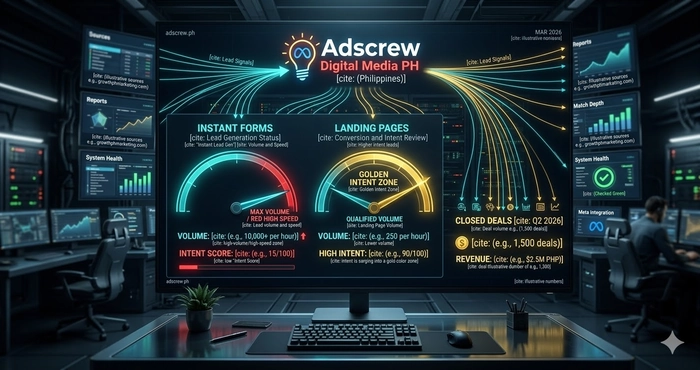
The choice between Meta instant forms vs landing page lead quality depends on your sales infrastructure and average order value. Instant forms typically generate a 25–30% lower cost per lead (CPL) by reducing friction through auto-filled data and on-platform submission. However, landing pages generate 50% higher lead-to-close rates because they require users to leave the platform and engage with your brand’s ecosystem. The best lead generation strategy Meta ads users can employ today is a hybrid approach: using instant forms for scale while implementing lead qualification strategy layers—such as conditional logic and higher intent settings—to mimic the filtering power of a landing page.
The Architecture of Friction – Why Quality Varies
To understand lead quality Meta ads instant forms vs landing page, we have to look at the psychology of the “Click.”
The Instant Form Experience: Low Friction, High Volume
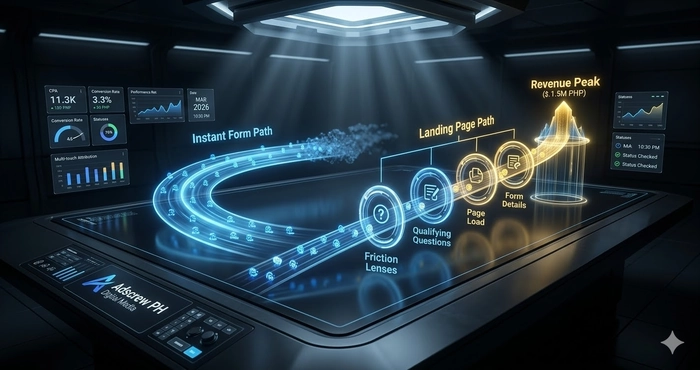
Meta designed instant forms to keep users on Facebook and Instagram. Because Meta already has the user’s name, email, and phone number, the form can be completed in two taps. This lack of friction is the primary reason why instant forms generate low quality leads. If a user can submit their data without typing a single character, the “Intent Bar” is at its lowest possible point.
The Landing Page Experience: High Friction, High Intent
A landing page forces a “Context Shift.” The user must wait for the page to load, read your headlines, and manually type their information. This extra effort acts as a natural lead quality Meta ads filter. If someone isn’t willing to wait three seconds for your page to load, they likely aren’t willing to spend ₱100,000 on your services.
For a deeper dive into the technical setup of these journeys, see our guide on how to run Meta ads.
Comparative Analysis – Instant Forms vs Landing Page Conversion Rate
When comparing instant forms vs landing page conversion rate, the numbers often tell a deceptive story.
| Metric | Meta Instant Forms | Landing Page Conversions |
| Average Conversion Rate | 8% – 15% | 3% – 7% |
| Typical Cost Per Lead (CPL) | Lower (₱50 – ₱200) | Higher (₱150 – ₱500) |
| Data Accuracy | High (Auto-filled) | Variable (Manual entry) |
| Lead Intent Level | Low to Medium | High |
| Technical Complexity | Low (Native to Meta) | High (Requires GTM & Web Dev) |
| Sales Closing Rate | 1% – 3% | 5% – 10% |
The “Vanity Metric” Trap
Many advertisers celebrate a low CPL from instant forms without realizing their cost per qualified lead is actually higher than a landing page. If you spend ₱10,000 on 100 leads from forms (₱100 CPL) but only 1 person buys, your cost per customer is ₱10,000. If you spend ₱10,000 on 20 landing page leads (₱500 CPL) but 2 people buy, your cost per customer is ₱5,000.
Always align your metrics with a Meta Ads KPI alignment strategy to avoid scaling into a loss.
When to Use Instant Forms vs Landing Page Meta Ads
The Meta lead forms vs landing pages choice should be dictated by your industry and your sales team’s speed.
Use Instant Forms If:
- Fast Follow-up: You have an automated SMS or an ISA (Inside Sales Agent) who can call leads within 5 minutes.
- Low-Ticket Offers: You are offering a free lead magnet, a coupon, or a simple newsletter signup.
- Top-of-Funnel Data: You are in the “Discovery” phase and need to populate your CRM with a high volume of prospects for long-term email nurturing.
Use Landing Pages If:
- High-Ticket Services: You are selling high-ticket services where trust and education are required before the “Ask.”
- Complex Offers: If your service requires a detailed explanation (e.g., Solar installation, Financial planning).
- No Sales Team: If you don’t have the capacity to call 50 people a day and only want to talk to the “Golden” 5.
The 5-Step Masterclass on How to Filter Low Quality Leads from Instant Forms
If you choose instant forms vs landing page Meta ads because of the lower CPL, you must implement these filtering layers to protect your sales team.
1. Enable “Higher Intent” Forms
Meta provides two options: “More Volume” and “Higher Intent.” Always choose Higher Intent. This adds a “Review Screen” before submission, requiring the user to slide a button to confirm. This single step eliminates 80% of accidental “pocket-dial” leads.
2. Add Custom Qualifying Questions
Never rely on auto-fill alone. Ask at least two custom questions that require a manual answer (Short Answer or Multiple Choice).
- Bad: “What is your phone number?” (Auto-fill)
- Good: “What is your monthly marketing budget?” or “When are you looking to start?”
This is the most effective way to improve lead quality Meta ads because it forces the brain to switch from “Passive Scrolling” to “Active Decision Making.”
3. Use Conditional Logic
In 2026, the Andromeda AI allows for native conditional logic within forms. If a user answers “No” to a qualifying question (e.g., “Do you own a home?”), you can redirect them to a “Thank You” page that doesn’t encourage a follow-up, while “Yes” answers are pushed to your high-priority CRM queue.
4. SMS and Phone Number Verification
One of the biggest issues with Facebook lead ads vs website conversions is fake phone numbers. By adding a question that asks users to “Verify your best number for a quick SMS,” you significantly increase the contact rate.
5. The “Appointment First” Redirect
On the “Thank You” screen of your instant form, don’t just say “We’ll call you.” Add a button that says “Book Your Strategy Session Now” and link it to your booking funnel strategy. This bridges the gap between a “Lead” and a “Booked Call.”
Why Landing Pages Generate Better Leads
The reason why landing pages generate better leads is psychological anchoring. When a user lands on your site, they are surrounded by your brand’s visual identity, testimonials, and authority signals.
1. Education and Objection Handling
A landing page can handle 90% of a prospect’s objections through FAQs, case studies, and team bios. By the time they fill out the form, they are already pre-sold.
2. Multi-Step Conversions
Landing pages allow for “Multi-Step” forms. A user who completes 3 pages of questions is 10x more likely to buy than a user who completed a 1-page instant form. This is the ultimate lead qualification strategy.
3. Better Technical Attribution
With landing pages, you have full control over Google Analytics 4 and GTM. You can track scroll depth and time on page, giving you a better understanding of how to improve lead quality Meta ads through creative optimization.
Funnel-Based Lead Generation Strategy
The best lead generation strategy Meta ads users can implement is a tiered funnel.
- Awareness (TOFU): Use Video View ads to explain the problem.
- Consideration (MOFU): Use traffic vs conversion campaign logic to send people to helpful blog posts or case studies.
- Conversion (BOFU): Retarget those engaged users with Meta instant forms or a landing page.
By the time they see your lead ad, they are already “warm,” which drastically reduces the cost per qualified lead regardless of the format you choose.
High-Ticket Lead Gen – Instant Forms or Landing Pages?
For high-ticket services, the choice of Meta instant forms vs landing page lead quality is critical. In these niches (Agency, Consulting, Medical), a bad lead doesn’t just cost money—it wastes the time of high-level executives.
The Adscrew PH Recommendation: Use Landing Pages for your primary lead capture to ensure maximum qualification. However, use Instant Forms as a “Catch-All” for people who clicked the ad but didn’t convert on the site. This “Down-sell” lead gen ensures you don’t lose the Meta value optimization strategy signals for those users.
Technical Setup – GTM, CAPI, and CRM Filtering
To scale Meta lead generation, you must have a “Closed-Loop” feedback system.
The Role of CAPI (Conversions API)
When a lead is submitted on your landing page, your server should send that event back to Meta via CAPI. This ensures Meta’s AI knows exactly which user converted, helping it find more people like them.
CRM Lead Filtering
Connect your lead ads to a CRM like HubSpot or Salesforce. Use “Lead Scoring” to automatically flag leads that answered your custom questions correctly. This allows your sales team to prioritize high intent vs low intent leads in real-time.
20-Question FAQ: Meta Instant Forms vs Landing Page Lead Quality
- Which is better: instant forms or landing pages? Instant forms for volume and low CPL; Landing pages for quality and high-intent conversion.
- Why are my instant form leads low quality? Because the process is too easy. Users often submit data without a genuine commitment to the outcome.
- How do I improve lead quality in Meta ads? By adding “Friction”—custom questions, higher intent settings, and mandatory review screens.
- Do landing pages have a lower conversion rate? Yes, usually 50% lower than forms, but the leads are significantly more valuable.
- How do I filter low quality leads from instant forms? Use conditional logic and qualifying questions that require manual typing.
- Can I use instant forms for high-ticket services? Yes, but only if you have a rigorous qualification step and immediate follow-up.
- What is a “Higher Intent” form? A Meta lead form setting that adds a confirmation step before submission.
- Is SMS verification worth it for lead ads? Yes, if you struggle with fake phone numbers. It improves contact rates by 20–30%.
- Should I use auto-fill for all questions? No. Use manual questions for the data points that determine qualification (e.g., Budget).
- How do I lower my cost per qualified lead? By improving your top-of-funnel creative to ensure only interested people click the ad.
- What is the best lead generation strategy Meta ads? A hybrid funnel that builds authority with video before asking for a lead.
- Do I need a landing page for Facebook lead ads? No, instant forms live entirely on the Meta platform.
- Why is my landing page CPL so high? Likely due to slow page load speeds or a “Context Gap” between the ad and the page content.
- How does CAPI help with lead generation? It sends more reliable signals to Meta’s AI, improving targeting for high-intent users.
- What is lead scoring? A method of assigning value to leads based on their form answers or website behavior.
- How fast should I call a lead? Within 5 minutes. The “Lead Decay” rate is massive—calling within 5 minutes increases conversion by 10x.
- Can I use videos in instant forms? No, but you can use a video ad that leads into an instant form.
- What is the “Context Shift”? The mental transition a user makes when leaving social media to enter a business website.
- How do I fix “I don’t remember filling this out” leads? Switch to a higher intent form or add a custom question that requires them to type your brand name.
- Should I hire Adscrew PH for lead gen? If you are spending over $2,000/month and your sales team is complaining about lead quality, a technical audit is essential.
Direct Answers
Which Meta lead generation method has the highest quality?
Landing pages generate the highest quality leads in Meta ads because they introduce “Intentional Friction.” Users must leave the platform and manually provide information, which filters out casual browsers and targets users with a higher cost per qualified lead profile.
How can I reduce fake leads on Facebook lead ads?
To reduce fake leads on Facebook lead ads, use “Higher Intent” forms, add mandatory qualifying questions that require manual typing, and implement SMS verification. Additionally, integrating your form with a CRM for real-time validation is a key lead qualification strategy.
What is the difference between a lead ad and a conversion ad on Meta?
A lead ad (Instant Form) keeps the user on Facebook to collect their data via a native form. A conversion ad (Website Leads) directs the user to an external landing page where they must complete a form. Conversion ads typically have higher intent but a higher initial CPL.
Summary: The Final Verdict from Adscrew PH
The debate over Meta instant forms vs landing page lead quality isn’t about finding a “winner.” It’s about matching your tool to your target.
- Scale with Instant Forms: If you need to feed a hungry sales team 50 leads a day.
- Qualify with Landing Pages: If you want 5 “Ready-to-Buy” appointments a week.
- Filter with Precision: Regardless of the format, use custom questions to protect your ROI.
In 2026, lead quality Meta ads are the only way to scale. Clicks are cheap, but intent is expensive. Optimize for the latter.