
Table of Contents
In 2026, broad targeting best practices for cold traffic show that manual broad targeting (age, gender, location only) often delivers lower CPA and higher ROAS than fully automated Advantage+ audiences – especially for service businesses and smaller ad accounts. While Advantage+ promises ease, its over‑automation can waste spend on low‑intent users when conversion signal density is low. The key is to test both, but start with manual broad targeting, let Meta’s Andromeda AI find your buyers, and only layer in Advantage+ when you have 50+ conversions per week. This guide gives you broad targeting best practices for cold traffic that protect your budget and scale profitably. For the complete foundation on running Meta Ads, start with our how to run Meta Ads guide.
Quick Answer
How do you use broad targeting effectively for cold traffic in 2026?
Set only age, gender, and location – no interests, no behaviors. Optimize for Sales or Leads, start with 50‑150/day, and run for 7‑10 days without touching the budget. Manual broad targeting often beats Advantage+ when you have fewer than 50 conversions per week. Use strong creative and exclude past purchasers.
Common Questions This Article Answers
*“Is broad targeting better than Advantage+ in 2026?”*
“How do I use broad targeting for cold traffic effectively?”
“What are the risks of Advantage+ over‑automation?”
“When should I avoid Advantage+ campaigns?”
“Can broad targeting work for service businesses?”
“How do I set up a manual broad targeting campaign?”
Let me be honest with you.
I’ve seen too many advertisers get seduced by the shiny “Advantage+” button. Meta promises automation, ease, and AI magic. And sometimes? It delivers.
But often, especially for cold traffic and smaller budgets, Advantage+ over‑automation burns cash on people who will never buy.
Here’s the thing: Meta’s Andromeda AI is brilliant. But it needs strong conversion signals to learn. If you don’t have a steady stream of purchases or leads (think 50+ per week), Advantage+ can go wild – serving your ads to click‑happy but low‑intent users.
That’s where manual broad targeting wins.
In this guide, I’ll walk you through broad targeting best practices for cold traffic, why you should be skeptical of over‑automation, and exactly how to set up campaigns that let Andromeda work for you – not against you.
What Is Broad Targeting in Meta Ads (2026 Definition)?
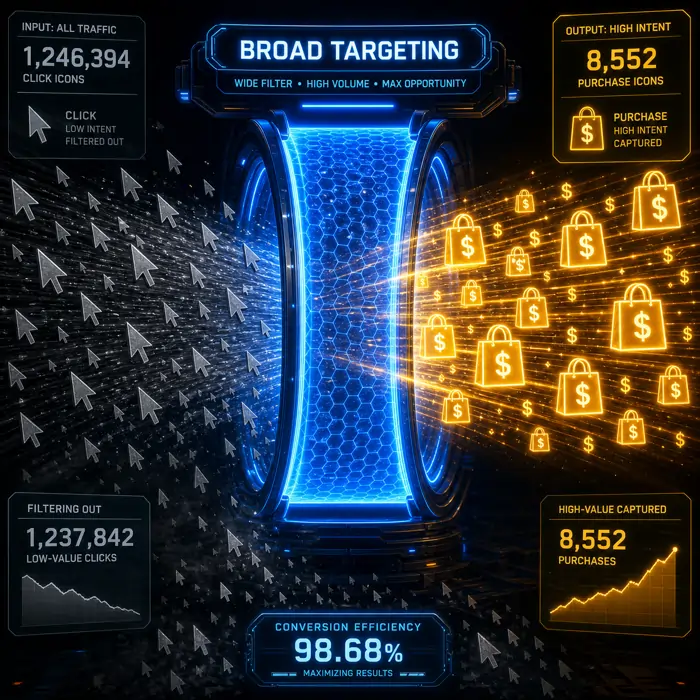
Direct answer: Broad targeting means setting only age, gender, and location – no interests, no behaviors, no lookalikes. You hand the reins to Meta’s Andromeda AI to find buyers based on your creative and conversion signals.
That’s it. No “people who like running and Nike.” No stacked job titles. Just the basics.
Why does this work? Because Meta’s AI now processes billions of real‑time signals about user intent – what they search, what they buy, what they engage with across the Meta ecosystem. Your job is to give it a good creative and a clear conversion goal. Andromeda does the rest.
But here’s the catch: broad targeting works best when you have enough conversion data. Without it, the AI has nothing to optimize toward. That’s where people get frustrated and switch back to interests – a mistake. For more on how Meta’s machine learning processes signals, check out Meta’s official documentation on delivery optimization.
For a deeper dive into building audiences from your best customers, check out our guide on the best source for lookalike high-value customers Meta – because while broad targeting is powerful, lookalikes still have a place in your strategy.
Broad Targeting vs. Advantage+ Audience: What’s the Real Difference?
Direct answer: Manual broad targeting lets you set basic demographics and nothing else. Advantage+ audience is a fully automated black box – Meta tests audiences, placements, and even creatives for you. The risk? Over‑automation can waste budget when your signal density is low.
Let me break it down.
| Feature | Manual Broad | Advantage+ |
|---|---|---|
| Control | High – you set age/gender/location | Low – Meta decides |
| Targeting | None beyond basics | Dynamically tests interests, behaviors, lookalikes |
| Best for | Cold traffic, low conversion volume, service businesses | High‑volume e‑commerce, 50+ conversions/week |
| Risk | Low – you control spend | Over‑automation, wasted spend on low‑intent users |
In my testing, manual broad targeting consistently outperforms Advantage+ for accounts spending less than $1,000/day or with fewer than 50 weekly conversions. Why? Because Advantage+ needs data to learn. Without it, it casts a wide net that catches tire‑kickers. For Meta’s own take on when to use Advantage+, see their Advantage+ audience best practices guide.
If you’re a service‑based business, you’ll also want to master audience layering for service-based Meta ads – because layering signals like job titles and interests can sometimes give you that extra targeting precision for high‑ticket offers.
Why Advantage+ Over‑Automation Can Destroy Your Cold Traffic Budget
Direct answer: Advantage+ over‑automation happens when Meta’s AI optimizes for low‑intent signals (clicks, video views) instead of real conversions – because it doesn’t yet know what a “good” conversion looks like. You end up paying for cheap, worthless traffic.
Let me give you a real example.
A coaching client of mine – selling a 2,000program–turnedonAdvantage+forcoldtraffic.Withinthreedays,theygottonsofcheapclicks.Costperclickwas0.30. Amazing, right?
But zero leads.
Why? Because Advantage+ found people who click on everything. Curiosity seekers. The algorithm had no purchase history to learn from, so it optimized for the only signal it had: clicks.
When we switched to manual broad targeting with a clear “Purchase” optimization and a strong creative hook, cost per lead dropped from 85to32 in two weeks.
That’s the danger of over‑automation. You think you’re being efficient. You’re not. Research from WordStream confirms that Advantage+ audiences can waste spend on low‑quality traffic when not paired with sufficient conversion data.
For more on why low‑intent signals wreck your campaigns, read our guide on how to exclude low-intent engagers from retargeting – because cleaning your retargeting pool is just as critical as cleaning your cold traffic approach.
Broad Targeting Best Practices for Cold Traffic: The 7‑Step Playbook
Direct answer: Follow this 7‑step playbook: clean account with 7‑14 days of data, Sales/Leads objective, age/gender/location only (no interests), Advantage+ placements monitored, 50‑150/day budget, run 7‑10 days without changes, then scale 15‑20% every 48 hours based on CPA.
Now let’s get practical. Here’s exactly how to set up a manual broad targeting campaign that works.
Step 1: Start With a Clean Ad Account
Make sure your pixel (Dataset) has at least 7‑14 days of conversion data. If it’s brand new, run a small engagement or traffic campaign first to build payment history. A cold account with zero history will struggle with broad targeting. Learn how to set up your pixel properly with Meta’s pixel setup guide.
Step 2: Choose the Sales or Leads Objective
Don’t use Traffic or Engagement objectives for cold broad targeting. You need to optimize for the end action – Purchase or Lead. That’s the only way Andromeda knows what a “good” user looks like.
Step 3: Set Only Age, Gender, and Location
In the ad set level:
- Location: Your target countries or radius.
- Age: Use the full range that fits your product (e.g., 25‑65+). Don’t narrow too early.
- Gender: All unless you have strong data otherwise.
- Detailed targeting: Leave it completely blank. No interests, no behaviors.
Yes, it feels scary. Do it anyway.
Step 4: Use Advantage+ Placement (But Be Careful)
For placements, I recommend Advantage+ placements (Meta’s automatic placement). But monitor it. If you see high spend on Audience Network or low‑quality apps, exclude them manually. For a breakdown of placement performance, see Meta’s placement optimization guide.
Step 5: Set a Reasonable Budget
Start with at least **50/day∗∗.Toolow,andMetacan′tfindbuyersfastenough.Toohigh,andyouriskburningcashwhiletheAIlearns.Ilike50‑$150/day for initial testing.
Step 6: Let It Run for 7‑10 Days – No Tinkering
The hardest part? Do nothing. Don’t adjust budgets daily. Don’t pause after two bad days. Andromeda needs time to explore and learn. Give it at least 7 days and 50 conversions before judging.
Step 7: Analyse and Scale
After 7‑10 days, check your CPA and ROAS. If they’re within your targets, start scaling – increase budget by 15‑20% every 48 hours. If not, check your creative. Broad targeting exposes weak creative fast. Here’s AdEspresso’s guide on scaling Facebook campaigns for more tactics.
Before You Go Broad: Get Your Data Right
Direct answer: You need clean data flowing into Meta for broad targeting to work. That means CAPI is set up, your pixel has 7‑14 days of conversion history, and your CRM syncs properly with Meta.
You can’t run broad targeting effectively without clean data flowing into Meta. That means your Conversions API (CAPI) needs to be properly set up, and your CRM data needs to sync with your pixel. Meta’s Conversions API documentation provides the technical steps.
If you’re struggling with data mismatches between your CRM and Meta, read our guide on how to match Facebook pixel data with CRM leads. It covers hashing emails, deduplication, and server‑side tracking – all essential for giving Andromeda the clean signals it needs to find your buyers.

When Should You Avoid Advantage+ Audience?
Direct answer: Avoid Advantage+ when you have fewer than 50 conversions/week, when you’re in a high‑ticket or long‑sales‑cycle business, or when you’ve seen it waste money on low‑intent clicks. Stick with manual broad targeting.
Here’s my rule of thumb:
| Scenario | Best Approach |
|---|---|
| New ad account (< 30 days) | Manual broad |
| < 50 purchases/leads per week | Manual broad |
| High‑ticket service ($1,000+ AOV) | Manual broad |
| Low conversion volume (e.g., consulting) | Manual broad |
| High‑volume e‑commerce (100+ sales/week) | Test Advantage+ |
| Large budget ($5,000+/day) | Test Advantage+ |
Advantage+ is powerful when it has data. Without data, it’s a slot machine. Industry analysis from Search Engine Journal echoes this caution.
How to Control Advantage+ When It’s Over‑Automating
Direct answer: Switch to manual broad targeting in a new ad set, lower budget to 50‑100/day, simplify creative, exclude past purchasers, and run for 10 days without changes. Return to Advantage+ later when conversion volume is higher.
If you’ve already tried Advantage+ and it’s burning cash, here’s how to course‑correct.
- Switch to manual broad targeting in a new ad set (don’t just edit the existing one – create a fresh test).
- Lower your budget to 50‑100/day while the AI resets.
- Simplify your creative – one strong hook, one clear CTA.
- Exclude past purchasers and low‑intent engagers using custom audiences.
- Let it run for 10 days before making any changes.
You can always return to Advantage+ later when your conversion volume is higher.
For a complete framework on keeping your funnels clean and preventing your own ad sets from competing against each other, read our guide on audience exclusion strategy for multiple ad sets.
Real‑World Example: Broad Targeting vs. Advantage+ – A Side‑by‑Side Test
Direct answer: In a recent A/B test with a 75subscriptionboxclient,manualbroadtargetingachieved18.50 CPA and 3.2x ROAS, while Advantage+ achieved $26.30 CPA and 2.1x ROAS – manual broad won by 30% lower CPA and 50% higher ROAS.
Let me share a recent A/B test from an e‑commerce client selling $75 subscription boxes.
- Ad Set A: Manual broad targeting (age 25‑50, gender all, no interests).
- Ad Set B: Advantage+ audience with same creative and budget.
Both ran for 10 days with $100/day each.
Results:
- Manual broad: CPA $18.50, ROAS 3.2x, 47 purchases.
- Advantage+: CPA $26.30, ROAS 2.1x, 32 purchases.
Manual broad won by 30% lower CPA and 50% higher ROAS.
Why? Because the client had only 60‑70 weekly sales – enough for Advantage+ to start, but not enough to stabilize. Manual broad gave Andromeda a tighter leash.
Once you’ve identified your winning audiences, use the data breakdown method for international scaling to see which age group, gender, or country is actually making you money – then pour more budget there.
Common Mistakes When Using Broad Targeting
Direct answer: The top mistakes are: using the wrong objective (e.g., Landing Page Views instead of Purchase), changing budget daily, running weak creative, not using exclusions, and relying on lookalikes before testing broad.
Even broad targeting can fail if you make these errors.
Mistake #1: Using the Wrong Objective
If you optimize for “Landing Page Views” instead of “Purchase,” broad targeting will find people who love to click but never buy. Always optimize for the end conversion.
Mistake #2: Changing Budget Daily
Resets the learning phase. Increase by 15‑20% every 48 hours – no more, no less.
Mistake #3: Running Broad With Weak Creative
Broad targeting amplifies your creative. If your ad sucks, broad targeting will show it to everyone – and everyone will ignore it. Test your creative first in a small interest audience before going broad.
Mistake #4: Not Using Exclusions
You must exclude past purchasers and recent website visitors. Otherwise, you’ll retarget people who already bought – a waste of budget.
Mistake #5: Relying on Lookalikes Before Broad
Many advertisers jump straight to lookalikes without testing broad first. While lookalikes from high‑value customers are powerful, broad targeting often outperforms them for cold traffic – especially when your seed audience is small. For a deep dive on lookalike sources, read our guide on the best source for lookalike high-value customers Meta.
A Better Way: Manual Broad Targeting
Direct answer: Manual broad targeting is actually simpler than stacking interests – you set age, gender, location, and that’s it. The real work is in your creative and offer. Let Andromeda find the buyers.
If all of this sounds like a lot of work, remember: manual broad targeting is actually simpler than stacking interests. You set age, gender, location – and that’s it.
The real work is in your creative and your offer. For inspiration on high‑performing creatives, check out Social Media Examiner’s ad creative guide.
For a complete walkthrough of building audiences from scratch – including first‑party data, lookalikes, and layering – check out our guide on how to build high-converting audiences. It’s the perfect companion to this article.
Key Takeaways
- Manual broad targeting (age/gender/location only) often beats Advantage+ for cold traffic – especially when you have fewer than 50 conversions per week.
- Avoid Advantage+ over‑automation – it can waste budget on low‑intent clicks when conversion signal density is low.
- Follow the 7‑step playbook: clean account, Sales/Leads objective, blank detailed targeting, 50‑150/day, 7‑10 days no tinkering.
- Scale with 15‑20% budget increases every 48 hours – and always exclude past purchasers.
20‑Question FAQ: Broad Targeting Best Practices for Cold Traffic
- What is broad targeting in Meta Ads?
Setting only age, gender, and location – no interests, behaviors, or lookalikes. You let Meta’s AI find the buyers. - Is broad targeting better than Advantage+?
For cold traffic and accounts with <50 weekly conversions, manual broad targeting usually performs better. Advantage+ needs high conversion volume to work well. - When should I use Advantage+ instead of broad targeting?
When you have at least 100 conversions per week, a large budget ($2,000+/day), and you’re selling low‑ticket e‑commerce products. - What is Advantage+ over‑automation?
When Meta’s AI optimizes for low‑intent signals (clicks, video views) because it doesn’t have enough real conversion data – leading to wasted spend. - How do I set up a manual broad targeting campaign?
Choose Sales or Leads objective, set only location/age/gender, leave detailed targeting blank, start with 50‑150/day, run for 7‑10 days. - Can broad targeting work for service businesses?
Yes – often better than interest stacks. Use a strong creative that clearly states your offer and who it’s for. Andromeda will find relevant users. - What budget should I start with for broad targeting?
At least $50/day. Too low, and Meta can’t find buyers fast enough. Too high, and you risk burning cash during learning. - How long does broad targeting take to work?
Give it 7‑10 days and 50 conversions. Don’t judge after 2‑3 days – the algorithm needs time to explore. - Should I use Advantage+ placements with broad targeting?
Yes, but monitor them. If Audience Network or low‑quality apps waste spend, exclude them manually. - What’s the biggest mistake with broad targeting?
Changing budget daily. It resets the learning phase. Increase by 15‑20% every 48 hours max. - Does broad targeting work for retargeting?
No – for retargeting, use custom audiences (website visitors, engagers). Broad targeting is for cold prospecting. - How do I know if Advantage+ is over‑automating?
Check your click‑to‑conversion rate. If you have many clicks but few conversions, and CPA is rising, Advantage+ is likely finding low‑intent users. - Can I use broad targeting with a brand new pixel?
It’s risky. Better to run a small traffic or engagement campaign first to build payment history and some signals. - What creative works best with broad targeting?
Clear, direct creative that states the offer and the problem you solve. Broad targeting amplifies your message, so make it count. - How do I scale a winning broad targeting ad set?
Increase budget by 15‑20% every 48 hours. Don’t double it overnight. Create duplicate ad sets with different creatives for horizontal scaling. - Does Meta’s Andromeda AI prefer broad targeting?
Yes – Andromeda is designed to find intent signals across the entire platform. Narrow interests can actually restrict its learning. - What’s the difference between broad targeting and open targeting?
Same thing. Both mean no detailed targeting – just age, gender, location. - Should I exclude past purchasers in broad targeting?
Absolutely. Create a custom audience of past purchasers and exclude them at the ad set level. Otherwise, you’ll retarget existing customers. - Can I test broad targeting against Advantage+ in the same campaign?
Use an A/B test in Meta Ads Manager – one ad set manual broad, another Advantage+. Keep budget equal and creative identical. - Where can I learn more about Meta audience strategies?
Start with our how to run Meta Ads guide and how to build high-converting audiences. For external reading, see Meta’s Audience Optimization resource.
When Broad Targeting Fails (And What to Do Instead)
Direct answer: Broad targeting fails when conversion volume is too low (optimize higher‑funnel), creative is weak (test first), or you’re in a tiny B2B niche (try audience layering instead).
Broad targeting isn’t a magic bullet. Sometimes it fails. Here’s what to check:
- Your conversion volume is too low. If you’re getting fewer than 20 conversions per week, Andromeda doesn’t have enough data. Switch to a higher‑funnel objective (e.g., optimize for Add to Cart instead of Purchase) or test a small interest stack temporarily.
- Your creative is weak. Broad targeting exposes poor creative faster than interest targeting. Run a creative test in a small audience first.
- You’re in a very niche B2B market. If your total addressable audience is tiny (e.g., C‑suite executives in a specific industry), try audience layering for service-based Meta ads instead – stacking job titles and interests can narrow the focus without over‑restricting.
The Data Breakdown Method for Cold Traffic Scaling
Direct answer: Use Meta’s data breakdown feature to analyse which age group, gender, platform, and country delivers the best CPA and ROAS. Then increase budget only on winning segments – not blindly.
Once you’ve got a winning broad targeting campaign, it’s time to scale. But don’t just increase budget blindly.
Use Meta’s data breakdown feature to analyse:
- Which age group is converting best?
- Which gender is driving the lowest CPA?
- Which platform (Instagram vs. Facebook) is delivering the highest ROAS?
- Which countries or regions are most profitable?
For a complete walkthrough of using breakdowns to scale globally, read our guide on the data breakdown method for international scaling. Meta’s own breakdown documentation is also a great resource.
The Exclusion Layer (Don’t Skip This)
Direct answer: Exclude past purchasers (last 180 days), recent website visitors (last 7‑14 days), and low‑intent engagers (3‑second video viewers, likes without clicks) from your broad targeting ad set.
A clean exclusion strategy is what separates amateur broad targeting from professional scaling.
Here’s what to exclude in your broad targeting ad set:
- Past purchasers (last 180 days) – you don’t want to pay for existing customers.
- Recent website visitors (last 7‑14 days) – these people are already in your retargeting funnel.
- Low‑intent engagers – people who watched 3 seconds of your video or liked a post but didn’t save or share.
For a complete exclusion framework, read our guide on how to exclude low-intent engagers from retargeting – the same principles apply to cold traffic exclusion.
Final Thoughts
In 2026, you don’t need to be a targeting guru. Meta’s Andromeda AI is incredibly powerful – but it’s not magic. It needs clean signals and enough conversion data to work.
Advantage+ over‑automation is real. It burns budgets on curiosity clicks when you don’t have volume. That’s why broad targeting best practices for cold traffic start with manual control.
Test broad targeting yourself. Start small. Give it 10 days. Let the AI learn from your real buyers – not from your guesses.
Then, when you’ve built up your conversion volume, layer in Advantage+ as a test. But always keep a manual broad campaign as your anchor.
Your ROI will thank you.
Need help setting up broad targeting or diagnosing Advantage+ waste? Reach out to Adscrew PH. We’ve been running Meta Ads for over nine years, and we’d love to help you scale profitably. Start with our how to run Meta Ads guide to build a solid foundation.
https://shorturl.fm/FLdMO
https://shorturl.fm/mJkOq
https://shorturl.fm/1WjTV
https://shorturl.fm/BOyGN
https://shorturl.fm/dvvB4
https://shorturl.fm/Z67Xg
https://shorturl.fm/aMoBR
https://shorturl.fm/l0AfS
https://shorturl.fm/GVcN0
https://shorturl.fm/SHRdq
https://shorturl.fm/MImTP