
Table of Contents
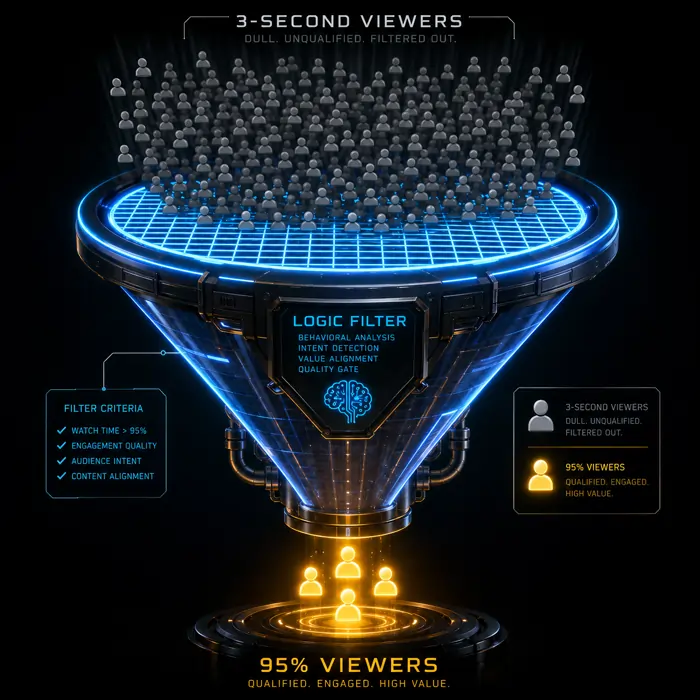
Want to stop wasting money on people who were never going to buy anyway? This is your guide on how to exclude low-intent engagers from retargeting in 2026. We’ll talk about low-intent engagement signals like 3-second video views, accidental page likes, and people who scroll past your content like it’s nothing. You’ll learn about video view quality thresholds, Instagram story engagement quality, and Facebook page engagement segmentation. Plus, how to use custom audience exclusions, engagement frequency filters, and retargeting window optimization with Meta’s new custom audience filters and Advantage+ audience controls. Whether you’re doing high-ticket retargeting, running a service-based business, or selling products online, this will help you stop burning cash on low-quality traffic and start retargeting only high-intent engagers—the ones who actually buy.
Let me be real with you for a second.
You’ve probably been here before.
You set up a retargeting campaign to catch everyone who showed a little bit of interest. Maybe they watched a video. Liked a post. Visited your page. You think, “Yes, these people are warm. They’re ready.”
Then the results come in.
Lots of clicks. Cheap engagement. Zero sales.
What happened?
You fell into a trap. A really common one.
You built your retargeting list with low-intent engagers. These are people who barely did anything. They watched three seconds of your video. They double-tapped your post without thinking. And now you’re paying to show them more ads.
The fix?
You need to exclude low-intent engagers from retargeting.
I’m not saying this to be mean. I’m saying it because you have a budget to protect.
Think about it like this. Would you ask someone to marry you just because they made eye contact with you on the street? No. You’d wait until they showed real interest. Same thing here.
In this article, I’ll show you how to exclude low-intent engagers from retargeting step by step. Which signals to ignore. Which ones to keep. And how to build audiences that actually turn into customers.
No fluff. Just stuff you can use today.
Let’s go.
What Even Are “Low-Intent Engagers”?
Let me explain this the simple way.
Intent is just the chance that someone will buy from you. Low-intent means… probably not.
Every single day, people scroll through Facebook and Instagram without really paying attention. They tap. Swipe. Double-tap. Move on. That’s your low-intent engager. They’re like window shoppers who tap on the glass and keep walking.
High-intent engagers are different. They watch most of your video. They save your post. They actually click through to your site. They spend time reading what you wrote.
Here’s the painful truth.
If you throw both groups into the same retargeting audience, you’re just throwing money away. The algorithm will show your ads to the cheapest, easiest people first. Those low-intent users will eat up your budget. And your real buyers? They won’t even see your ads.
That’s why learning how to exclude low-intent engagers from retargeting is one of the best skills you can build right now.
Why Low-Intent Signals Kill Your Retargeting Campaigns
Let me paint a picture for you.
You spend hours making a beautiful video ad. Funny. Emotional. It shows off your product perfectly. You launch a video views campaign to get some awareness. People watch. You feel good.
Then you create a retargeting audience for everyone who watched that video. You show them a “buy now” ad.
And nothing happens.
Why? Because you included people who only watched three seconds.
Three seconds is nothing. That’s barely enough time to see a logo. Those people didn’t learn about your offer. They didn’t understand your value. They just… scrolled past.
But Meta counted them as “engaged.” So you retargeted them.
That’s the low-intent engagement trap.
Here’s what happens inside your ad account when you ignore how to exclude low-intent engagers from retargeting:
- Your click-through rate looks great, but your conversion rate tanks. You get excited about the clicks, but nobody buys.
- Your frequency goes through the roof. The same low-intent people see your ad twenty times. They get annoyed. You waste money.
- Meta’s algorithm gets confused. It starts thinking low-intent users are your ideal audience. So it finds more people just like them. The problem gets worse.
I’ve seen this happen more times than I can count. The fix is simple: exclude low-intent engagers from retargeting before you spend another dollar.
Which Engagement Signals Are Actually Worth Keeping?
Not all engagement is the same. Let me break it down.
Video Views: The Sneakiest Signal
Video views are the biggest problem here.
Meta calls something a “view” after just three seconds. Three seconds! That’s like saying someone read your book because they looked at the cover.
If you’re serious about how to exclude low-intent engagers from retargeting, start with video.
Here’s my rule:
Exclude anyone who watched less than 50% of your video.
If you’re selling something expensive (services over
850 or products over
850 or more products over 85), raise that to 75% or even 95%. You want the people who stayed till the end.
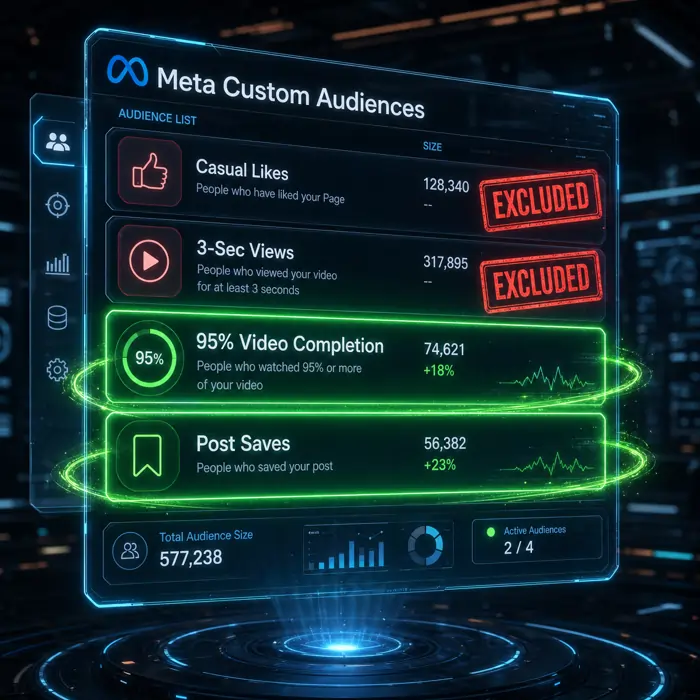
Retarget people who watched 95% or more. Those viewers are locked in. They saw your whole message. They’re way more likely to buy.
Page Engagement: Likes Are Cheap
Someone liked your Facebook page. Cool. But did they actually read anything? Did they visit your site?
A page like takes less than a second. It’s almost an accident.
When you build audiences for retargeting, don’t just grab everyone who engaged with your page. Look for meaningful interactions: comments, shares, saves, link clicks.
If you really want to master how to exclude low-intent engagers from retargeting, create separate audiences for “post saves” and “post likes.” You’ll see a huge difference in conversions.
Instagram Engagement: Saves > Likes
Instagram is the same story, just louder.
Likes are cheap. Saves are valuable. Why? Because saving a post takes an extra tap. The person is saying, “I want to come back to this.” That’s high-intent.
Exclude people who only liked your post but didn’t save, comment, or share. Include only the ones who took real action.
Website Visits: Time Matters
Someone clicked through to your site. Good.
But if they bounced in two seconds? Not good.
Meta lets you build custom audiences based on time spent on site. Use this. Exclude anyone who stayed less than 10 seconds.
This is a key step in how to exclude low-intent engagers from retargeting for both ecommerce and service businesses.
How to Exclude Low-Intent Engagers: Step-by-Step
Alright, let’s get into the actual “how.” Here’s exactly what to do inside Meta Ads Manager.
Step 1: Build Your High-Intent Audiences First
Before you exclude anyone, you need to know who you want to keep.
Go to Audiences → Create Audience → Custom Audience.
Pick your source:
- Video → Choose “People who watched at least 75% (or 95%) of your video”
- Instagram → Choose “People who saved your post”
- Page → Choose “People who engaged with any post” (then narrow by post type)
Give it a clear name like “High-Intent Video Viewers – 75%.”
Step 2: Build Your Low-Intent Exclusion List
Now create the audience you’ll use to exclude people.
Same process, but pick lower thresholds:
- Video → “People who watched 3 seconds but less than 25%”
- Page → “People who liked your page in the last 30 days”
- Instagram → “People who liked but did not save”
Name it something like “Low-Intent – Exclude.”
Step 3: Apply Exclusions to Your Retargeting Campaign
When you set up your retargeting ad set, scroll down to the Audience section.
Under Exclude, add your low-intent audience.
That tells Meta: “Don’t show these ads to the people who barely engaged.”
That’s it. That’s the core of how to exclude low-intent engagers from retargeting.
Step 4: Use Engagement Frequency Filters
Here’s a pro tip for 2026.
Meta now lets you retarget based on engagement frequency. You can create a custom audience of people who’ve engaged with your content at least twice in a certain timeframe.
Why does this matter?
Because someone who engaged once might have been an accident. Someone who engaged two or three times is actually interested.
Set a filter for “at least 2 engagements in the last 30 days.” This automatically removes the lowest-intent people while keeping the ones who’ve shown genuine, repeated interest.
This is one of the most effective modern tricks for how to exclude low-intent engagers from retargeting without losing potential buyers.
The Warm Audience Trap: Why This Saves Your Funnel
I mentioned the “warm audience trap” earlier. Let me explain why this matters for high-ticket retargeting.
A warm audience is just a group of people who’ve interacted with your brand. But not all warm audiences are equal.
If you fill yours with low-intent engagers, you’re actually making your targeting colder.
Here’s a real example from one of my clients.
They were selling a
1,300coachingprogram.Theyrana∗∗videoviewscampaign∗∗and retargetedeveryonewho watched any amount.Theircostperbookedcallwas
1,300coachingprogram.Theyrana∗∗videoviewscampaign∗∗and retargetedeveryonewho watched any amount.Their cost per booked call was 210. Ouch.
Then we applied how to exclude low-intent engagers from retargeting. We removed anyone who watched less than 75% of the video.
Within two weeks, their cost per booked call dropped to $80.
Same product. Same creative. Same budget. Just cleaner targeting.
That’s the power of excluding low-intent engagers.
Want to go deeper? Check out our full guide on how to build high-converting audiences.
Retargeting Window Optimization: How Long Is Too Long?
Another mistake I see all the time? Keeping people in your retargeting audience for way too long.
Someone watched your video 90 days ago. Are they still interested? Probably not.
The longer you keep low-intent engagers around, the more you water down your retargeting pool.
Here’s what I recommend for retargeting window optimization:
| Engagement Type | Retention Window |
| 3-second video view | 7 days max |
| 50% video view | 30 days |
| 95% video view | 60–90 days |
| Post save / share | 90 days |
| Page like only | 14 days |
| Website visit (10+ sec) | 30–60 days |
Shorter windows force you to exclude low-intent engagers from retargeting automatically. Simple but effective.
Audience Exclusion Strategy for Multiple Ad Sets
Now let’s go a little deeper.
If you’re running multiple ad sets in the same campaign, you need an audience exclusion strategy for multiple ad sets.
Otherwise, your ad sets will fight each other. One will steal all the cheap, low-quality traffic. The others will starve.
Here’s the fix:
When you build your prospecting (cold audience) ad set, exclude everyone who’s ever engaged with your brand. You want new people, not retargeting.
When you build your retargeting ad set, exclude your low-intent engagers. Keep only the high-intent ones.
And when you build your conversion ad set for warm audiences, exclude anyone who already bought in the last 30–60 days.
This layered approach makes sure every ad set gets the right audience.
For more, read our guide on audience exclusion strategy for multiple ad sets.
The Role of Engagement Quality in 2026
Meta’s algorithm is getting smarter. But it still needs your help.
In 2026, engagement quality matters more than ever. Why? Because Meta has removed a lot of detailed targeting options. You can’t rely on super-specific interests to find your buyers anymore.
So the algorithm learns from the signals you feed it.
Feed it low-intent engagers? It will find more low-intent engagers. Your campaigns get cheaper… and worse.
Feed it high-intent engagers? It will find more high-intent buyers. Your campaigns might get a little more expensive… but your ROAS will go through the roof.
That’s why mastering how to exclude low-intent engagers from retargeting directly helps your event match quality and overall performance.
For more on improving your signal quality, check out how to match Facebook pixel data with CRM leads.
Instagram Engagement Quality: A Special Note
Instagram is its own beast.
The platform encourages fast, visual interactions. People double-tap without thinking. It’s almost a reflex.
That means Instagram engagement quality is often lower than Facebook engagement quality. A like on Instagram doesn’t mean much.
So when you build retargeting audiences from Instagram, focus on:
- Story replies (not just views)
- Post saves
- Link clicks in bio
- DMs (if you’re using click-to-DM ads)
Exclude anyone who only liked or viewed your story without taking any further action.
For service-based businesses, Instagram can be a goldmine. But only if you filter out the noise. Learn more about audience layering for service-based Meta ads.
Local Business Targeting Considerations
If you run a local business, your retargeting strategy needs a slightly different lens.
Local customers often decide faster. They might find you today and buy tomorrow.
So you don’t want to be too aggressive with exclusions. You might miss someone who was genuinely interested but didn’t watch your full video.
Here’s my advice for local business targeting:
- Use a lower video threshold (50% instead of 75%)
- Keep your retargeting window shorter (15–30 days maximum)
- Use page engagement more heavily—local customers often engage with local pages before visiting
Even for local businesses, though, you still need to exclude low-intent engagers from retargeting. A 3-second view is still a 3-second view, whether you’re in Manila or Sydney.
Leveraging CRM Data for Smarter Exclusions
Here’s an advanced move that most people miss.
Your CRM is full of information about who your bad leads are. Use it.
Upload a list of unqualified leads to Meta as a custom audience. Then exclude that audience from your retargeting campaigns.
What counts as an unqualified lead?
- People who asked for pricing but never replied
- People who booked a call and didn’t show up (twice)
- People from certain locations or industries that aren’t a good fit
This is one of the smartest ways to exclude low-intent engagers from retargeting using real-world data, not just engagement metrics.
For best results, pair this with our guide on the best source for lookalike high-value customers Meta.
Common Mistakes When Excluding Low-Intent Engagers
Let me save you some headache. Here are the mistakes I see most often.
Mistake #1: Excluding Too Aggressively
If you only retarget people who watched 100% of your video, you might end up with an audience of 50 people. That’s too small. Meta needs data to optimize.
Find a balance. Start with 75% for video. Adjust based on your audience size.
Mistake #2: Forgetting to Exclude Purchasers
This one’s big.
If someone already bought from you, don’t keep them in your general retargeting audience. Create a separate post-purchase campaign for upsells, and exclude them from your main retargeting.
Otherwise, you’re wasting money showing “buy now” ads to people who already bought.
Mistake #3: Using the Same Exclusions for Every Campaign
Your prospecting campaign needs different exclusions than your retargeting campaign.
Prospecting should exclude purchasers and high-intent engagers. Retargeting should exclude low-intent engagers and recent converters.
Don’t just copy-paste the same exclusions everywhere.
Mistake #4: Ignoring Advantage+ Audience Controls
Meta’s Advantage+ audience feature is powerful. But it can override your exclusions if you’re not careful.
Always review your Advantage+ audience settings before launching. Make sure your exclusions are applied at the ad set level, not just the campaign level.
For more, read about the data breakdown method for international scaling.
Real-World Examples of High-Intent Retargeting
Let me give you a few examples so you can see how this works in real life.
Example 1: Ecommerce Store Selling $50 Bags
Keep in audience:
- Watched 50%+ of video
- Added to cart (anything)
- Visited product page for 30+ seconds
- Saved a post
Exclude from retargeting:
- 3-second video viewers only
- Page likes only
- Bounced in under 5 seconds
Example 2: High-Ticket Coaching ($1,300+)
Keep in audience:
- Watched 95% of video
- Downloaded lead magnet
- Watched webinar replay
- Submitted application form
Exclude from retargeting:
- Any video view under 75%
- Page likes
- Casual website visits under 30 seconds
Example 3: Local Restaurant
Keep in audience:
- Visited menu page
- Clicked “Get Directions”
- Sent a message
- Watched 30% of video
Exclude from retargeting:
- 3-second video viewers only
- People outside delivery radius
The common thread? Every business needs to exclude low-intent engagers from retargeting. The thresholds just change based on your price and sales cycle.
How to Measure If Your Exclusions Are Working
You’ve set up your exclusions. Now how do you know if it’s working?
Watch these three metrics.
1. Cost per result (CPA)
If your CPA drops after applying exclusions, you’re on the right track. You’re no longer wasting money on low-intent users.
2. Return on ad spend (ROAS)
ROAS should go up as you filter out window shoppers. The people left are more likely to buy.
3. Frequency
A healthy retargeting frequency is 3–7 over 30 days. If it’s higher than that, you’re showing the same ad too many times. Your exclusions might be too narrow.
Check these weekly. Adjust as needed.
20-Question FAQ: How to Exclude Low-Intent Engagers from Retargeting
- What is low-intent engagement in Meta Ads?
It’s stuff like 3-second video views, accidental page likes, and quick scroll-bys that don’t show real buying interest. - How do I exclude low-intent engagers from retargeting?
Create custom audiences for low-intent actions, then add them as exclusions in your retargeting ad set under the Audience section. - What video view threshold should I use?
For expensive items, 75% or 95%. For cheaper products, 50% is usually fine. - Does Instagram engagement quality differ from Facebook?
Yes. Instagram likes are often reflexive. Focus on saves, shares, story replies, and DMs. - Why is my retargeting campaign not converting?
You’re likely retargeting low-intent people. Review your thresholds and add exclusions. - What are Meta’s new custom audience filters for 2026?
Engagement frequency filters. You can retarget people who’ve engaged at least twice in a set timeframe. - How does Advantage+ affect my exclusions?
It can override them if you’re not careful. Always check your ad set settings. - Should I exclude page likes from retargeting?
Yes, unless those likes came from people who also commented, shared, or clicked through. - What’s the ideal retargeting window for video views?
3-second views: 7 days. 50% views: 30 days. 95% views: 60–90 days. - Can I use CRM data to exclude low-intent engagers?
Absolutely. Upload unqualified lead lists as custom audiences and exclude them. - How small is too small for a retargeting audience?
Under 500 people is usually too small for Meta to optimize well. - Do I need to exclude purchasers from retargeting?
Yes. Create a separate post-purchase campaign and exclude them from your main funnel. - What’s the difference between low-intent and high-intent engagers?
Low-intent: accidental or minimal actions (3-second views, likes). High-intent: saves, shares, long watches, form fills. - Should I use the same exclusions for prospecting and retargeting?
No. Prospecting excludes purchasers and high-intent engagers. Retargeting excludes low-intent engagers. - How often should I update my exclusion audiences?
At least once a month, or when you launch new creative or change your offer. - Can I exclude low-intent engagers from Advantage+ Shopping Campaigns?
Yes, but set exclusions at the ad set level inside the ASC configuration. - What’s a good frequency for retargeting ads?
3–7 impressions per user over 30 days. Above 10 means you’re overdoing it. - Does excluding low-intent engagers increase my CPM?
Sometimes, because you’re removing cheap inventory. But your CPA usually drops, which is what matters. - Can I test exclusions without launching a new campaign?
Use A/B testing in Meta Ads Manager: one ad set with exclusions, one without. - Where can I learn more about Meta audience strategies?
Check these out:
- Meta Business Help: Custom Audiences
- Meta Blueprint: Retargeting Best Practices
- HubSpot’s Guide to Facebook Retargeting
The Bottom Line
You don’t have to burn money on people who were never going to buy.
Learning how to exclude low-intent engagers from retargeting is one of the highest-ROI things you can do inside Meta Ads Manager. It costs nothing but a few minutes of setup. And it can easily double or even triple your conversion rates.
Start small. Create one exclusion audience for your lowest-intent signal—like 3-second video viewers. Apply it to your best retargeting campaign. See what happens.
Then add more exclusions. Try different thresholds. Use engagement frequency filters. Pull in data from your CRM.
Over time, you’ll build a high-intent retargeting machine that only shows ads to people who are genuinely interested in what you sell. And your ROAS will thank you.
Need help setting up your audience exclusions or building a full-funnel Meta Ads strategy? Reach out to us at Adscrew PH. We’ve been doing this for over nine years, and we’d love to help you stop wasting ad spend.