
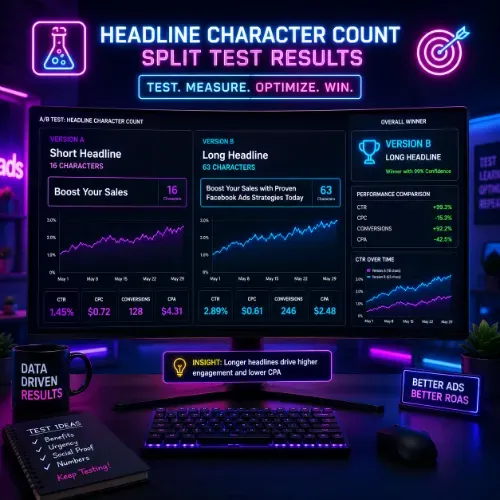
Table of Contents
Overview:
This guide breaks down the short form vs long form ad copy for Meta 2026 debate and teaches you the hook problem solution ad copy framework that actually converts. You’ll learn when to use short-form ad copy vs long-form ad copy, how to structure your Meta primary text, and why the Problem-Agitate-Solution (PAS) framework is the most reliable Meta ad copy structure for cold audiences and high-ticket offers.
Key Takeaways:
- There is no universal ideal ad copy length — short copy (under 125 characters) wins for simple offers with cold audiences, while long copy (200–500 characters) wins for considered purchases, B2B products, and audiences needing more context.
- Meta body copy under 50 characters has a 15.5% survival rate, with a second peak at 250–500 characters (10.8%) — the middle ranges underperform.
- The Hook → Problem → Solution framework mirrors how humans make decisions: recognize a problem, feel the pain, then seek relief.
- PAS (Problem-Agitate-Solution) works best for cold traffic where the audience has an unresolved pain.
- Meta primary text truncates after ~125 characters with a “See more” link — your first two lines must earn the click.
- Test both short and long copy — many accounts find long-copy outperforms short-copy for high-ticket offers, while short copy wins for impulse or low-ticket purchases.
- Ad copy is the second leg of a relay race — it receives the baton from the creative, not from the copywriter’s intent.
So here’s a question for you.
Have you ever stared at your Meta Ads Manager, watching your CTR sit at 0.5%, wondering why absolutely nobody is clicking?
You’ve got a decent creative. Your targeting isn’t terrible. You’re spending real money.
But your ad copy? It’s just… there.
I feel you. I’ve been there too.
The short form vs long form ad copy debate has been going on forever. Some people swear shorter is always better. Others say you need long-form storytelling to win. And honestly? Both are right. And both are wrong.
Here’s what I’ve learned after running Meta ads for over nine years: there’s no single ideal ad copy length.
What works for a $19 ebook won’t work for a **$5,000 coaching program**. What stops the scroll for a cold audience won’t work for warm retargeting.
The real secret isn’t picking one length forever. It’s knowing when to use each one. And more importantly, knowing how to structure your copy so every single word actually earns its keep.
That’s exactly what I’m sharing today.
The Hook → Problem → Solution framework. Plus exactly when to go short, when to go long, and how to test both like a pro.
For the foundational strategy behind all of this, check out our pillar guide on how to create Meta ads that convert in 2026 .
Let’s get into it.
The “See More” Cliff Is Real
Before we dive into frameworks and lengths, you need to understand one brutal reality about Meta ads in 2026.
Meta primary text cuts off after about 125 characters with a “See more” link. On mobile feed, you get roughly two lines before that link appears.
So your first sentence — those first 125 characters — is doing 80% of the heavy lifting.
If line one says “We are a company founded in 2010 to help businesses…” — you already lost them.
If line two doesn’t make them curious enough to click “See more” — you lost them too.
This “See more” cliff is real. And most advertisers fall right off it.
The good news? Once you know the rules, you can play the game.
Meta’s ads guide recommends 50 to 150 characters for feed placements. The headline should be 27–40 characters, and the description around 25 characters.
But here’s the thing. Character limits tell you what fits. They don’t tell you what works.
That’s where the real data comes in.
What 211 Million Ads Taught Us About Copy Length
AdSpyder looked at over 211 million Google Search and Meta ads to figure out which copy lengths actually produce ads that keep running — a real market signal, not just a platform spec sheet.
Here’s what they found.
For Meta, body copy under 50 characters wins at 15.5% survival rate. There’s a second strong peak at 250–500 characters at 10.8%.
Everything in the middle? It underperforms.
That means the data points to two distinct winning strategies on Meta:
- Ultra-short copy — a single sharp hook, a compressed value proposition, and an immediate call to action.
- Long-form copy — a sustained argument through proof, storytelling, and objection handling.
What doesn’t work? The middle ground. The “just enough” copy that’s neither punchy enough to stop the scroll nor detailed enough to build conviction.
Here’s another thing. Google Search and Meta reward opposite copy lengths. Google users have active intent — they need quick confirmation of relevance. Meta users are scrolling passively — they need either a one-line hook that stops them cold or a complete story that builds conviction.
Writing to a universal character count isn’t a strategy. It’s a compromise that serves nobody.
Short-Form Ad Copy: When and Why It Wins
Short-form ad copy stays under 125 words. It relies on a single sharp hook, a compressed value proposition, and an immediate call to action.
Short copy (under 125 characters) works well for simple offers with cold audiences who don’t need much convincing.
Think about it this way.
If you’re selling a free trial, a clear discount, or a single well-understood product, the value is obvious. You don’t need to explain what a 30-day free trial is. You don’t need to convince someone that 50% off is a good deal.
You just need to stop the scroll and get the click.
When to use short-form ad copy:
- The offer is simple and self-evident
- The audience is cold and needs a quick pattern interrupt
- The price point is low (impulse purchase territory)
- You’re running prospecting campaigns where attention is scarce
- The creative does most of the explaining
Short-form ad copy examples:
“We cut our client’s CPL in half in 30 days.”
“Your competitors are running this ad. You’re not.”
“Stop wasting money on bad ads.”
Here’s the psychology behind it. A punchy statement creates a gap in the reader’s mind. Is that true? How? What are they talking about? That gap pulls them into the body copy.
The hook’s only job is to earn the next sentence. For more on crafting scroll-stopping openers, check out our guide on Meta ad hook formulas for high-ticket services .
Long-Form Ad Copy: When and Why It Wins
Long-form ad copy runs 150 words or more. It builds a sustained argument through proof, storytelling, and objection handling.
Long copy (200 to 500 characters) works well for considered purchases, B2B products, or audiences who need more context before converting.
When to use long-form ad copy:
- The offer needs explaining
- The purchase carries real risk (higher price point)
- The audience is unaware or problem-aware and needs education
- The product has a complex value proposition that can’t be compressed into a single sentence
- You’re targeting warm retargeting audiences who already know who you are
Long-form ad copy examples:
“When Sarah came to us, she was stuck at $8K months. Three months later, she hit $47K. Here’s exactly what changed. She stopped chasing cheap clients. She started positioning herself as the expert. She implemented our value-first ad framework. And now? She works 20 hours a week, charges $10K per client, and actually enjoys her life.”
See the difference? Long-form builds a story. It creates an emotional connection. It walks the reader through the transformation.
Long-form ad copy gives you space to stack benefits, introduce social proof, address the “what if it doesn’t work” fear, and present a risk-reversal guarantee.
500–1,200 words is a workable range for complex ecommerce or high-consideration offers. That range exists because those offers usually carry a bigger proof burden and a colder landing page.
For more on building trust through authentic content, check out our guide on UGC ad scripts for B2B performance marketing .
The Hook → Problem → Solution Framework
Now that you know when to go short and when to go long, let’s talk about how to structure your copy regardless of length.
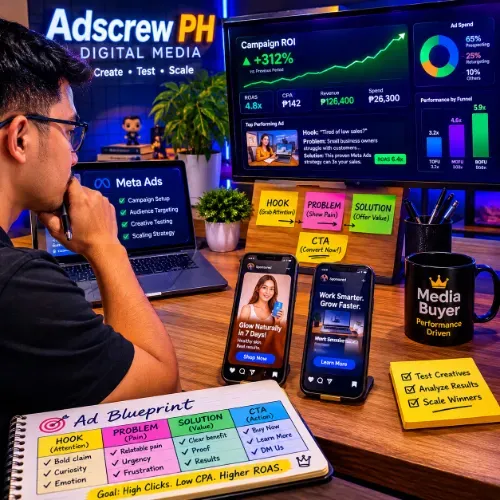
The Hook → Problem → Solution framework is the most versatile ad copy formula in advertising.
It works because it mirrors how humans make decisions: recognize a problem, feel the pain, then seek relief.
Here’s how it breaks down.
Step 1: The Hook (0–3 seconds)
The hook is your opening line. It’s the first thing your audience sees. It’s what stops the scroll.
A great hook does three things:
- Names a specific pain the audience feels
- Makes a surprising claim
- Asks a question they cannot ignore
Generic openings like “Introducing” or “Looking for X?” perform poorly because they signal an ad immediately. The strongest opening lines are specific: they name the audience’s exact frustration, in the words the audience uses to describe it.
Use voice-of-customer research — reviews, Reddit threads, DMs — to find those exact phrases, then lead with them.
Hook examples:
- “Still paying high shipping fees for low-quality supplements?”
- “Is your back hurting from sitting all day?”
- “Stop copying and pasting code that doesn’t work.”
Step 2: The Problem (Agitate)
Once you’ve hooked them, you need to make the problem feel real.
This is where the Problem-Agitate-Solution (PAS) framework shines.
Problem: State the pain point your audience experiences.
Agitate: Make the problem feel urgent and painful.
You’re not just saying “you have a problem.” You’re saying “here’s why this problem is costing you sleep, money, and sanity.”
Problem-Agitate examples:
- “Posture correctors are uncomfortable and chiropractors are expensive.”
- “You’re spending $10K a month on ads and your cost per lead is going up, not down.”
- “Your Facebook ads are getting scrolled past. Your competitors are winning. And you’re watching your budget disappear.”
The agitation step is crucial. It creates emotional tension that your solution will resolve.
Step 3: The Solution
Now you introduce your product or service as the obvious answer.
Solution examples:
- “Meet the ErgoChair. Spine support for $99.”
- “Our value-first ad framework changed everything. Here’s how.”
- “Book a strategy call with us for better Meta Ads.”
The solution should feel like relief. Like the answer they’ve been searching for.
The Problem-Agitate-Solution (PAS) framework works best for cold traffic where the audience has an unresolved pain. It focuses on the user, not the product.
The Complete Structure: Hook → Problem → Solution → Proof → CTA
For maximum impact, especially with long-form ad copy, expand the framework to five parts:
1. Hook — Stop the scroll. Name the pain, make a bold claim, or ask an intriguing question.
2. Problem — Agitate the pain. Make it feel urgent and real.
3. Solution — Introduce your product or service as the answer.
4. Proof — Show social proof. Testimonials, case studies, data. Prove it works. For more on this, check out our guide on native social proof ads for Meta retargeting .
5. CTA — Tell them exactly what to do next.
This is the Hook-Problem-Solution-Proof-CTA script that powers high-performing Meta ads.
How to Test Short vs Long Copy (The Right Way)
Now that you’ve got the framework, you need to test.
Here’s a simple system.
- Write three versions of primary text for your next campaign:
- Version A: Short & Punchy (1 sentence, under 125 characters)
- Version B: Features List (Bullets, medium length)
- Version C: Story (Long form, 200–500 characters)
- Test them in a 3:2:2 Dynamic Creative setup.
- Review which one gets the most clicks.
- But don’t stop at clicks. Look at CTR, cost per lead, and ROAS. A short copy might get more clicks but lower quality leads. A long copy might get fewer clicks but higher conversion rates.
- Scale the winner.
Many accounts find that long-copy ads outperform short-copy for high-ticket offers, while short copy wins for impulse or low-ticket purchases.
For more on structuring your testing, check out our guide on Meta dynamic creative vs flexible ad format testing .
Facebook vs Instagram: Does It Matter?
Should you write different ad copy for Facebook vs. Instagram?
The angle and message can stay the same, but the format and tone often need to shift.
Facebook audiences tend to be older. They respond to longer copy with more detail. They’re less sensitive to polished aesthetics — authenticity and specificity perform well.
Instagram audiences skew younger. They process information faster. They respond to visual hooks and tighter copy. On Instagram Stories and Reels, the first 3 seconds of a video or the first visible line of text is all you get.
In practice, run the same core offer with the same copy in Advantage+ placements and let Meta’s delivery system find who converts on which placement. Only create placement-specific variations if your data shows a major performance gap.
How Often Should You Refresh Ad Copy?
Watch frequency and CPM trends — not the calendar.
Ad copy fatigue shows up as rising CPM, falling CTR, and declining ROAS as the same people see the same message repeatedly.
For most accounts spending under $500 per day, creative fatigue appears after 2 to 4 weeks of active delivery.
For larger accounts with broader audiences, a winning piece of copy can run for 2 to 3 months before performance degrades.
The signal to refresh is when your frequency exceeds 3 to 4 for your target audience AND your CTR has dropped more than 25 percent from its peak.
Don’t change copy reactively after a single bad day — wait for a trend.
For more on spotting fatigue early, check out our guide on predicting ad fatigue before ROAS drops .
Frequently Asked Questions (FAQs)
1. What’s the best ad copy length for Meta ads in 2026?
There’s no single answer. Short copy (under 125 characters) works for simple offers and cold audiences. Long copy (200–500 characters) works for complex offers, high-ticket items, and audiences who need more convincing. The data shows two winning ranges: under 50 characters and 250–500 characters. Everything in between underperforms.
2. Should I use short or long ad copy for Facebook ads?
It depends on your offer and audience. If you’re selling a low-ticket impulse product to a cold audience, go short. If you’re selling a high-ticket service or B2B product, go long. Test both and let the data decide.
3. How long should Meta ad primary text be?
Meta recommends 50–150 characters for feed placements. But the best-performing ads fall into two ranges: under 50 characters or 250–500 characters. The middle ranges (50–250 characters) tend to underperform.
4. What is the hook problem solution ad copy formula?
It’s a three-part framework: Hook (stop the scroll with a compelling opener), Problem (name and agitate the pain point), Solution (present your product or service as the answer). It works because it mirrors how humans make decisions.
5. What is the Problem-Agitate-Solution (PAS) framework?
PAS is a copywriting formula where you first state the Problem your audience faces, then Agitate it by making the pain feel urgent and real, then offer the Solution. It works best for cold traffic with an unresolved pain.
6. How do you structure high-converting ad copy for Meta?
Use the Hook → Problem → Solution → Proof → CTA structure. Hook them, name the pain, agitate it, offer the solution, prove it works with social proof, and tell them exactly what to do next.
7. When should you use long-form vs short-form ad copy?
Use short copy for simple offers, cold audiences, low price points, and prospecting campaigns. Use long copy for complex offers, high-ticket items, warm audiences, and when you need to build trust and overcome objections.
8. How does Meta’s algorithm treat short vs long copy?
Meta’s algorithm doesn’t care about length directly. It cares about engagement signals—hook rate, hold rate, CTR, and conversions. Both short and long copy can win. The algorithm will favor whatever keeps people watching and clicking.
9. What’s the “See more” cliff in Meta ads?
Meta primary text truncates after about 125 characters with a “See more” link on mobile feed. That means your first two lines are doing 80% of the heavy lifting. If they don’t hook the reader, they won’t click to read the rest.
10. How many characters should Meta ad headlines be?
Meta recommends headlines between 27–40 characters. Keep them short, punchy, and benefit-driven. The headline is often the first thing people read after the primary text hook.
11. Can I use the same ad copy for Facebook and Instagram?
You can, but you might get better results with slight variations. Facebook audiences tend to prefer longer, more detailed copy. Instagram audiences respond better to tighter copy and visual hooks. In practice, run the same core offer in Advantage+ placements and let Meta optimize.
12. How do I test short vs long ad copy on Meta?
Write three versions: short and punchy (under 125 chars), features list (medium), and story (200–500 chars). Test them in a 3:2:2 Dynamic Creative setup. Look at CTR, cost per lead, and ROAS—not just clicks. Scale the winner.
13. What copy length works best for cold audiences on Meta?
Short copy (under 125 characters) generally works best for cold audiences. They don’t know you yet. You need to stop the scroll with a quick hook, not a long story. Save the long copy for warm retargeting.
14. What copy length works best for high-ticket offers on Meta?
Long copy (200–500 characters) tends to work better for high-ticket offers. Premium buyers need more convincing. They have objections. They need proof. Long copy gives you space to address all of that.
15. How often should I refresh my Meta ad copy?
Watch frequency and CPM trends, not the calendar. For most accounts, creative fatigue appears after 2–4 weeks. Refresh when frequency exceeds 3–4 AND CTR has dropped more than 25% from its peak.
16. What’s the Hook-Value-CTA framework?
It’s a simplified version of the Hook → Problem → Solution framework. Hook them, deliver value (teach them something useful), and then give a clear call to action. Works well for educational content and lead gen.
17. Does ad copy length affect ROAS?
Yes, but not in a straight line. The right length for your specific offer and audience will improve ROAS. The wrong length will hurt it. That’s why testing is so important.
18. What’s the best way to structure a Meta video ad script?
Use the Hook → Problem → Solution → CTA structure. First 3 seconds: hook. Next 10–15 seconds: name and agitate the problem. Next 10–15 seconds: present the solution. Final 5 seconds: clear call to action.
19. How do I write ad copy that stops the scroll for cold audiences?
Use a pattern interrupt. Start with something unexpected—a bold statement, a surprising question, or a counterintuitive claim. Don’t be generic. Be specific. Name their exact pain in their exact words.
20. Is long-form ad copy dead on Meta?
No. Long-form copy is very much alive. It works well for considered purchases, B2B products, and high-ticket offers. The data shows a strong peak at 250–500 characters. Just don’t use long copy for cold audiences or simple offers—that’s where short copy wins.
Quick Reference: Short vs Long Copy Decision Matrix
| Factor | Short Copy Wins | Long Copy Wins |
|---|---|---|
| Offer complexity | Simple, self-evident | Complex, needs explaining |
| Price point | Low, impulse | High, considered purchase |
| Audience | Cold, prospecting | Warm, retargeting |
| Product type | B2C, low-ticket | B2B, high-ticket |
| Proof needed | Low | High |
| Platform | Instagram Reels | Facebook Feed |
Final Thoughts
Look, the short form vs long form ad copy debate isn’t really about length.
It’s about matching your copy to your audience’s awareness level, your product’s complexity, and your platform’s constraints.
Short copy stops the scroll. Long copy builds conviction.
Both work. Just not for the same thing.
The Hook → Problem → Solution framework gives you a structure that works regardless of length. Hook them. Name the pain. Agitate it. Offer the solution. Prove it works. Tell them what to do next.
Test both short and long. Let the data decide.
Your next wave of cold audience conversions — or your future high-ticket clients — are waiting for the right words.
Now go write some copy that actually converts.
About the author: Jemmar Macasusi is a Davao-Based Media Buyer and Performance Marketing specialist with over nine years of experience managing Meta Ads. He helps premium service providers and B2B consultants scale their high-ticket offers through data-driven ad strategies and scroll-stopping creative.
hmrmsjhtniezfsvnexxpsmhnnmxtth
An Engaging Blog Post
WOW,Very wonderful
The content is really great
I AM BACK AGAIN
That was amazing