
Table of Contents
Overview
To create Meta ads that convert in 2026, you need to stop obsessing over targeting and start obsessing over creative. Creative quality now determines 70-80% of ad performance. Meta’s AI system – the Andromeda retrieval engine working alongside the GEM (Generative Ads Model) – evaluates your ad’s creative signals first, not your interest stacks. This guide breaks down the Meta Ads creative strategy 2026 that actually works: hook-driven creatives that stop the scroll in under 2 seconds, the 70-20-10 creative budget rule, a repeatable creative testing framework, and matching ad formats to your buyer’s funnel stage. Stop chasing cheap clicks. Start creating ads that find your buyers.
Common Questions This Article Answers
“How do I create Meta ads that convert in 2026?”
“What makes a Meta ad creative high-converting?”
“Why is creative the new targeting in Meta Ads?”
“What is the 70-20-10 rule for Meta ad creatives?”
“How do I test Meta ad creatives for better results?”
“What creative formats work best for Meta Ads in 2026?”
Let me ask you something.
Have you ever spent hours tweaking your targeting – stacking interests, layering behaviors, building the perfect lookalike – only to launch your ad and hear… crickets?
I’ve been there. More times than I care to admit.
Here’s the truth that took me way too long to learn: targeting is dead. Well, not dead exactly. But it’s no longer the secret weapon it used to be.
In 2026, creative is the new targeting.
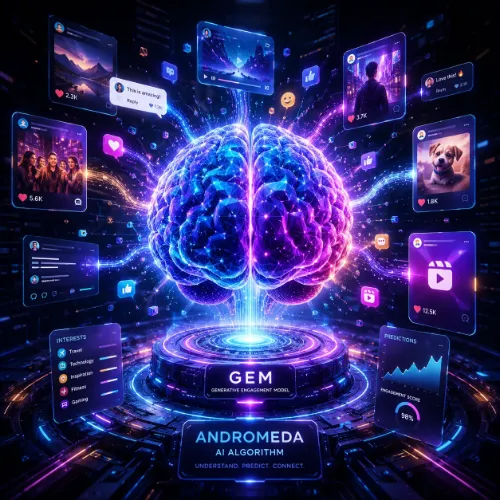
Meta’s AI system works through a powerful two‑engine approach. The Andromeda retrieval engine acts as the gatekeeper, scanning millions of ads to filter them down to a shortlist based on semantic similarity and relevance. Then the GEM (Generative Ads Model) takes over – it actually reads your ad’s visuals, text, and audio to predict exactly how a user will respond, mapping emotional and visual signals to the right user.
That means your ad’s performance depends less on who you target and more on what you show them – and how Meta’s GEM interprets it.
In this guide, I’ll walk you through exactly how to create Meta ads that convert in 2026. No outdated hacks. No fluff. Just a proven creative strategy that works with Meta’s AI, not against it.
For the foundational framework, check out our pillar guide: how to run Meta Ads.
Key Takeaways
- Creative quality now determines 70-80% of ad performance. Targeting is secondary. Your ad’s creative signals – not your interest stacks – drive results.
- The first 2-3 seconds decide everything. If your hook doesn’t stop the scroll immediately, nothing else matters. A good hook rate on Meta in 2026 is 30% or above.
- Use the 70-20-10 creative budget rule: 70% on proven creative, 20% on tested variations, 10% on experimental formats. This balances stability with innovation.
- Build a repeatable creative system. Don’t chase 50 creatives a week. Focus on deep research, intentional messaging, and a structured testing framework.
- Match ad formats to the buying process. Different creatives for cold, warm, and hot audiences. Build video for silence, static for conversions, and carousels for discovery.
Why Creative Is the New Targeting in 2026
Here’s what changed.
In the old days, you’d build a hyper-specific interest stack. “People who like Nike AND running AND fitness AND live in Manila.” You’d spend hours tweaking it. Then you’d launch your ad and pray.
Today? Meta’s AI system works differently. Andromeda filters the noise – it scans millions of ads based on semantic similarity to find the most relevant shortlist for each user. Then GEM (Generative Ads Model) steps in. GEM is the engine that actually “reads” your ad – analyzing visuals, text, and audio to predict engagement and conversion signals. It maps your creative’s emotional and visual cues to the right user profile.
The result? The system no longer relies on your interest stack the way it used to. It evaluates user behavior and ad creative simultaneously – with GEM doing the heavy lifting on creative interpretation.
With the rollout of this two‑engine system, Meta shifted away from audience-first advertising to creative-first matching. Targeting became less deterministic as interests and lookalikes no longer performed as strongly as they once did. Instead, creatives became the primary signal as the system evaluated creative elements like visuals, themes, hooks, and language to determine relevance. As Search Engine Land explains, “Meta Ads is no longer an open, manual optimization environment”.
That means broad targeting – age, gender, location, nothing else – is now consistently delivering lower costs and more stable conversions.
So if targeting is dead, what’s alive?
Creative.
Your ad’s creative does the targeting for you. A great ad naturally attracts the right audience and puts off the wrong one. A bad ad does the opposite – no matter how perfect your targeting is.
Motion’s 2026 Creative Benchmarks report, based on 578,750+ ads and $1.29 billion in Meta ad spend across 6,015 advertisers, found that only 4% to 8% of ad creatives became winners.
What does a “winner” actually mean in 2026 terms? It’s not just an ad that gets clicks. A winning ad is one that the Meta algorithm trusts enough to allocate at least 10x the median account spend – meaning the system believes in its ability to drive conversions and scales it aggressively across the most valuable audiences.
That means 92-96% of creatives fail.
The winners? They’re not the ones with perfect targeting. They’re the ones with scroll-stopping creative that GEM recognizes as high-relevance and Andromeda surfaces to the right users.
For product launches, that makes the creative itself a critical part of the strategy. Studios like Flowjam can help turn product ideas into short, engaging videos designed to grab attention and work as Meta ad creative.
And this shift goes beyond creative production. It is tied to how Meta’s AI systems evaluate, understand, and distribute ads. For a deeper look at that process, read Inside Meta’s AI-driven advertising system: How Andromeda and GEM work together.
The Hook: Your Ad’s Make-or-Break Moment
The first 2-3 seconds determine whether your ad survives. If your hook feels slow, irrelevant, or unclear, users scroll past without processing your message. A good hook rate on Meta in 2026 is 30% or above; 35%+ is elite.
Here’s the thing about scrolling.
People are moving fast. Really fast. They don’t have time to figure out what your ad is about. If you don’t grab them in the first 2-3 seconds, you’ve lost them forever.
The early signals Meta watches for: thumb-stop rate, 3-second hold, scroll velocity, and comment intent.
Thumb-stop rate is the percentage of feed impressions where a viewer stops scrolling long enough to count as a video view. According to Coinis, thumb-stop rates under 15 percent mean the opening frame is failing, while rates over 35 percent are rare and usually come from UGC openers with motion plus on-screen text.
Overproduced, polished ads often lose to raw, clear ones.
So what makes a great hook?
The 5 high-performing hook styles in 2026:
- Problem-Solution: “Tired of [problem]? Here’s how we fixed it.”
- Story-based: “Let me tell you how [customer] went from X to Y.”
- TikTok/Reel style: Fast-paced, raw, authentic.
- Comparison: “Before vs after. Old way vs new way.”
- Testimonials: Real customers, real results, real faces.
If you’re selling high-ticket services, the hook needs to work even harder. You’re asking someone to make a bigger commitment, so your hook has to build trust fast. For a deep dive into hooks that work specifically for premium offers, check out our guide on meta ad hook formulas for high-ticket services.
Pro tip: Research is now more important than production. The best hooks come from your customers’ own words. Listen to their language. Use their phrases. That’s what converts.
Ad Copy That Converts: Short vs Long
Your ad copy matters just as much as your visuals. But how much should you write?
The answer depends on your audience and your offer.
Short-form ad copy (under 125 characters) works best for:
- Cold audiences who need a quick hook
- Mobile-first scrolling
- Retargeting campaigns where the audience already knows you
Long-form ad copy (over 125 characters) works best for:
- High-ticket items that need explanation
- Educational content
- Audiences in the consideration stage
The key is to match your copy length to your audience’s stage in the buying process. For a complete breakdown of when to use short vs long copy, read our guide on short-form vs long-form ad copy for Meta 2026.
The 70-20-10 Creative Budget Rule
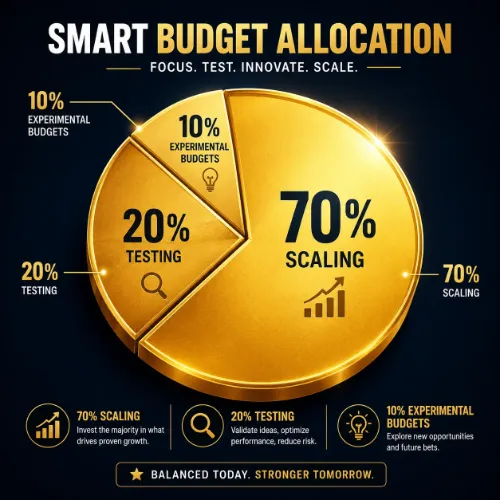
Invest 70% of your budget in proven creative, 20% in tested variations, and 10% in experimental formats. This framework balances stability with innovation and prevents you from over-investing in unproven ideas.
Here’s a framework that works.
70% – Proven Creative. These are your winners. Ads that have already demonstrated performance. Scale these confidently. This is your revenue engine.
20% – Tested Variations. These are new angles, hooks, or formats based on what’s already working. You’re not starting from zero – you’re iterating on success.
10% – Experimental Formats. This is where you take risks. New concepts. Untested hooks. Formats you’ve never tried before. If they work, they move into the 20% bucket. If they don’t, you cut them without losing sleep.
This approach protects your budget while still giving you room to innovate. It’s the Meta Ads creative strategy 2026 that scales.
A 2025 AppsFlyer report found that 70–80% of Meta ad performance stems from how strong the creative is – not budget or targeting. The 70-20-10 rule ensures you’re investing that creative budget wisely.
For more insights, read EMARKETER’s analysis of the 70/20/10 rule and how top brands like Zara use it to scale.
Creative Testing: How to Find Your Winners
Run one campaign with one ad set containing multiple creatives for 3-4 days to identify winners. Meta’s Andromeda and GEM perform best when paired with thoughtful, consistent, human-led strategy.
Here’s the simple testing framework I use.
Step 1: One Campaign, One Ad Set, Multiple Creatives
Don’t overcomplicate this. Create a single campaign with a single ad set. Put 3-5 creatives inside. Let Meta’s algorithm decide which ones to show and to whom.
This is the creative testing framework that works in 2026.
Step 2: Run for 3-4 Days
Don’t judge performance after 24 hours. Give it at least 3-4 days. Meta’s AI needs time to learn and optimize.
Step 3: Identify Winners
Look at your metrics. Which creatives have the highest hook rate, CTR, and conversion rate? Those are your winners.
Step 4: Scale Winners
Move your winners to the 70% bucket. Increase budget gradually – 15-20% every 48 hours. Don’t double overnight.
Step 5: Kill Losers
If a creative isn’t performing after 3-4 days, cut it. Don’t hold onto hope. The Andromeda and GEM era rewards scroll-stopping creative, not incremental optimization.
When testing different ad formats, you’ll often face a choice between dynamic creative and flexible ad formats. Each has its strengths, and knowing when to use which can save you weeks of testing. Our guide on meta dynamic creative vs flexible ad format testing breaks down the differences and helps you choose the right approach.
Pro tip: Build a repeatable creative system. Don’t chase 50 creatives a week. Focus on deep research, intentional messaging, and a structured testing framework.
Matching Ad Formats to the Buying Process
Match ad formats to where the customer is in the buying process. Build video for silence, static for conversions, and carousels for discovery.
Different audiences need different creatives.
Cold Traffic (Top of Funnel):
- Goal: Stop the scroll, build awareness.
- Best formats: Video (Reels, TikTok-style), carousels, UGC.
- Creative style: Educational, entertaining, problem-focused. Don’t sell – educate.
When running video ads to cold audiences, retention is everything. If viewers drop off in the first 3 seconds, you’ve lost them. For specific tactics to keep cold audiences watching, check out our guide on meta video ad retention hacks for cold audiences.
Warm Traffic (Middle of Funnel):
- Goal: Build trust, nurture intent.
- Best formats: Testimonials, case studies, carousels with proof.
- Creative style: Social proof, comparison, story-based.
If you’re running B2B campaigns, user-generated content (UGC) can be a game-changer. B2B buyers trust peer reviews and real-world examples more than polished corporate ads. For a complete script and framework, read our guide on ugc ad script for B2B performance marketing.
Hot Traffic (Bottom of Funnel):
- Goal: Convert to sale.
- Best formats: Static image with clear offer, video with urgent CTA.
- Creative style: Direct, urgent, offer-focused. “Limited spots,” “Today only,” “Apply now.”
For retargeting hot audiences, native social proof ads are incredibly effective. They feel less like ads and more like recommendations from real people. Learn how to build them in our guide on native social-proof ads for Meta retargeting.
A quick note on video: Most users scroll without sound. Build your video for silence – captions, visual storytelling, and text overlays are essential.
Real-World Example: Fixing a Struggling Ad Account
I worked with a DTC brand spending $15,000/month on Meta Ads. They had perfect targeting – detailed interests, layered behaviors, custom lookalikes. But their ROAS was stuck at 1.8x.
We didn’t touch their targeting.
We rebuilt their creative strategy.
Before:
- 3 static images, all similar angles
- No video
- No testing framework
- Same creatives running for 3 months
After:
- 5 creatives per ad set (3 videos, 2 statics)
- Diverse hooks (problem-solution, UGC, comparison)
- 70-20-10 budget allocation
- Weekly creative refresh
Result: Within 30 days, ROAS jumped from 1.8x to 3.4x. CPA dropped 35%. Same targeting. Same budget. Better creative.
That’s the power of creating Meta ads that convert.
Common Creative Mistakes (And How to Fix Them)
Mistake #1: Overproducing. Raw, authentic ads often outperform polished ones. Stop spending thousands on production. Start spending time on research.
Mistake #2: Running Too Few Variations. In 2026, with warm audiences becoming saturated and Meta’s Andromeda rollout emphasizing dynamic creative, you need a deep bench. We often recommend 20+ ad variations, not just 3.
Mistake #3: Ignoring the Hook. The first 2-3 seconds determine everything. If your hook doesn’t stop the scroll, nothing else matters.
Mistake #4: Same Creative for All Funnel Stages. Cold audiences don’t want a sales pitch. Warm audiences don’t need education. Match your creative to where the customer is in their journey.
Mistake #5: No Testing Framework. Randomly creating ads without a structured testing process is gambling. Build a repeatable creative system.
Mistake #6: Ignoring Ad Fatigue. Creative fatigue is the silent killer of scaling campaigns. You don’t want to find out your ROAS is dropping only after you’ve already lost money. Learn how to spot the warning signs early in our guide on predicting ad fatigue before ROAS drops.
Key Takeaways
- Creative quality now determines 70-80% of ad performance. Stop obsessing over targeting and start obsessing over your ad’s creative signals.
- The first 2-3 seconds decide everything. If your hook doesn’t stop the scroll immediately, nothing else matters.
- Use the 70-20-10 creative budget rule: 70% proven, 20% tested variations, 10% experimental. This balances stability with innovation.
- Build a repeatable creative testing system. Run 3-5 creatives per ad set for 3-4 days, identify winners, scale them, cut losers.
Question FAQ: How to Create Meta Ads That Convert
- How to create Meta ads that convert in 2026? Focus on scroll-stopping hooks, diverse creative formats, a structured testing framework, and the 70-20-10 budget rule. Targeting is secondary – creative is now the primary driver of performance.
- What makes a Meta ad creative high-converting? A strong hook that stops the scroll in under 2 seconds, clear messaging that matches the audience’s funnel stage, and authentic visuals that build trust.
- What is the difference between Andromeda and GEM? Andromeda is the retrieval engine that filters millions of ads to a shortlist. GEM (Generative Ads Model) actually reads your creative – visuals, text, audio – and predicts user response.
- What is the 70-20-10 rule for Meta ad creatives? Invest 70% of your budget in proven creative, 20% in tested variations, and 10% in experimental formats. This balances stability with innovation.
- How do I test Meta ad creatives for better results? Run one campaign with one ad set containing 3-5 creatives for 3-4 days. Identify winners, scale them, cut losers. Build a repeatable system.
- What creative formats work best for Meta Ads in 2026? Video (for silence with captions), static images (for conversions), carousels (for discovery), and UGC (for authenticity).
- What is a good hook rate on Meta in 2026? 30% or above is good; 35%+ is elite.
- How many ad variations should I run? At least 20+ ad variations. With Meta’s Andromeda emphasizing dynamic creative, you need a deep bench.
- Should I use video or static images? Both. Use video for cold traffic and discovery, static for conversions and retargeting. Build video for silence with captions.
- How long should I run a creative test? 3-4 days. If a creative doesn’t perform in the first 24-48 hours, it probably never will.
- What is creative fatigue and how do I fix it? When your audience gets bored of seeing the same creative. Refresh creatives every 2-4 weeks. Use the 70-20-10 rule to keep a pipeline of fresh ideas.
- Can I use AI-generated creative for Meta Ads? Yes. AI-generated creative is rising and can be effective, but always test it against human-created ads.
- What’s the biggest mistake with Meta ad creatives? Overproducing. Raw, authentic ads often outperform polished ones. Focus on research, not production.
- How do I match creative to funnel stage? Cold traffic: educational video. Warm traffic: testimonials and case studies. Hot traffic: direct offer with urgency.
- What defines a “winning” ad in 2026? A winning ad is one the Meta algorithm trusts enough to allocate at least 10x the median account spend – not just one that gets clicks.
- How do I write a scroll-stopping hook? Use the 5 hook styles: problem-solution, story-based, TikTok/Reel style, comparison, or testimonials. Research customer language.
- Should I use broad targeting or interest targeting? Broad targeting (age/gender/location) now consistently delivers lower costs and more stable conversions. Let your creative do the targeting.
- How much of ad performance comes from creative? 70-80% of Meta ad performance comes down to creative quality – not budget, not targeting.
- How often should I refresh my creatives? Every 2-4 weeks. Monitor frequency and CTR drops as signals to refresh.
- Where can I learn more about Meta Ads creative strategy? Check out our pillar guide on how to run Meta Ads and how to build high-converting audiences. For external reading, see Meta’s creative best practices, Search Engine Land’s Andromeda explainer, and EMARKETER’s 2026 Meta ad strategies.
Final Thoughts
Here’s the truth about how to create Meta ads that convert:
Targeting is dead. Creative is king.
The advertisers winning in 2026 aren’t the ones with the best interest stacks. They’re the ones with the best hooks, the most diverse creative, and the most disciplined testing systems.
Stop spending hours on targeting. Start spending hours on creative.
Test more. Produce less. Listen to your customers. Their words are your best hooks.
The algorithm optimizes for whatever you feed it. Feed it great creative, and it’ll find you great customers.
It’s that simple.
Need help creating high-converting Meta Ads or building a creative testing system? Reach out to Adscrew PH. We’ve been running Meta Ads for over nine years, and we’d love to help you stop wasting money on ads that don’t convert.