
Table of Contents
Overview:
This guide breaks down 5 proven Meta ad hook formulas for high-ticket services that actually stop the scroll. You’ll learn the value-first ad framework, call-out positioning method, and how to measure hook rate so your high-ticket Meta ad copy frameworks finally convert cold audiences into premium clients.
Key Takeaways:
- Hook rate is the most important Meta ad metric in 2026. Aim for 30%+.
- Pattern interrupt hooks work best for cold audiences—break the scroll pattern immediately.
- Curiosity gap hooks work for problem-aware audiences—hint at the solution without giving it all away.
- Bold claim hooks work for differentiation—make specific, provable claims.
- Social proof hooks work for warm retargeting—show prospects that people like them have succeeded.
- Transformation hooks work for high-value content—paint the before and after picture.
- The value-first ad framework builds trust with premium buyers by delivering genuine value before asking for anything.
- Test your hooks systematically using a creative testing matrix.
- Write for both humans and AI—clear structure, direct answers, and natural language.
Let me ask you something.
How many times have you poured your heart into a Meta ad… only to watch people scroll past it like it’s invisible?
It hurts, right?
You’ve got an amazing high-ticket service. You know it can change lives. You’ve got the testimonials, the case studies, the transformation stories.
But none of that matters if nobody stops to read your ad.
Here’s the brutal truth most media buyers won’t tell you: your copy is the targeting. In 2026, creative quality now determines 70-80% of ad performance. It doesn’t matter how precise your cold audiences are if your hook doesn’t grab them by the eyeballs in the first three seconds.
I’ve been running Meta ads for over nine years. I’ve managed campaigns for premium service providers, high-ticket coaching programs, B2B consultants—you name it. And I’ve seen the same mistake over and over again.
People write hooks for impulse buyers when they’re selling to considered purchase audiences.
That’s a fatal error.
High-ticket buyers don’t impulse buy. They evaluate risk. They look for credibility. They need to trust you before they hand over $5,000, $10,000, or more.
So why would you write ad copy like you’re selling a $20 t-shirt?
You wouldn’t.
That’s why today, I’m sharing five hook frameworks that stop the scroll—specifically designed for premium offers. These aren’t generic templates you find everywhere. These are scroll-stopping hooks built on psychology, tested across millions in ad spend, and proven to work for high-ticket services in 2026.
For the foundational creative strategy behind all of this, check out our pillar guide on how to create Meta ads that convert in 2026 .
Let’s dive in.
First, Let’s Talk About Hook Rate
Before we get into the frameworks, you need to understand one metric that changed everything for me.
Hook rate.
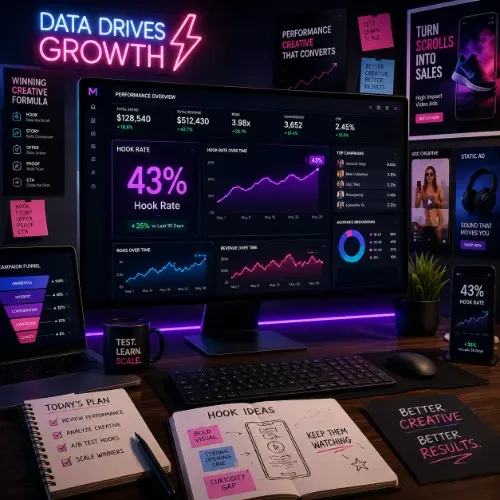
In 2026, Meta Ads Manager measures hook rate as 3-second video views divided by total impressions, multiplied by 100. It’s essentially the percentage of people who actually stop scrolling to watch your ad.
Here’s what the benchmarks look like in 2026:
| Hook Rate Range | Performance Level | What It Means |
|---|---|---|
| Under 20% | Below Average | Time to rewrite everything |
| 20–30% | Average | Decent but room for improvement |
| 30–40% | Good | You’re onto something—scale it |
| 40–50% | Excellent | Keep this creative forever |
The median Meta ad lands at about 28%. The top 10% of performers? They’re pulling 43% or higher.
That gap? That’s the difference between ads that scale and ads that bleed money.
But here’s the thing about hook rate—it’s just the beginning. You also need to look at hold rate, which measures how many people stick around after those first three seconds. A hook rate of 35% with a hold rate of 9% means your opening is winning attention, but your body copy is losing it immediately.
You need both.
📊 Hook Rate Checkpoint:
If your hook rate is below 25%, stop everything. Your creative isn’t stopping the scroll. Test a different opener before spending another dollar.
Now, let’s get to the good stuff.
Quick-Reference Table: Which Hook Framework Should You Use?
| Framework | Best For | Audience Temperature | Hook Format Example |
|---|---|---|---|
| Pattern Interrupt | Breaking scrolling trance | Cold audiences | “Stop. If you’re spending $10K on ads and your cost per lead is going up…” |
| Curiosity Gap | Hinting at a secret solution | Problem-aware audiences | “The one thing every consultant gets wrong about Meta ads…” |
| Bold Claim | Differentiation & standing out | Cold / mixed audiences | “We’ve generated $12.4M for B2B consultants using this framework.” |
| Social Proof | Building trust through results | Warm retargeting | “When Sarah came to us, she was stuck at $8K months…” |
| Transformation | Emotional before-and-after | High-value content / UGC | “Six months ago I was drowning. Today I work 20 hours a week.” |
Now let me break down each one in detail.
Framework #1: The Pattern Interrupt Hook
Best for: Cold audiences
Why it works: The human brain is wired to notice change.
Think about it. When you’re scrolling through your feed, you’re in a trance-like state. Thumb up, thumb down, scroll, scroll, scroll. Everything looks the same.
Until something breaks the pattern.
That’s the pattern interrupt hook.
It’s a statement, question, or visual that’s so unexpected, so out of the ordinary, that your brain literally can’t help but stop and pay attention.
How to use it for high-ticket services:
Most people start their ads with something safe. “Hi, I’m [Name] and I help [audience] achieve [result].”
Bor-ing.
Instead, try something like:
“Stop. If you’re spending $10K a month on ads and your cost per lead is going up, not down, this is the most important video you’ll watch today.”
Or:
“I almost deleted this ad. But then I realized—if you’re a B2B consultant who’s tired of chasing cheap clients, you need to hear what I’m about to say.”
See the difference?
The pattern interrupt doesn’t give away the whole farm. It just stops the scroll long enough for you to deliver your value proposition.
Real example:
I had a client selling a $15,000 coaching program. Their old ads started with “Are you struggling to scale your business?”—which got a hook rate of about 18%.
We swapped it for:
“Warning: This ad is not for everyone. If you’re happy with $5K months, keep scrolling. But if you’re ready for $50K months… keep watching.”
Their hook rate jumped to 34% in three days.
Why? Because we called out exactly who the ad was for—and who it wasn’t for. That’s call-out positioning in action.
Key takeaway: Don’t be afraid to polarize. High-ticket offers aren’t for everyone. Your hook should reflect that.
💡 Pro Tip:
Use the word “you” or “your” in the first 3 seconds. Personalization stops the scroll faster than generic statements.
Framework #2: The Curiosity Gap Hook
Best for: Problem-aware audiences
Why it works: Humans hate not knowing something.
It’s called the curiosity gap—the space between what someone knows and what they want to know. When you create that gap, people feel an almost physical need to close it.
How to use it for high-ticket services:
The curiosity gap hook works best when your audience already knows they have a problem. They’re problem-aware. They’ve tried things. They’ve spent money. Nothing’s worked.
Your job? Hint at a solution without giving it all away.
“The one thing every high-ticket coaching program owner gets wrong about Meta ads—and how to fix it in 10 minutes.”
Or:
“I spent $47,000 on **Facebook ads** before I learned this one **hook formula**. Now I never spend more than $500 to get a premium client.”
See what I did there?
I created a gap between what they know (they’re struggling with Meta ads) and what they want to know (the secret that fixes it).
The mistake most people make:
They close the gap too early.
If your hook says “Here’s how to get high-ticket leads” and then your first sentence explains exactly how, there’s no reason to keep watching.
Keep them curious. Give them just enough to want more.
Key takeaway: The curiosity gap isn’t about being vague. It’s about being intriguing. Hint at the transformation without explaining the entire process.
Framework #3: The Bold Claim Hook
Best for: Differentiation
Why it works: Big claims demand attention.
In a sea of ads all saying the same thing, a bold claim cuts through the noise. It’s the advertising equivalent of walking into a room and announcing something so audacious that everyone turns to look.
How to use it for high-ticket services:
Here’s the catch with high-ticket services—you can’t make claims you can’t back up. Premium buyers are savvy. They’ll fact-check you. They’ll ask for proof.
So your bold claim needs to be specific, provable, and defensible.
“We’ve generated $12.4M in revenue for B2B consultants using this one ad framework. Here’s exactly how.”
Or:
“Our clients see an average ROAS of 5.2x within 30 days. If we don’t hit it, we work for free.”
Notice the difference between these and empty claims like “We’re the best” or “We’ll change your life.”
The bold claim hook works because it’s specific and verifiable. It gives your audience something to hold onto.
But here’s the thing:
A bold claim without social proof is just arrogance.
If you’re going to make a big promise, you better have the social proof to back it up. That means testimonials, case studies, data—anything that demonstrates you can actually deliver.
⚠️ Warning:
Bold claims without proof = reputation damage. Always pair a bold hook with a case study or data point in the body copy.
Key takeaway: Make a bold claim that’s specific, measurable, and backed by proof. High-ticket buyers respect confidence when it’s earned.
Framework #4: The Social Proof Hook
Best for: Warm retargeting
Why it works: People trust people like them.
Social proof is one of the oldest persuasion techniques in the book—and for good reason. When we see others like us achieving results, we believe we can too. In fact, Meta’s own data shows UGC-style ads receive 4.2x higher engagement and 2.8x better conversion rates compared to brand-produced creative.
How to use it for high-ticket services:
The social proof hook is particularly powerful for warm retargeting audiences—people who’ve already visited your website, watched a video, or engaged with your content.
They know who you are. Now they need to know you’re legit.
“When Sarah came to us, she was stuck at $8K months. Three months later, she hit $47K. Here’s exactly what changed.”
Or:
“This isn’t another ‘get rich quick’ ad. It’s a breakdown of how 47 consultants used this value-first ad framework to book out their high-ticket services.”
The social proof hook works because it shifts the focus from you to your clients. It’s not about how great you are. It’s about the results you’ve delivered.
Pro tip:
Use UGC-style content for social proof hooks. Real clients talking about real results in their own words. It doesn’t need to be polished. In fact, the less polished it looks, the more authentic it feels. For a deep dive into this approach, check out our guide on native social proof ads for Meta retargeting .
Key takeaway: For warm retargeting, social proof is your secret weapon. Show prospects that people just like them have already succeeded with your help.
Framework #5: The Transformation Hook
Best for: High-value content offers and UGC
Why it works: People buy outcomes, not features.
Nobody buys a high-ticket service because they love the features. They buy it because of the transformation it delivers.
The transformation hook taps directly into that desire for change.
How to use it for high-ticket services:
Start by painting a picture of the “before” state—the pain, the frustration, the struggle. Then contrast it with the “after” state—the relief, the success, the freedom.
“Six months ago, I was drowning in client work, making no profit, and hating every minute of it. Today, I work 20 hours a week, charge $10K per client, and actually enjoy my life.”
Or:
“This is what happens when you stop chasing cheap clients and start positioning yourself as the expert. Watch till the end—it might just change everything.”
The secret sauce:
The transformation hook works best when it’s deeply personal. Share your own story. Share your clients’ stories. Make it emotional.
High-ticket buyers aren’t making logical decisions. They’re making emotional decisions and then justifying them with logic.
So appeal to their emotions first.
Key takeaway: The transformation hook is about showing the before and after. Make your audience feel the pain of the “before” and crave the relief of the “after.”
How to Test Your Hooks (The Right Way)
Now that you’ve got five hook frameworks, you need to test them.
But here’s where most people mess up.
They test one hook, get mediocre results, and declare the whole thing a failure.
That’s not testing. That’s guessing.
Here’s a simple creative testing matrix you can use:
- Run five different hooks against the same audience.
- Keep everything else the same—same offer, same visuals, same targeting.
- Let each ad spend at least $50–100 before making any decisions.
- Measure hook rate first, then hold rate, then cost per lead.
- Kill the losers. Scale the winners.
It sounds simple because it is. Most people just don’t have the patience to do it properly.
📋 Quick Testing Checklist:
☐ 5 different hooks running simultaneously
☐ Same audience, offer, and visuals
☐ Minimum $50 spend per variation
☐ Measure hook rate + hold rate + CPL
☐ Scale winners, pause losers
Pro tip: Don’t just test different hooks. Test different hook formats. Try a question hook against a bold claim hook against a social proof hook. See which one resonates with your specific audience.
For more on structuring your testing, check out our guide on Meta dynamic creative vs flexible ad format testing .
The Value-First Ad Framework for High-Ticket Offers
Before I wrap this up, I want to share something that completely changed how I write high-ticket ad copy.
It’s called the value-first ad framework.
Here’s the philosophy: High-ticket buyers don’t respond to hype. They respond to value.
Instead of leading with “Buy now!” or “Limited time offer!”—which screams desperation—lead with genuine value.
Give them something useful. Something educational. Something that demonstrates your expertise without asking for anything in return.
Here’s how it works in practice:
Step 1: Hook them with one of the five frameworks above.
Step 2: Deliver genuine value. Teach them something. Share a framework. Give away your best stuff.
Step 3: Build authority. Show them you know what you’re talking about.
Step 4: Introduce your offer as the logical next step.
This is the exact opposite of the “fake urgency” approach that floods most Meta ads. And it works infinitely better for premium offers.
Why?
Because high-ticket buyers are making a considered purchase. They’re not impulse buying. They need to trust you first. The value-first ad framework builds that trust.
The Technical Layer: Hooks & AI Matching Models
Here’s something for the technical SEOs and media buyers who want to stay ahead in 2026.
Modern ad delivery isn’t just about targeting anymore. It’s about ad retrieval engines and creative AI matching models that determine which creative gets shown to which user.
Meta’s Ad Retrieval Engine—called Andromeda—scans tens of millions of ads to find candidates for each impression. Then the GEM (Generative Ads Recommendation Model) takes over, actually reading your ad’s visuals, text, and audio to predict exactly how a user will respond. Together, they evaluate creative attributes, user context, and behavioral signals to build a candidate set of eligible ads for every single impression opportunity.
Here’s what that means for you:
- Pattern interrupt hooks signal high engagement potential to the algorithm.
- Bold claim hooks with specific numbers get classified as “high-value content.”
- Social proof hooks perform well in warm retargeting because the model already has affinity data.
- Transformation hooks with emotional language trigger higher hold rate predictions.
Amazon’s Orion, TikTok’s Shop Ads, and YouTube’s AI-driven creative optimization all operate on similar principles. The hook isn’t just your opening line—it’s a signal to the platform’s matching models.
So when you write your hooks, you’re not just writing for humans. You’re writing for the algorithmic systems that decide who sees your ad in the first place.
Actionable tip: Use clear, distinct language in your hooks. The AI models prefer specific, unambiguous phrasing over vague fluff. “We generated $12.4M” > “We’re really good at what we do.”
For more on keeping your creative fresh, check out our guide on predicting ad fatigue before ROAS drops .
Frequently Asked Questions (FAQs)
1. What exactly is a hook in a Meta ad?
A hook is the very first thing your audience sees or hears in your ad. It’s that opening line, visual, or sound that either stops the scroll or gets ignored. In a feed full of noise, your hook is your one shot at grabbing attention. If you nail it, they’ll watch the rest. If you don’t? They’re gone.
2. What’s a good hook rate for Meta ads in 2026?
Anything under 20% needs serious work. The average sits around 28%, but you really want to be in that 30–40% “good” range. The top performers hit 43% or higher. If you’re consistently above 35%, you’re in a great spot to start scaling your high-ticket campaigns.
3. How do I calculate hook rate in Meta Ads Manager?
It’s simple. Take your 3-second video views, divide that by your total impressions, then multiply by 100. Meta gives you that number right in the dashboard. I check it daily when I’m testing new creative.
4. Can I use these hook frameworks for Instagram Reels too?
Absolutely. These scroll-stopping hooks work on Meta Reels, Instagram Stories, and even TikTok. The platform doesn’t matter as much as the psychology behind the hook. Short-form video eats these frameworks up.
5. What’s the difference between hook rate and hold rate?
Think of hook rate as your front door—it measures who stopped scrolling long enough to watch 3 seconds. Hold rate measures who stuck around after that. If your hook rate is high but your hold rate is low, your opening worked but your body copy let you down. You need both.
6. Why do most traditional ad hooks fail for high-ticket services?
Because they’re written for impulse. “Buy now” and “limited stock” work for cheap products, but premium buyers don’t work like that. They need trust, credibility, and proof. The old-school tactics scream desperation, and high-ticket buyers smell it from a mile away.
7. How many hooks should I test at once?
I typically test five different hook formats against the same cold audiences. That gives me enough data to see what resonates without spreading my budget too thin. Anything less than three and you’re not really testing.
8. What’s the call-out positioning method?
It’s when you explicitly name who your ad is for—and who it’s not for. Instead of saying “Hey everyone,” you say “If you’re a B2B consultant tired of cheap clients…” That filters out the wrong people and attracts the right ones. It’s incredibly powerful for high-ticket offers.
9. How do I write a hook for a cold audience?
Use a pattern interrupt. Break their scrolling trance with something unexpected. A bold statement, a shocking question, or even a weird visual. They don’t know you yet, so you need to earn that initial glance.
10. Should I use question hooks or statement hooks?
It depends on your audience. Question hooks work well for problem-aware audiences—they get people nodding along. Statement hooks (especially bold ones) work better for differentiation. I’ve seen both crush it. Test both and see which one wins for your niche.
11. What’s the value-first ad framework?
It’s a copywriting approach where you lead with genuine value rather than hype. You educate, share insights, and give away your best stuff before you ever ask for the sale. For premium services, this builds the trust you need to justify a high price tag.
12. Can I use social proof hooks for cold audiences?
Not as effectively. Social proof hooks work best for warm retargeting—people who already know who you are. For cold audiences, they don’t care about your clients yet. They care about themselves. Save the testimonials for after you’ve hooked them.
13. How long should my hook be?
For video ads, your hook is the first 3 seconds. For text or image ads, it’s the headline and the first line of primary text. Keep it punchy. Short sentences win. If you can say it in five words, don’t use ten.
14. What’s the curiosity gap hook?
It’s when you hint at a solution or a secret without giving it all away. You create a gap between what they know and what they want to know. Humans hate not knowing something, so they keep watching to close that gap.
15. How often should I refresh my hooks?
In 2026, creative fatigue hits faster than ever. I refresh hooks every 2–3 weeks, even for winning ads. The algorithm likes fresh creative, and so do scrolling eyeballs. Don’t wait until performance tanks—stay ahead of it.
16. Do bold claim hooks work without social proof?
No. A bold claim without proof is just arrogance. If you say “We generated $12M,” you better be able to back it up with case studies or data. Premium buyers fact-check. If you can’t prove it, don’t claim it.
17. What’s the best hook for UGC-style ads?
Transformation hooks and social proof hooks work beautifully for UGC. Real people sharing real before-and-after stories feels authentic. Less polished = more trustworthy. Don’t overproduce it. For a full breakdown, check out our UGC ad script for B2B performance marketing guide.
18. How do I know if my hook is working?
Look at your hook rate first. If it’s below 25%, your hook isn’t doing its job. Then look at hold rate to see if people stay. Finally, track cost per lead or ROAS. If those metrics improve when you change your hook, you’ve found a winner.
19. Should I put my hook in the text or the video?
Both. Your video or visual hook should grab attention, but your primary text headline reinforces it. They should work together. Don’t rely on just one. Your hook needs to hit from multiple angles.
20. Is the transformation hook emotional or logical?
It’s deeply emotional. People don’t buy high-ticket services because of features—they buy because of how they’ll feel afterward. Relief. Freedom. Success. The transformation hook paints that emotional picture, and then logic steps in to justify the price.
Actionable AI Optimization Checklist
For SEOs and media buyers looking to rank in ChatGPT, Gemini, Perplexity, Copilot, DeepSeek, Meta AI, Grok, and Claude:
✅ Answer questions directly in the first 100 words of each section.
✅ Use clear H2 and H3 headings—AI models use these for structure.
✅ Include specific numbers and data points (e.g., 30% hook rate, 5.2x ROAS).
✅ Add a table of contents or structured outline for crawlability.
✅ Write in natural, conversational language—avoid robotic or overly formal phrasing.
✅ Cover related semantic topics like cost per lead, hold rate, call-out positioning, and value-first ad framework.
✅ End with a clear summary that reinforces the main points.
For more on ad length considerations, see our comparison of short-form vs long-form ad copy for Meta in 2026 .
Final Thoughts
Look, I’ve been doing this for nine years. I’ve seen Meta ads evolve from text-heavy newsfeed posts to the short-form video, Reels, and UGC-dominated landscape we have today. For more on keeping viewers engaged, check out our guide on Meta video ad retention hacks for cold audiences .
But one thing hasn’t changed.
The hook is still everything.
You can have the best offer in the world. The most compelling value proposition. The most stunning creative.
But if your hook doesn’t stop the scroll, none of it matters.
So here’s my challenge to you: Take these five hook frameworks and test them. Not just once. Not just twice. Test them until you find the one that resonates with your specific high-ticket audience.
Because when you do? That’s when the magic happens. That’s when cost per lead drops, ROAS climbs, and your premium service finally gets the attention it deserves.
Now go write some scroll-stopping hooks.
Your future high-ticket clients are waiting.
About the author: Jemmar Macasusi is a Davao-Based Media Buyer and Performance Marketing specialist with over nine years of experience managing Meta Ads. He helps premium service providers and B2B consultants scale their high-ticket offers through data-driven ad strategies and scroll-stopping creative.