
Table of Contents
Before we ever tried to rank Below100 Cafe for anything, I had to stop and look at where they truly stood. Not where I hoped they’d be. Not where their competitors sat. Where they actually stood.
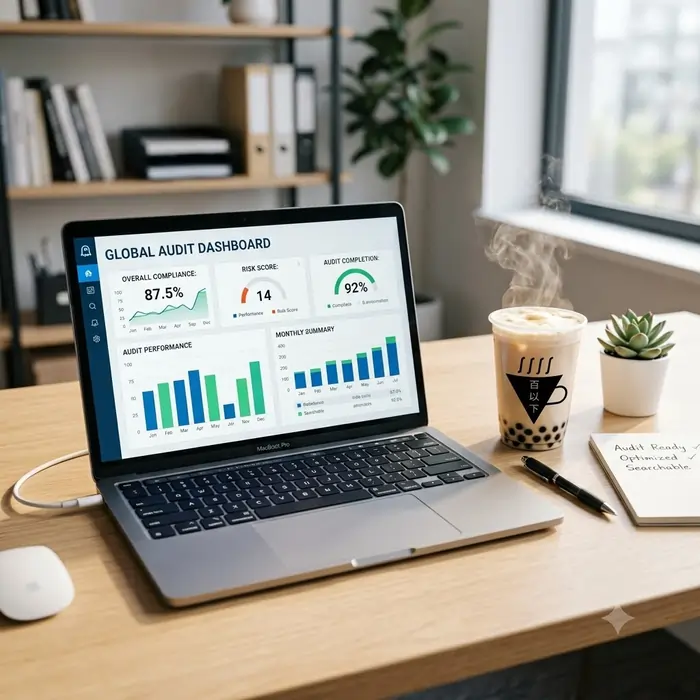
So one afternoon I opened my laptop and ran a full, unapologetically honest local SEO audit on a milk tea shop that had been open exactly three weeks—and didn’t even show up when you typed its exact name into Google.
I called it the Below100 Cafe SEO audit before ranking.
Because you can’t draw a map if you don’t know your starting point.
What I found wasn’t weird or unusual. I’ve seen it dozens of times with brand‑new small businesses. But it was stark. This is the raw, pre‑optimization reality of a cafe that was completely invisible on Google. If you’re a business owner wondering why people walk past your door, or a freelancer trying to learn how to diagnose a local SEO mess, this is what “invisible” actually looks like.
Later on, we’d tell the full transformation story in our case study about how we landed an SEO client to rank “best milk tea in Monkayo,” but today I want to focus on the audit itself—the starting line nobody likes to talk about.
Overview:
- Business: Below100 Cafe, a milk tea shop in Monkayo, Davao de Oro, Philippines—three weeks old, run by two cousins, zero customers.
- Online Presence: Only a Facebook page and an unclaimed Google Maps listing .
- Pre‑Audit Status: Completely invisible for local searches like “best milk tea in Monkayo,” not in the map pack, no reviews, no website, no citations, no structured content.
- Audit Findings: Critical gaps in Google Business Profile, Facebook page optimization, NAP consistency, keyword targeting, and review generation.
- Audit Toolset: Manual checks, Google Search Console (not yet set up), Google Maps, Facebook Page inspection, and directory lookups.
- Purpose of Audit: To build a roadmap that would eventually turn Below100 Cafe into a business recommended by both Google and AI search engines. Our team at Adscrew PH uses this exact framework for every local client.
First, Let’s Talk About the Google Business Profile (or Lack of One)
The very first thing I check in any audit is whether the business has claimed its Google Business Profile.
When I pulled up Below100 Cafe, there was a listing—barely. It existed, but nobody had verified or claimed it. The name was there, sure. But the address was vague. No phone number. No website link. Not even a category selected.
I was staring at a digital ghost.
A Google Business Profile audit is step zero. Without a verified GBP, you don’t appear in the map pack—that row of three businesses that shows up above the organic results when someone searches “cafe near Monkayo high school” or “milk tea near me.”
Below100 was completely missing from the Google map pack.
When I typed “best milk tea in Monkayo,” competitors with fully optimized profiles grabbed the top three spots. Below100 didn’t even make the “More places” list. That’s a silent killer. Most customers don’t scroll any further. They tap one of those three and walk right past the cousins’ shop.
The category field was empty—it should’ve been “Milk Tea Shop.” The services section was blank. No attributes for dine‑in, takeout, or delivery. The Q&A section didn’t exist. Not a single post or photo had been uploaded by the business. Zero reviews. Not even a one‑star from a confused passerby.
This is what I call a Google Business Profile not ranking issue. The profile was technically there, but it had zero signals telling Google, “Show this to people.”
If you’ve ever wondered how to do a Google Maps visibility audit, start with exactly these questions: is the profile claimed and verified? Are all fields filled? Is the category correct? Are there photos, reviews, posts? Below100 failed every single one.
The Facebook Page—Good Heart, But Not Optimized
Below100’s Facebook page was their only online home, and it had a spark. The description read:
🧋 Below100 — Home of the best milk tea in Monkayo! Refreshing drinks, affordable prices, and your favorite flavors. Available for dine‑in and milk tea delivery in Monkayo. 🤎
Honestly, that description is better than what most small businesses write.
It naturally includes keywords like “best milk tea in Monkayo,” “affordable prices,” and “milk tea delivery in Monkayo.” So I’m not saying they had nothing. But an unoptimized Facebook page audit revealed a pile of missed chances.
The page had only a few photo albums, all with generic names—“Mobile uploads,” “Timeline photos.” None included location keywords or drink names. The Services tab was completely empty. No “Student Bundles.” No “Office Group Orders.” Nothing that told customers or Google what they actually offered beyond the pinned menu.
The About section, beyond that great intro, didn’t clearly mention the city (“Monkayo, Davao de Oro”) in the longer description. It also didn’t mention their proximity to the high school or the nearby offices—two massive audiences sitting right outside the door. The page’s username and contact info were correct, but they hadn’t been leveraged for search at all.
When you ask how to audit a Facebook page for local SEO, the rule is simple: treat every field like a mini‑webpage. Does the About section answer who you are, where you are, what you sell, and why someone should visit? Are all service options listed and described with local terms? Are photo albums named with keywords? Are you posting regularly?
At the time of our audit, the answer to most of these was no.
Citations, NAP, and Directory Listings—The Invisible Web
One of the least glamorous but most important parts of a local SEO audit is checking NAP consistency—Name, Address, Phone number—across the internet.
A local citation audit looks at how your business appears on directories, social platforms, maps, and anywhere else customers might look.
For Below100, the answer was brutally simple: they didn’t appear anywhere.
I did a quick citation audit using manual searches and found exactly zero directory listings. No mention on local food blogs. No listing on Google Maps beyond the unclaimed profile. No presence in Facebook groups. No entry on free local business directories.
This is what missing from local search results looks like at the citation level. Google and AI models both hunt for consistency—they want to see the same business name, address, and phone number repeated across multiple trusted sources. Below100 had none of that.
When a business has zero citations, search engines don’t just see low authority—they see a risk. Without third‑party confirmation, the business might as well not exist. That’s why even a handful of consistent directory entries can make a difference. But at audit time, Below100’s digital footprints were practically non‑existent.

No Website, No Content, No Keywords
One of the first questions I hear from small business owners is, “Why is my milk tea shop not showing up on Google?”
Often they assume it’s because they don’t have a website. And while a website definitely helps, it’s not the whole answer. But it was absolutely part of Below100’s problem.
A traditional on‑page SEO audit for a cafe would examine title tags, meta descriptions, header structure, and content relevance. But Below100 had no website. So there was no on‑page SEO to audit. No blog. No menu page. No “About Us” story. No location page targeting “best milk tea in Monkayo.”
That meant for any search query that wasn’t purely a map result, they couldn’t compete. There was nothing for Google to crawl, no content to index, no keywords to match. They were truly at zero organic traffic.
We ran a keyword gap analysis by looking at the phrases their competitors were ranking for— “Monkayo milk tea shop,” “milk tea flavors Monkayo,” “cheap milk tea in Monkayo,” “student budget milk tea,” “office break milk tea delivery.” Below100 wasn’t targeting any of them because there was no content to target with.
They were stuck in a loop: no content, no visibility, no customers, no urgency to create content.
If you’re asking how to check if a business is indexed on Google, a quick site: search would’ve shown nothing for a website they didn’t have. The Facebook page was indexed, but without proper structure and keyword integration, it wasn’t enough to pull them into the search results for any competitive local term.
Reviews—The Ghost Town
I’ve touched on reviews already, but they deserve their own section because they’re one of the top three local ranking factors.
At the time of our audit, Below100 Cafe had zero Google reviews. Not one. They also had very few Facebook recommendations. This meant that even if they had appeared in search results, customers would see a blank slate with no social proof at all.
A no Google reviews audit is a huge red flag. Google wants to recommend businesses people trust. Reviews, especially recent ones with relevant keywords like “best brown sugar milk tea” or “affordable student drinks,” act as powerful ranking signals. Without them, Below100 was fighting with one hand tied behind its back.
The cousins told me, “We don’t have customers yet, so how can we get reviews?” Fair question. But the audit showed they also had no system in place to collect reviews when customers did come. No QR codes on tables. No gentle ask after a sale. No follow‑up message.
The small cafe SEO mistakes here were easy to fix once spotted, but at the time, they were invisible barriers.
Technical Issues and Missing Structured Data
Even without a website, a technical SEO issues for small business audit looks at things like Google Search Console setup, structured data, and indexation.
Below100 hadn’t set up Search Console—again, no website. But they also hadn’t taken advantage of the schema markup available through Google Business Profile, like menu items, opening hours, and location data—all of which feed into AI‑generated overviews.
There was no Google Search Console audit to run. No sitemap. No robots.txt. No HTML improvements to analyze. And while that sounds like “no problems,” it really meant “no foundation.”
The business was invisible not just because of what was wrong, but because of what was missing entirely.
Questions
What was the state of Below100 Cafe’s online presence before SEO?
Before Adscrew PH stepped in, Below100 Cafe had an unclaimed Google Business Profile, a weakly optimized Facebook page , zero citations, no website, no reviews, and no keyword targeting. They were completely invisible for searches like “best milk tea in Monkayo.” This Below100 Cafe SEO audit before ranking details every gap.
Why was Below100 Cafe not appearing on Google Maps?
The cafe’s GBP was unverified, lacked a category, had no photos or posts, and collected zero reviews. These are all critical ranking signals for the map pack, and their absence kept them out of local results.
How do you do a local SEO audit for a business without a website?
You zero in on the Google Business Profile, Facebook page, citation consistency, and review presence. Check if the GBP is claimed and completely filled out, examine the Facebook page for keyword use and service details, audit NAP across the web, and measure review volume and sentiment. This framework works even when there’s no site to crawl.
What’s the first step in auditing a new cafe’s SEO?
Always start with the Google Business Profile. Verify it’s claimed, check the category, fill every field, add photos, and look for reviews. Without a solid GBP, no local SEO effort will gain real traction.
Key Takeaways
- An honest audit is the most valuable first step you can take. Before you optimize anything, you have to know what’s actually broken. Below100’s audit uncovered a ghost profile, a half‑filled Facebook page, no citations, no reviews, and zero keyword content.
- Your Google Business Profile can make or break your visibility. An unverified, empty GBP is as bad as having none. Fill it, claim it, post on it.
- Consistency builds trust with machines. NAP consistency across the web and structured data are what tell Google and AI models that your business is real.
- Without a website, your Facebook page and GBP must work overtime. Every field, every photo album name, every service listing matters more than you think.
- Don’t wait for customers to leave reviews—build a system to ask for them. Reviews are a ranking signal, social proof, and now AI training data.
The audit of Below100 Cafe wasn’t a fun conversation for the cousins. It’s hard to hear that the business you poured your heart into doesn’t exist on Google. But that honest look was the foundation of everything that followed: the optimizations, the content, the citations, the review strategy, and eventually, the AI visibility we later documented.
Before you can rank #1 for “best milk tea in Monkayo,” you have to understand exactly why you’re at zero. An audit doesn’t judge—it just shines a light. And once you see the gaps, you can finally start filling them.
If your own business feels invisible, run the same checks I ran. Or if you’d rather have a team do it for you, Adscrew PH starts every client relationship with exactly this kind of audit. We dig into your GBP, your Facebook, your citations, and your content, then hand you a roadmap. And if you’re curious how Below100’s story turned out, read the full journey in our review of the best milk tea in Monkayo or dive into the original SEO client case study .
Now, stop guessing and start auditing. Your business deserves to be seen.