
Table of Contents
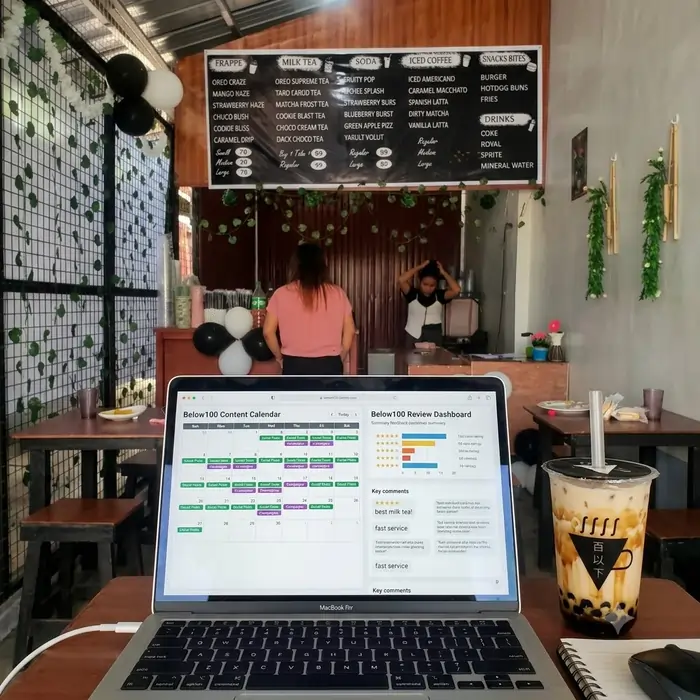
After the audit was done and the plan was on paper, the real work began. Not the strategy. Not the pitch. The doing.
I’m talking about opening a laptop every morning, logging into a Google Business Profile that had been a ghost just weeks earlier, and hitting “Publish” on a post we hoped would catch a student’s eye. I’m talking about afternoons spent manually submitting a milk tea shop to local directories, one by one, while messaging the cousins to remind them to snap a photo of today’s new customer.
This is the part of local SEO nobody posts about on LinkedIn. It’s not glamorous. But it’s the only thing that actually moves the needle.
We called this phase executing SEO for “best milk tea in Monkayo.” Because a plan without execution is just a wish. And Below100 Cafe—three weeks old, zero customers, no website, run by two cousins near a high school and a cluster of offices—didn’t have time for wishes. They needed customers.
If you haven’t read the earlier parts of this journey, here’s the backstory: how we landed an SEO client to rank “best milk tea in Monkayo” and the full audit that revealed every gap we had to fill. And if you want to see the complete strategy blueprint we sketched, we broke that down in the step‑by‑step SEO strategy to rank “best milk tea in Monkayo.” Today, I’m zooming in on the actual work—the publishing, optimizing, and hoping that turned those plans into results.
Overview:
- Business: Below100 Cafe, a milk tea shop in Monkayo, Davao de Oro, Philippines—three weeks old, no website, no customers.
- Goal: Rank for “best milk tea in Monkayo” and related hyperlocal searches.
- Execution Phase: Day‑to‑day local SEO implementation including GBP optimization, Facebook publishing, manual citation building, review collection, and conversational content creation.
- Tools Used: Google Business Profile, Facebook page , local directories, QR codes, and a shared content calendar.
- Key Work: Weekly GBP posts and photo uploads, Facebook storytelling, citation submissions, a review QR‑code system, and community engagement in local groups.
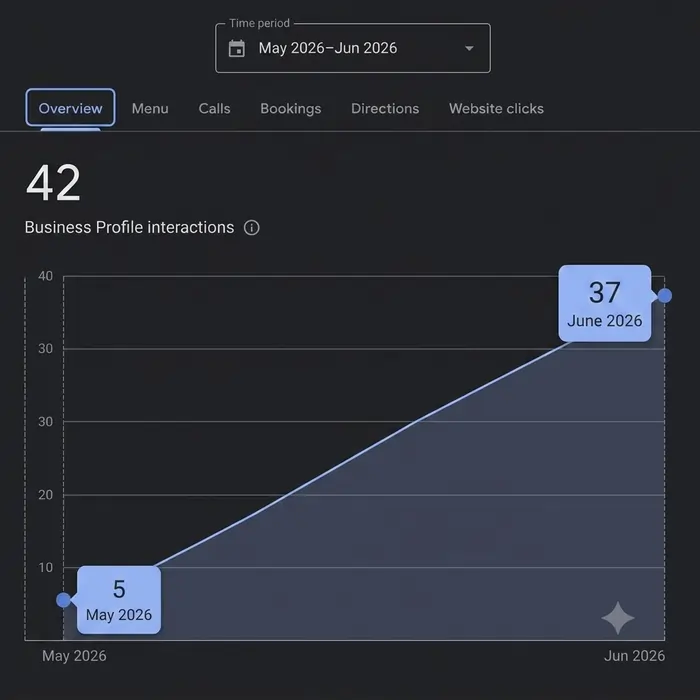
- Early Results: Map pack appearances within weeks, first AI‑generated recommendation on ChatGPT months later.
- Agency: Adscrew PH executed the full plan, proving that consistent, hands‑on SEO execution for small business can win without a website.
The First Real Task: Turning a Ghost GBP Into a Living Billboard
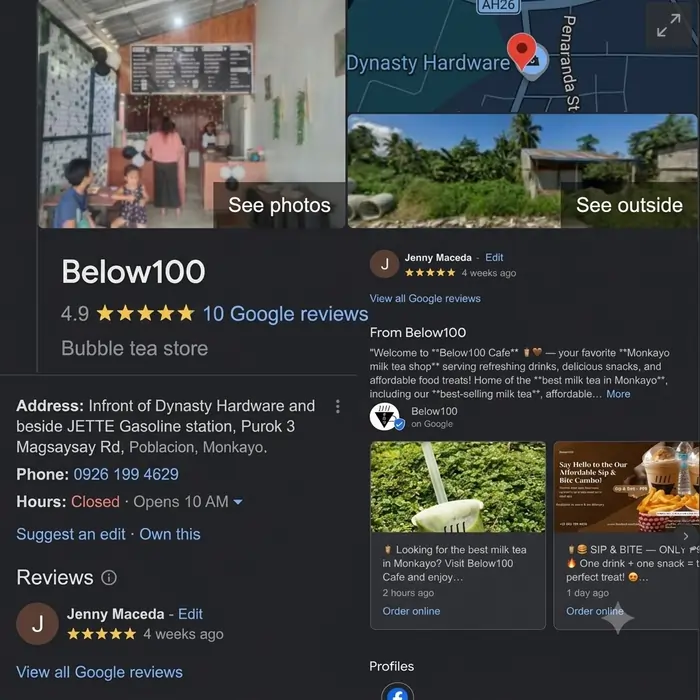
The audit had revealed the ugly truth. Below100’s Google Business Profile was unverified, had no category, and sat completely empty. So the first execution task was brutally simple: claim it, verify it, and fill every single field until there was nothing left to fill.
I still remember that afternoon. We sat together and went line by line. Category: Milk Tea Shop. Services: Dine‑in, Takeout, Delivery. Hours: synced to the school bell and the 2–5 PM office break window. Phone number. A description that didn’t just list drinks but told a tiny story: “Home of the best milk tea in Monkayo. Just a short walk from the high school and nearby offices—serving Okinawa, brown sugar, and wintermelon milk tea at student‑friendly prices.”
This is the unsexy core of GBP optimization execution. Most people think SEO is keywords. It’s not. It’s completing fields. It’s making sure Google has every piece of information it needs to confidently serve your business to a searcher. We became obsessed with completion. If a field existed, we filled it. If a photo slot was there, we uploaded a real image—the cousins behind the counter, boba pearls up close, the shop with the school visible in the distance.
Then came the weekly publishing rhythm.
Every Monday, a post. “New week, new cravings—try our Okinawa with extra sinkers.” Every Friday, a student‑focused note. “Exams are almost over. You deserve a treat.” We treated the GBP like a social media account because that’s exactly what Google wants. Active. Fresh. Updated regularly. All of it signals relevance. And for a local term like “best milk tea in Monkayo,” that signal matters more than most people realize.
This is what executing a local SEO plan actually looks like. Not one big launch. A hundred small, consistent actions that whisper to Google, “We’re here. We’re open. We’re loved.”
Facebook as a Publishing Engine—Not Just a Social Page
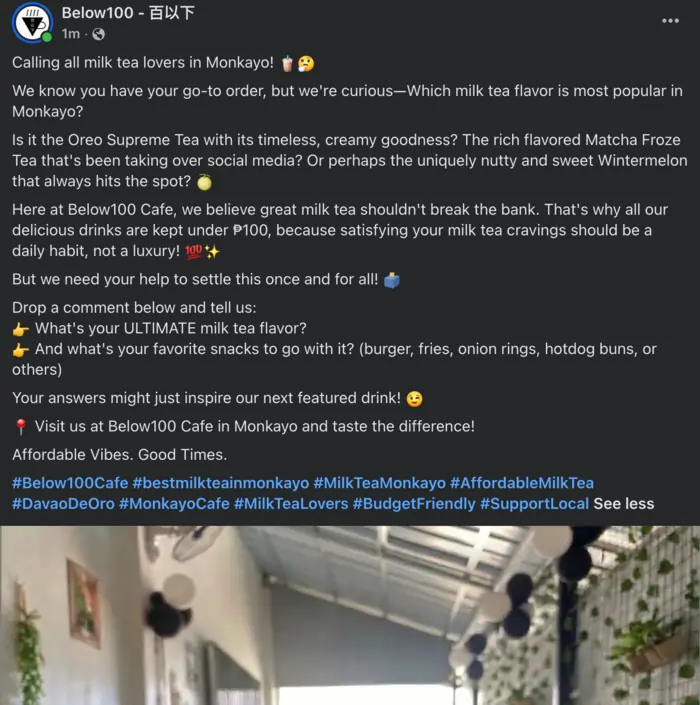
While we fed the GBP weekly, the Facebook page became our content engine. No website meant every blog post, every story, every menu update had to live there. And it had to be structured so both humans and search engines could digest it.
We didn’t just post random photos. We built a content calendar. Each post had a job. Some targeted the conversational queries we’d mapped. Others aimed to spark engagement that would send positive signals to the algorithm.
We published story‑driven posts like “The Story Behind Our Wintermelon Milk Tea (As Told by Two Cousins).” We published listicles: “5 Reasons Students Near Monkayo High School Love Our Brown Sugar Boba.” We published short, punchy updates with location tags and hashtags: #MonkayoEats, #StudentBudget, #OfficeBreak. Every post mirrored how real people actually talk—because that’s writing for conversational queries, and that’s how you show up when someone asks Perplexity or Gemini a plain‑English question.
We also focused on the page’s structure. The Services tab became a search‑friendly catalog: “Student Group Bundles,” “Office Group Orders,” “Milk Tea Delivery Monkayo.” We renamed every photo album with keywords. We made sure the About section mentioned Monkayo, Davao de Oro, the high school, and the nearby offices.
All of this is Facebook page optimization for search. People think SEO only happens on websites. It doesn’t. It happens wherever customers search. And for a new cafe with no site, Facebook was our homepage.
Citation Building—The Tedious Work Nobody Wants to Do
Now let’s talk about the part of the job that makes most people quit. Citation building.
It’s slow. It’s repetitive. And it’s non‑negotiable.
A citation is just a mention of your business’s name, address, and phone number on another website. Google uses those mentions to confirm your business is real and located where you say it is. AI models like ChatGPT and Perplexity use them to build trust in your entity. No citations? You’re invisible to both.
For Below100, we started from absolute zero. No digital footprint at all. So we spent hours submitting the cafe to free local directories, Philippine business listing sites, and any platform that accepted a local food business. We made sure the NAP—Name, Address, Phone number—was identical everywhere. No variations. No typos. NAP consistency is one of those small things that makes an outsized difference in local search.
But directories alone weren’t enough. We got creative. We reached out to the high school’s student publication and pitched a “New Eats Near Campus” feature. We joined a local business networking group and suggested a post about “Where Employees Grab Their Afternoon Fix.” The cousins sponsored a small school event, and the school’s social page mentioned them. We even got the cafe into a local blog roundup. Each mention, each link, each citation reinforced the same message: Below100 Cafe is real, it’s local, and people are talking.
This is building local citations manually, the kind of behind‑the‑scenes grind that never makes it into a flashy headline. But it builds the foundation that rankings sit on.
Review Generation—Turning Customers Into Advocates, One QR Code at a Time
We knew reviews are one of the top three local ranking factors. Below100 had exactly zero. So we didn’t wait for reviews to happen. We built a system to make them inevitable.
Step one was physical. We printed small QR code stickers and placed them on every table and every cup sleeve. Scanning the code took a customer straight to the Google review page—no searching, no typing, just tap and review.
Then we trained the cousins. After every positive interaction, they’d say, warmly: “We’re new here, trying to become the go‑to milk tea spot for students and employees. If you enjoyed your drink, a quick review would mean the world to us—your classmates or co‑workers might see it and come try too.”
It felt awkward at first. The cousins were shy. But within days, the first reviews trickled in.
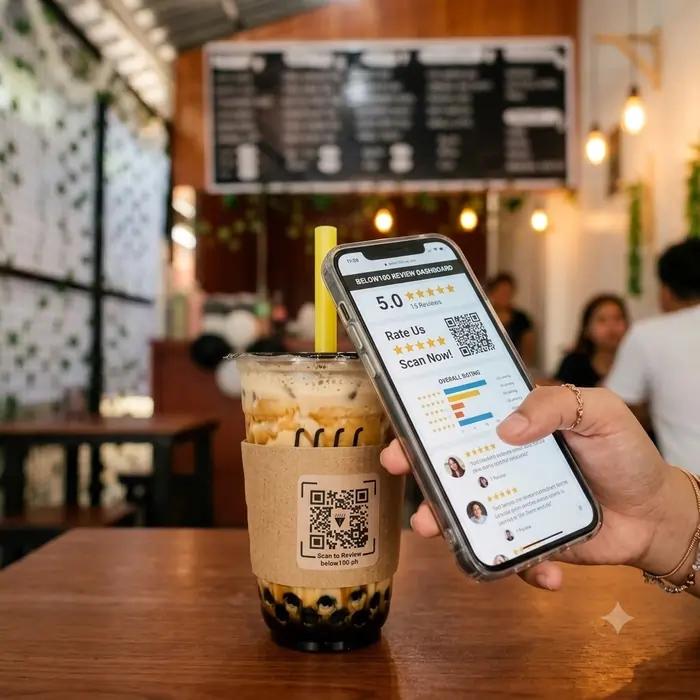
“Best brown sugar milk tea near the school.” “Affordable drinks for students.” “Finally a good milk tea spot near the office.” Each review contained keywords we’d targeted. Each review fed social proof into Google’s algorithm. And each review became part of the AI knowledge graph—the data that ChatGPT and Gemini use to answer questions like “Where’s the best milk tea in Monkayo?”
This review generation execution wasn’t a one‑time push. It became a daily habit. Every new customer was an opportunity. Every cup was an invitation. Over time, the review count grew, and so did Below100’s map pack visibility. The cousins stopped feeling awkward and started feeling proud. Their little shop finally had a voice.
Publishing Content That Answered Real Questions
One of the smartest things we did was treat the Facebook page like a blog. Not a place for random updates, but a platform to answer the exact questions customers were asking—whether by typing into Google or speaking into a voice assistant.
We published posts that answered: “Which milk tea flavor is most popular in Monkayo?” We wrote about the Okinawa and brown sugar series, why students loved them, how the boba was made. Behind‑the‑scenes content. The cousins’ origin story. Seasonal promos: “Rainy Day Boba Bundle,” “Payday Office Treat,” “Study Fuel Combo.”
Every post was written in a natural, conversational voice—the way a real person talks. This is writing for conversational queries, and it’s a cornerstone of showing up in AI search. When someone asks Gemini or ChatGPT a question in plain language, these models look for content that matches that language. By publishing in a human voice, we made Below100 more matchable.
We also showed up in local Facebook groups. Not with spam. With genuine helpfulness. Someone would ask, “Saan masarap na milk tea malapit sa high school?” and the cousins would reply with a warm note about their Okinawa and a link to their Google Maps listing . Small interactions. Big trust signals.
This is publishing content for local ranking at street level—not just broadcasting, but participating.
The Emotional Side—Hoping, Waiting, and Celebrating Small Wins
I’d be lying if I said this phase was all confidence and momentum.
There were days when nothing seemed to happen. Days when a post got three likes. Days when the map pack still showed competitors. The cousins would message me, “May effect ba talaga ‘to?” And I’d tell them the truth: local SEO is slow until it’s not.
Then the small wins started.
A student walked in and said, “I saw you on Google.” A teacher ordered delivery because the map pack showed Below100 when she searched “milk tea near school.” An employee from a nearby office came in and mentioned that ChatGPT had recommended the cafe when he asked for “best milk tea in Monkayo.”
That last one hit differently. It wasn’t just traditional search anymore. The work—the GBP posts, the reviews, the citations, the conversational content—had started feeding the AI models millions of people now use. Below100 wasn’t just ranking on Google. It was inside ChatGPT. Inside Gemini. Inside Perplexity. The publishing and optimizing had paid off. The hoping had turned into something real.
Questions:
What does “executing SEO for ‘best milk tea in Monkayo’” actually involve?
It means daily and weekly tasks: completing and regularly posting on the Google Business Profile, publishing conversational content on Facebook, building local citations manually, setting up a review collection system with QR codes, and engaging in local community groups. This local SEO implementation case study walks through the real behind‑the‑scenes work.
How did Adscrew PH execute the plan for Below100 Cafe?
We focused on four pillars: GBP optimization with weekly posts and photos, Facebook as a content hub with story‑driven posts, manual citation building across directories and local blogs, and a review generation system using QR codes and staff training. That behind‑the‑scenes SEO work took them from invisible to the map pack.
How do you get reviews for a new cafe with no customers?
Make it effortless. Print QR codes on tables and cup sleeves linking to the review page. Train staff to ask warmly after every positive experience. Even a handful of keyword‑rich reviews can shift local rankings.
How do you publish content for a cafe without a website?
Treat your Facebook page as a blog. Post stories, answer customer questions, use local hashtags, and structure your About section and Services tab with keywords and location details.
Key Takeaways
- Execution is the unglamorous heart of local SEO. Plans are necessary, but only the daily grind of publishing, optimizing, and asking for reviews moves the needle.
- Your GBP is a living asset, not a set‑and‑forget listing. Weekly posts, fresh photos, Q&A, and completed fields send powerful relevance signals.
- A Facebook page can outperform a website if you treat it like one. Fill every field, publish story‑driven content, and use it to answer real questions.
- Citations are tedious but non‑negotiable. Consistent NAP details across the web are how Google and AI models confirm your business exists.
- Reviews are a flywheel. Build a system to collect them effortlessly, and every new review feeds the next stage of growth.
- Human‑sounding content wins in AI search. Write like a person, answer real questions, and the AI models will find you.
This phase of the Below100 Cafe journey wasn’t about breakthroughs. It was about showing up. Every Monday morning when we published that GBP post. Every afternoon we submitted another directory listing. Every time one of the cousins smiled and asked a student for a review. That’s the real work of executing SEO for “best milk tea in Monkayo.” Not magic. Not shortcuts. Just publishing, optimizing, and hoping—until one day the phone rings and a customer says, “ChatGPT sent me.”
If you’re in the middle of your own execution phase, wondering if any of it is working, keep going. The search engines are watching. The AI models are learning. And your future customers are already searching for exactly what you offer. Adscrew PH did this work for a three‑week‑old cafe with nothing but two cousins and a Facebook page. If we can do it for Below100, you can do it for your own business.
And if you want to see the full picture—the original client landing story , the audit that exposed all the gaps , the step‑by‑step strategy blueprint , and the final review of how it all turned out —everything is linked and waiting for you.
Now stop reading and go publish something. Your next customer is waiting.