
Table of Contents
I remember sitting across from the cousins, their Okinawa milk tea sweating onto the table, and feeling the weight of their question hang in the air. “So what’s the actual plan?” one of them asked. “Not the pitch. Not the hope. The steps. How do we go from invisible to the top of Google when we have no website, no reviews, and no customers yet?”
It was a fair question. And honestly, it’s the same one I’d ask if I were in their shoes.
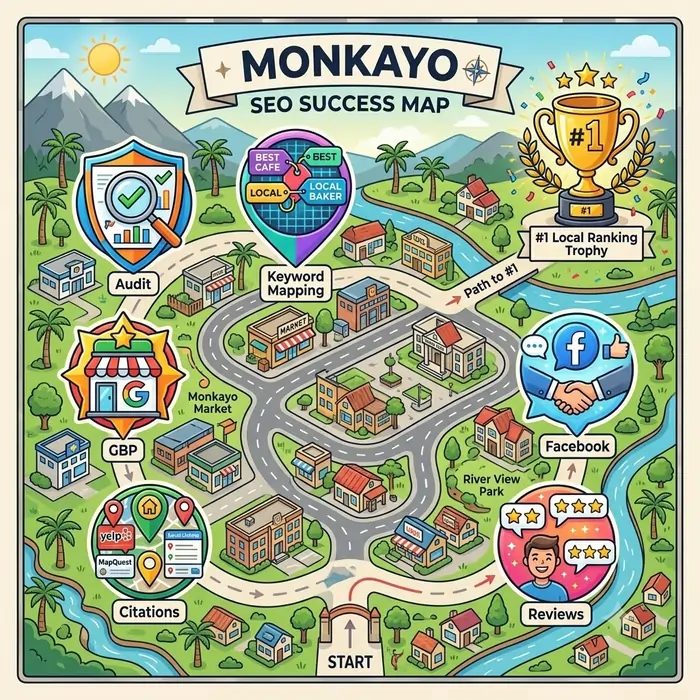
So I didn’t give them fluff. I pulled out a notebook and sketched a roadmap that we would later call our SEO strategy to rank “best milk tea in Monkayo.” Not a theory. Not a template from a YouTube video. A custom‑fit, six‑step plan built for a three‑week‑old milk tea shop with two cousins, a Facebook page, and a storefront near a high school and a cluster of small offices.
This article is the plan itself—the exact steps, the reasoning behind each one, and the real‑world tweaks we made along the way. We’d already told the story of how we landed an SEO client to rank “best milk tea in Monkayo,” and we later published the full Below100 Cafe SEO audit before ranking that uncovered all the gaps. But today, I’m focusing purely on the action plan. If you’re a business owner trying to get your cafe noticed, or a freelancer building your first local SEO proposal, you can steal every single piece of this.
Overview:
- Business: Below100 Cafe, a milk tea shop in Monkayo, Davao de Oro, Philippines—three weeks old, no customers, no website.
- Goal: Rank #1 for “best milk tea in Monkayo” and related local searches.
- Strategy: A six‑step hyperlocal SEO plan covering audit, keyword research, Google Business Profile domination, Facebook page optimization, citation building, review generation, and content marketing targeting both students and nearby employees.
- Key Tactics: Conversational keyword mapping, GBP category and service optimization, Facebook page as a mini‑website, local directory citations, a QR‑code‑powered review system, and story‑driven social content.
- Timeline: Visible progress in the map pack within weeks; sustained organic ranking built over months.
- Agency: Adscrew PH designed and implemented the plan, proving that a step‑by‑step local SEO plan for a cafe can win even without a website.
Step 1: The Audit—You Can’t Fix What You Don’t Measure
Before we did anything, we had to know exactly why Below100 Cafe was invisible. So we ran a full local SEO audit—a health check that looked at every signal Google uses to rank a business locally. (We later turned that audit into a standalone piece: Below100 Cafe SEO audit before ranking , if you want to see every gory detail.)
The Google Business Profile was the first shock. The listing existed, but it wasn’t verified or claimed by the cousins. No phone number, no category, no services listed, no photos.
When you typed “best milk tea in Monkayo,” the map pack showed three competitors with complete profiles. Below100 wasn’t just not in the top three; it wasn’t even in the “more places” list. That’s a GBP ranking disaster.
Then we turned to their Facebook page . The description was charming and keyword‑rich—“Home of the best milk tea in Monkayo”—but the rest of the page was bare. No Services tab, generic photo album names, no location‑specific details in the long description.
Their digital footprint was almost non‑existent. No directory listings. No local blog mentions. No citations at all. A local citation audit turned up exactly zero third‑party references.
And with no website, there were no title tags, no meta descriptions, no on‑page content to target any keywords. They were starting from absolute zero—a zero organic traffic situation.
That audit wasn’t meant to be discouraging. It was the foundation. Without it, we’d be guessing. With it, we had a clear to‑do list.
If you’re asking yourself, “What’s the first step in a local SEO strategy for a cafe?” —it’s this. You audit everything, no matter how brutal the results look.
Step 2: Hyperlocal Keyword Research—Thinking Like a Student and an Employee
With the audit done, we moved to the spine of the entire plan: local keyword research for a cafe. Most people guess at keywords. We mapped them.
We started with the obvious one: “best milk tea in Monkayo.” But we didn’t stop there.
We thought about the two audiences who literally walked past Below100 every day: students from the high school and employees from the small offices nearby. So we built two keyword clusters.
For students: “milk tea near Monkayo high school,” “student budget milk tea Monkayo,” “after school milk tea spot,” “cheap milk tea in Monkayo,” and even “best snack bites for studying.”
For employees: “milk tea near offices Monkayo,” “afternoon milk tea delivery Monkayo,” “office break milk tea,” and “milk tea for working people.”
We also targeted broader local terms: “Monkayo milk tea shop,” “milk tea flavors Monkayo,” “wintermelon milk tea Davao de Oro,” “affordable milk tea Monkayo,” and “best‑selling milk tea Below100 Cafe.”
This keyword gap analysis showed us exactly what phrases our competitors were already ranking for and where Below100 could slide in. The beauty of this approach? Google doesn’t look at one keyword in isolation. It sees the whole cluster. When your Facebook page and Google profile naturally talk about Okinawa milk tea, student budgets, and office delivery, Google starts to trust that you’re the real deal.
If you’re wondering “What keywords should a milk tea shop target?” — the answer is a web of intent phrases, not a single term.
Step 3: Google Business Profile Domination—Your 24/7 Billboard
With our keywords in hand, the first platform we tackled was the Google Business Profile. I told the cousins, “This is your most valuable piece of online real estate right now. Forget a website. A fully optimized GBP will put you in front of more customers than a homepage ever could.”
We claimed and verified the profile. Then we filled every single field. Category set to “Milk Tea Shop.” Services added (Dine‑in, Takeout, Delivery). Hours aligned with after‑school and office break windows. A business description that naturally wove in our top phrases like “best milk tea in Monkayo,” “near the high school,” and “close to local offices.”
This is the core of any GBP optimization checklist.
We uploaded real photos—the shop front with the school visible in the background, the cousins behind the counter, the drinks being made. We started posting weekly updates: “Good luck on exams, students!” and “Mid‑afternoon slump? We deliver to your office.” We added Q&A items like “What’s the best milk tea near the high school?” and answered them with natural, helpful language.
Why does this matter so much? Because the map pack ranking strategy for a local term like “best milk tea in Monkayo” starts and often ends with the GBP. Google wants to show users nearby businesses that are active, verified, and rich with information. We gave them exactly that.
If you’ve ever asked, “How to get a new cafe to appear in the Google map pack?” —this is the answer. Complete the profile, make it active, and feed it consistently.
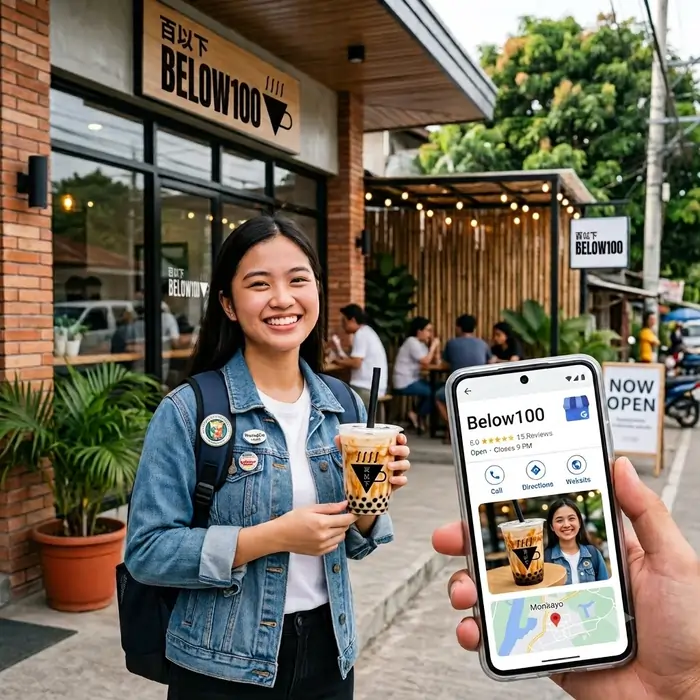
Step 4: Facebook Page Optimization—Turning a Social Page Into a Mini‑Website
Below100 Cafe didn’t have a website, but they did have a Facebook page with a personality. Our job was to turn that page into a search‑friendly hub.
We kept their description—it was already gold: “🧋 Below100 — Home of the best milk tea in Monkayo! Refreshing drinks, affordable prices, and your favorite flavors. Available for dine-in and milk tea delivery in Monkayo. 🤎” —and built around it.
In the longer About section, we added “Monkayo, Davao de Oro” and mentioned the proximity to the high school and offices. We activated the Services tab and listed “Student Group Bundles,” “Office Group Orders,” “Milk Tea Delivery Monkayo,” each with a short description that included relevant keywords.
We renamed all photo albums from generic “Timeline Photos” to “Below100 Cafe – Monkayo Milk Tea Flavors,” “Student Favorites,” “Office Workers’ Top Picks.”
We pinned a menu post that detailed every drink, weaving in terms like “authentic milk tea shop PH,” “student budget boba,” and “office break milk tea.” And we created a content calendar of posts—story‑driven, not salesy. “The Story Behind Our Wintermelon Milk Tea (As Told by Two Cousins).” “5 Reasons Students Love Our Brown Sugar Boba.”
All of this is Facebook page SEO for cafe—treating every field as a signal to Google and, later, to AI models. The page’s structure, keyword‑rich descriptions, and regular activity told search engines exactly who Below100 was and where they were.
This is the core of a no‑website SEO strategy. When you don’t have a site, your Facebook page has to work overtime. And Below100’s started doing just that.
Step 5: Citations, Backlinks, and the Art of Getting Mentioned
Even the best‑optimized GBP and Facebook page need third‑party validation. That’s where citations and mentions come in. A citation building for local business strategy is essentially getting your business listed on directories, local blogs, and community pages so that Google sees your name, address, and phone number repeated across the web.
For Below100, we started from scratch. We listed them on every free local directory we could find—Google Maps, of course, plus local Philippine business directories and community pages. We ensured NAP consistency (Name, Address, Phone number) was identical everywhere.
Then we got creative. We reached out to the high school’s student publication and pitched a “New Eats Near Campus” feature. We contacted a local business networking group and suggested a post about “Where Employees Grab Their Afternoon Fix.” The cousins sponsored a small school event, and the school’s social page mentioned them. Each mention, even without a traditional backlink, pointed to the Facebook page or the Google Maps listing .
These are local citations for a Davao de Oro business and they serve a dual purpose. For Google, they reinforce the business’s existence and relevance. For AI models like ChatGPT and Gemini, they create the digital footprints that signal a real, trusted entity. So when someone asks an AI, “Where’s the best milk tea in Monkayo?” the model finds multiple consistent references to Below100 Cafe and surfaces it confidently.
Step 6: Review Generation and Content—Fueling the Flywheel
The final piece of the plan tackled two things that feed each other: reviews and ongoing content.
We knew Below100 had zero customers, so we designed a review generation strategy that would activate the moment the first student walked in. We printed small QR codes on tables and cup sleeves linking directly to the Google review page. We coached the cousins to say, warmly, after every order: “We’re new here, trying to become the go‑to milk tea spot for students and employees. If you enjoyed your drink, a quick review would mean the world to us—your classmates or co‑workers might see it and come try too.”
Why obsess over reviews? Because they’re one of the top local ranking factors. Fresh, keyword‑rich reviews (“best brown sugar milk tea near the school,” “affordable milk tea for students”) boost your GBP ranking and feed social proof. They also become part of the AI knowledge graph, helping AI search engines understand what people love about Below100.
On the content side, we made sure the Facebook page stayed alive. Posts that celebrated customer wins, behind‑the‑scenes videos of drinks being made, seasonal promos like “Rainy Day Boba Bundle” and “Payday Office Treat.” Each post targeted conversational queries—the exact language students and employees use when they talk to voice assistants or chatbots.
We also joined local Facebook groups. Not to spam, but to be genuinely helpful. When someone asked, “Saan masarap na milk tea malapit sa high school?” the cousins would reply with a friendly note about their Okinawa milk tea and a link to their Google Maps listing . These small interactions built community trust and sent positive engagement signals to search engines.
Questions:
What is the SEO strategy to rank “best milk tea in Monkayo”?
The strategy involves a full local SEO audit, hyperlocal keyword research targeting students and employees, Google Business Profile domination, Facebook page optimization, local citation building, and a review generation system. This exact SEO strategy to rank “best milk tea in Monkayo” was built for Below100 Cafe by Adscrew PH .
How do you create a step‑by‑step SEO plan for a new cafe with no website?
Start with an audit of the Google Business Profile and Facebook page. Build a keyword map based on local audiences. Fully optimize the GBP and treat the Facebook page as a mini‑website. Generate consistent local citations, and implement a review collection system from day one.
How to do local SEO for a milk tea shop near a school?
Target keywords like “milk tea near Monkayo high school” and “student budget milk tea.” Optimize your GBP with after‑school hours, add Q&A about student favorites, and create content that speaks to student life. Engage with local school groups and event pages for mentions.
What’s the best content strategy for a local cafe without a website?
Use your Facebook page as a blog. Tell stories about your drinks, share customer photos, and write posts that answer real questions like “Which milk tea flavor is most popular in Monkayo?” Use local hashtags and always tag your location.
Key Takeaways
- Audit before you act. You can’t build an effective plan until you know exactly why a business is invisible. Below100’s audit revealed a ghost GBP, empty citations, and zero reviews. (See the full Below100 Cafe SEO audit before ranking .)
- Your Google Business Profile is your homepage. Fill every field, post weekly, and treat it as a living, breathing asset.
- Facebook can be a full‑fledged SEO tool. Optimize the About section, Services tab, photo albums, and pins with keywords and location details.
- Citations create trust with both Google and AI models. Consistent NAP details across directories, local blogs, and community pages build the digital footprint AI search engines rely on.
- Reviews are a flywheel. Make leaving a review effortless, and ask every happy customer. Fresh, keyword‑rich reviews boost both traditional rankings and AI visibility.
- Content that speaks to real people wins. Target the conversational queries your customers actually use—both typed and spoken—across all platforms.
This step‑by‑step plan wasn’t built in a boardroom. It was sketched over milk tea with two nervous cousins who just wanted someone to find their shop. The full backstory of how we landed them as a client is documented in how we landed an SEO client to rank “best milk tea in Monkayo,” and the deep audit that set the foundation lives in its own case study . And if you’re curious how the story turned out—whether the plan actually worked—our review of the best milk tea in Monkayo has the results.
If you’re sitting where the cousins sat, staring at an empty shop and an invisible online presence, know this: you don’t need a website. You don’t need a massive budget. You need a clear, actionable SEO strategy to rank “best milk tea in Monkayo” —or whatever your town’s equivalent may be—and the patience to see it through. Adscrew PH built this plan for a three‑week‑old cafe with nothing but a dream and a Facebook page. And if they can do it for Below100, they can do it for you.
Now, pick up that notebook and start mapping your own first step. Your business deserves to be seen—and it starts with a plan.