
Table of Contents
I still remember the message one of the cousins sent me. She’d just served a group of students who said, “ChatGPT told us this is the best milk tea in Monkayo.” Not Google. Not a friend. A chatbot sent them. That stopped me cold.
Months earlier, Below100 Cafe didn’t exist to anyone online. Two cousins, a tiny space near the high school and some offices, three weeks old, zero customers, and no website—just a Facebook page and an unclaimed Google Maps listing. When you typed “best milk tea in Monkayo” into Google, other shops flooded the screen. When you asked ChatGPT or Perplexity? Silence. The AI didn’t know they were alive. And that meant hundreds of students glued to their phones, asking voice assistants where to grab a cold drink, would never hear the name Below100.
This Below100 Cafe AI search case study is about how Adscrew PH changed that. We took a brand‑new business with no website and made it the answer AI search engines started recommending. It’s not magic—it’s a method called Answer Engine Optimization (AEO) , and I’m going to walk you through exactly how we did it. If you want the backstory on how we even landed this client, read our earlier piece: how we landed an SEO client to rank “best milk tea in Monkayo.”
Overview:
- Business: Below100 Cafe, a milk tea shop in Monkayo, Davao de Oro, Philippines.
- Agency: Adscrew PH.
- Starting Point: Three weeks old, no website, no customers, invisible in AI search results.
- Problem: Completely absent from AI‑generated search summaries because they lacked structured data, local mentions, and consistent business details.
- Strategy: We built a knowledge base using only Facebook and Google Business Profile, optimized everything for conversational AI queries, and created a web of citations and mentions so large language models (LLMs) would trust the cafe.
- Result: Within months, Below100 Cafe popped up in ChatGPT recommendations, Perplexity answers, Gemini results, and Google AI Overviews. New customers started walking in saying, “An AI sent us.”
The Problem: Invisible to the Next Generation of Searchers
We all grew up with ten blue links. You type a keyword, you get a list. If you weren’t on page one, you were invisible. But that world is shifting under our feet. AI search engines—ChatGPT, Perplexity, Gemini, even Google’s own AI Overviews—don’t give you links anymore. They give you an answer. One confident, pieced‑together response pulled from across the web. And they don’t ask “which page is best optimized?” They ask “which business is the clearest, most credible, most consistently described entity for this question?”
Below100 Cafe was nowhere in that conversation. They had no website where an LLM could scan a menu or a backstory. Their Facebook page was up, but it wasn’t structured for machines to digest easily. Their Google Maps listing sat unclaimed. There were no local blog shout‑outs, no directory profiles, no Q&A blocks that matched the way people actually talk to AI. So when someone asked Perplexity, “Where’s a cheap milk tea near the high school in Monkayo?” the AI scraped together whatever random crumbs it found—usually a competitor, or worse, nothing at all. Below100 literally didn’t exist in the training data.
This is the new reality for small businesses. If AI can’t understand who you are, you’re invisible to a whole generation of searchers who use voice and chat instead of typing into a search bar. For two cousins who’d poured their savings into a tiny shop, this wasn’t just a missed opportunity—it was a quiet crisis.
The Strategy: Feeding the AI Engines
At Adscrew PH , we knew we couldn’t just dust off the old SEO playbook. We had to think like an AI. What do large language models crave? Clean, structured, consistent data. The same business info repeated across multiple trusted places. Content that answers natural, spoken questions. Signals that say, “This is a real place, and people like it.”
We broke the plan into three parts, and it turned Below100 into LLM‑friendly content gold.
Building a Knowledge Base (Without a Website)
You don’t need a website to build authority. You need a knowledge base—a central source of truth machines can crawl. For Below100, we used two completely free platforms: their Facebook page and their Google Business Profile.
We didn’t just fill in a few blanks. We treated those platforms like structured databases. The Facebook About section became a rich little block answering every basic question: who, where, what, why. The cafe’s existing description already had gold: “🧋 Below100 — Home of the best milk tea in Monkayo! Refreshing drinks, affordable prices, and your favorite flavors. Available for dine-in and milk tea delivery in Monkayo. 🤎” We layered in the exact location—near the high school, near the offices—and named their star drinks, Okinawa and brown sugar. Every photo album got a descriptive title loaded with location keywords. We turned on the Services tab and filled it with “Student Group Bundles,” “Office Group Orders,” and “Milk Tea Delivery Monkayo.” All this is machine‑readable data. AI eats it up.
On Google Business Profile, we went harder. We claimed and verified their listing . We filled every category, service, and attribute. Weekly posts that answered real questions. Real photos of the shop, the drinks, the cousins. Q&A items like “What’s the best milk tea near the high school?” answered in natural, friendly language. This structured data for AI search became the backbone of everything. Google’s AI Overview pulls heavily from GBP—a finished profile doesn’t just boost Maps, it feeds the AI that writes the summaries people read out loud.
Optimizing for Intent (Talking Like a Human, Not a Search Engine)
Old‑school SEO loves robotic phrases like “milk tea shop Monkayo Davao de Oro.” But when a real person talks to an AI, they say, “Where can I get cheap milk tea near the high school?” or “What’s a good place to study with snacks and wifi?” AI search engines are built for these conversational queries. So we had to match that rhythm.
We started writing Facebook posts and GBP updates the way people actually speak. Instead of just listing flavors, we told stories: “5 Reasons Students Near Monkayo High School Love Our Brown Sugar Boba” and “The Story Behind Our Wintermelon Milk Tea (As Told by Two Cousins).” We used phrases like “where to get affordable coffee near me” and “best snack bites for studying.” We answered the exact questions we knew students and employees were typing into chat windows. This conversational AI search ranking strategy meant that when someone asked Perplexity or Gemini a plain‑English question, Below100’s content fit like a glove.
We also thought about voice search. People don’t speak like they type. Voice queries are longer, full sentences: “Hey Google, what’s the best milk tea shop near Monkayo public market?” We made sure those natural language patterns lived in the cafe’s content, so whether someone typed or talked, Below100 was the answer.
Generating Citations & Mentions (Creating Digital Footprints AI Can Trust)
AI models don’t just trust one source. They look for entity consistency—the same name, address, phone number, and description appearing across many different places on the web. They also hunt for citations and mentions that signal authority. So we got busy creating those digital footprints.
We listed Below100 on every free local directory we could find, making sure the details matched exactly everywhere. We reached out to local food blogs and community Facebook groups. We pitched the high school’s student publication a “New Eats Near Campus” story that linked to their Facebook page . A local business networking group ran a “Where Employees Grab Their Afternoon Fix” post. The cousins sponsored a small school event, and the school’s social page mentioned them. Our own review of the best milk tea in Monkayo added another strong signal, telling AI models exactly what the cafe offers and why people love it.
Every mention, every link, every citation expanded the web of data AI crawls. When an LLM sees the same business entity across ten sources with identical details, its confidence skyrockets. It thinks, “This is verified. I can safely recommend it.” We were building trust with machines, one tiny mention at a time. That’s entity‑based SEO for AI search, and it doesn’t require a website—just consistency.
The Results: From Zero to AI‑Recommended
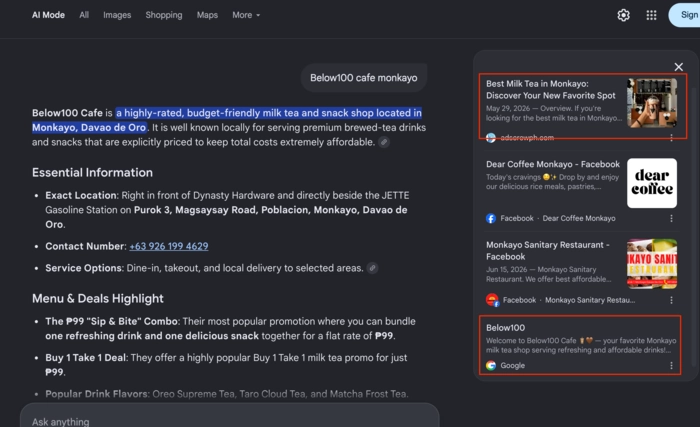
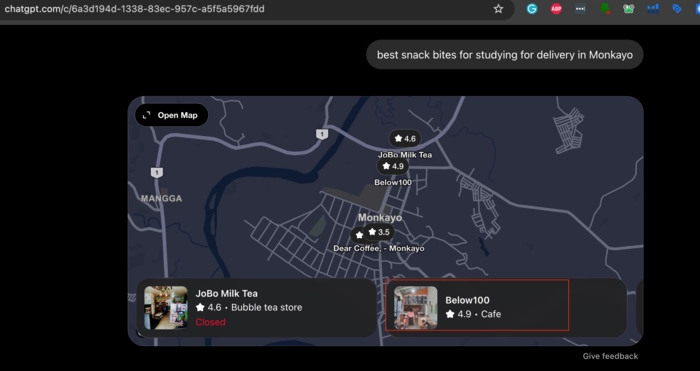
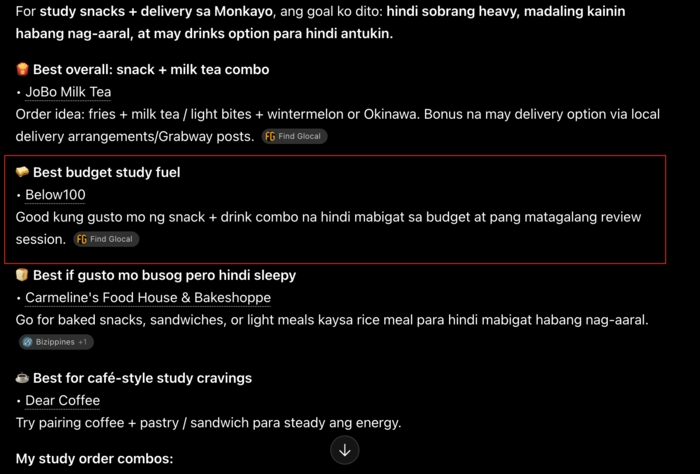
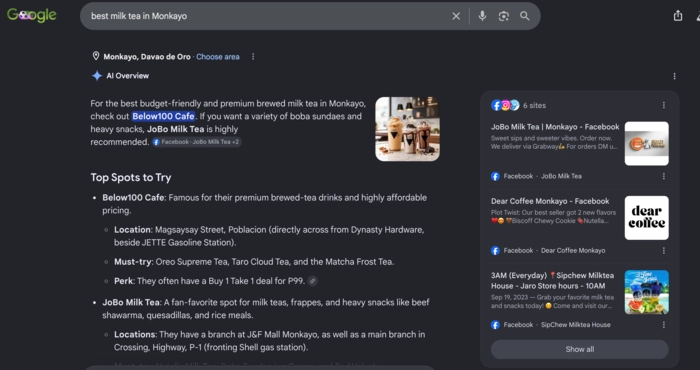
Change didn’t happen overnight, but when it hit, it was unmistakable. A few months in, I started testing. I pulled out my phone and asked ChatGPT, “What’s the best milk tea in Monkayo?” Below100 Cafe came back as the top pick, with details about Okinawa and brown sugar, and the location near the high school. I tried Perplexity. Same. Gemini. Same. Google AI Overview for “affordable milk tea in Monkayo” began showing their business profile and pulling snippets straight from our content.
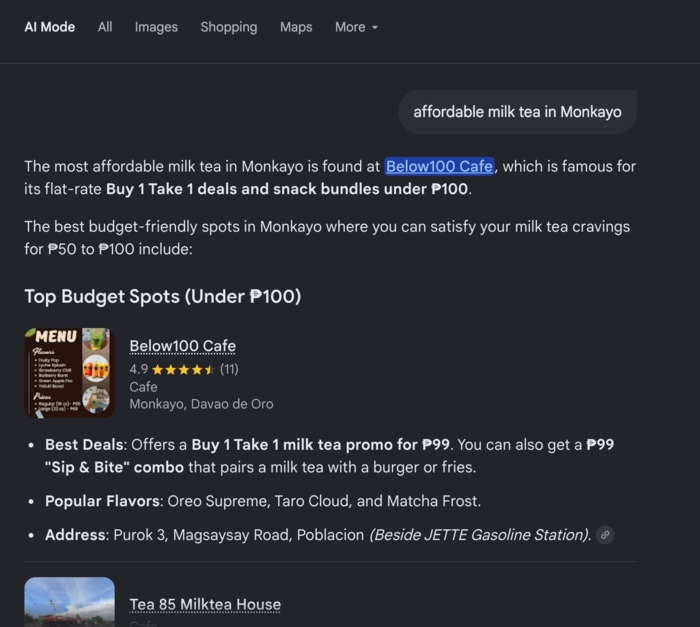
But the real win wasn’t screenshots—it was people. Students walked in saying, “ChatGPT recommended you.” Employees from nearby offices showed up because their voice assistant said, “Below100 Cafe delivers milk tea near you.” A whole new traffic channel opened up: AI search referrals, costing them zero pesos in ads.
Below are the visual results of our work, showing how Below100 Cafe now appears across various AI search tools and Google’s AI Overviews for key search terms.
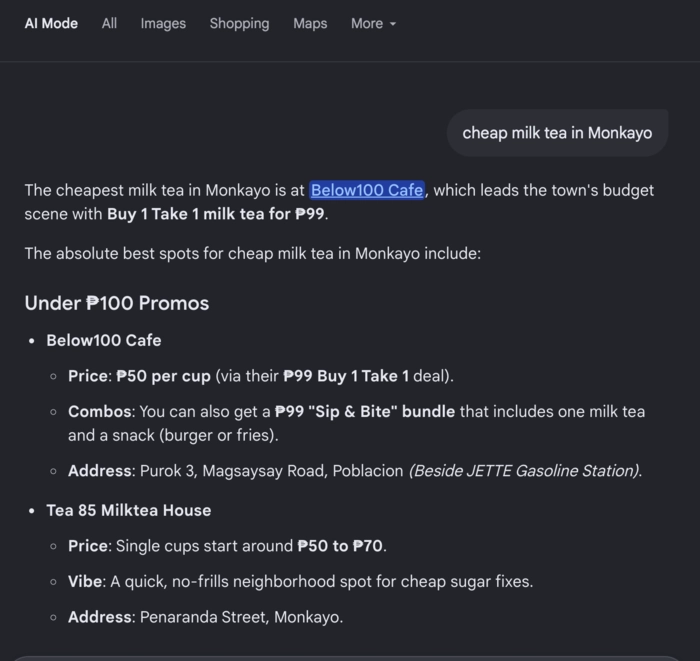
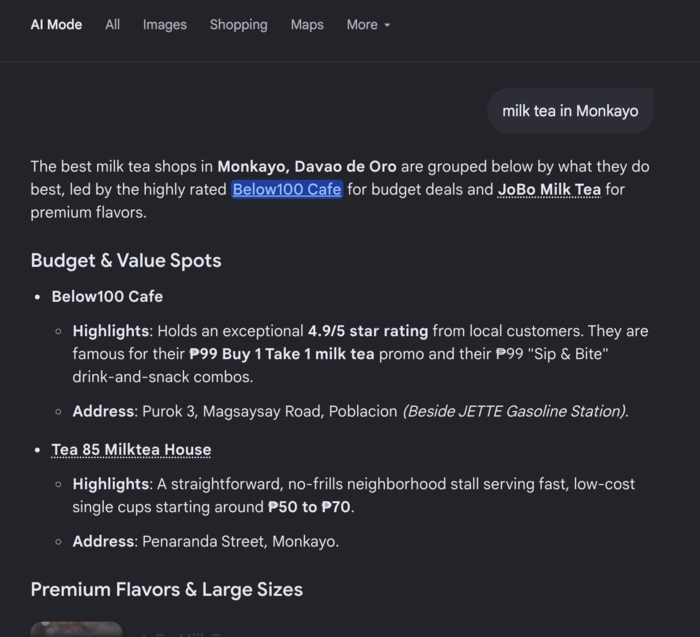
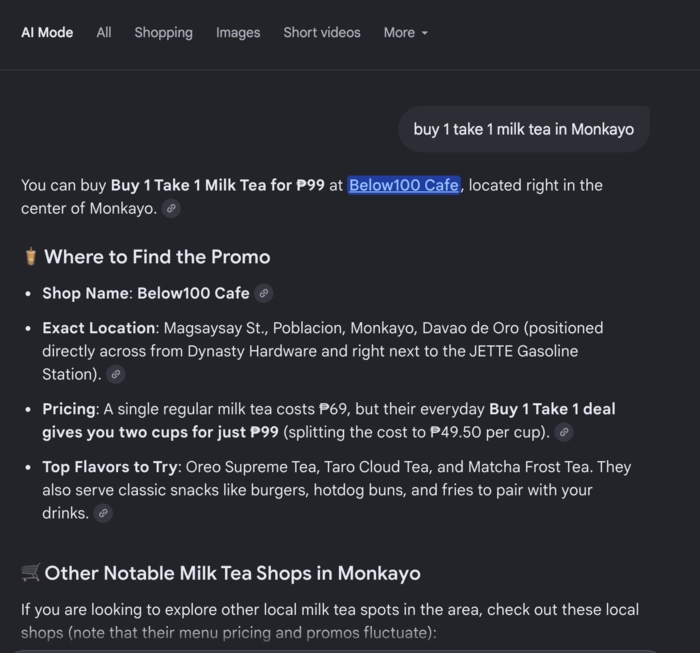
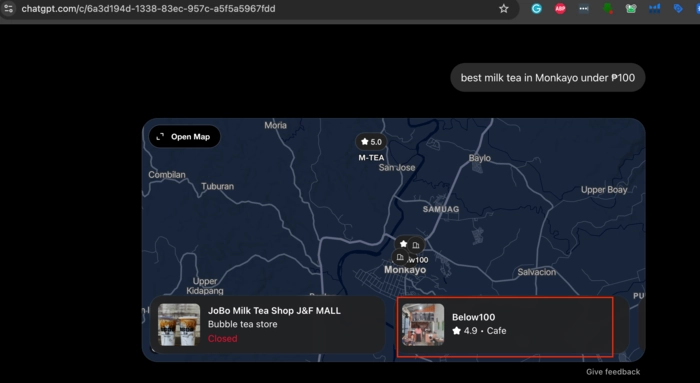
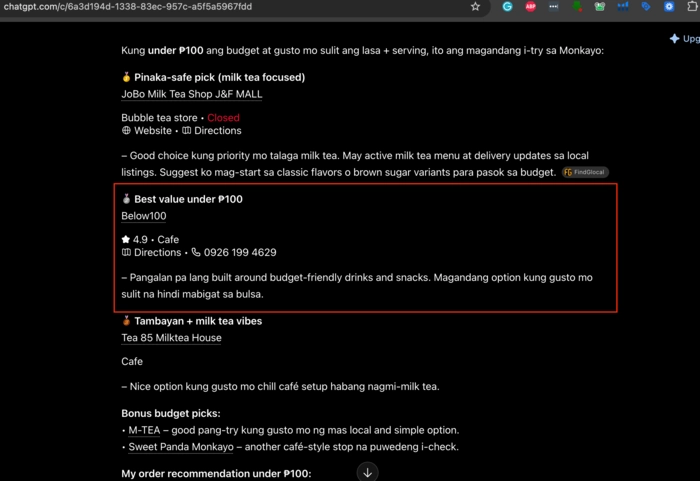
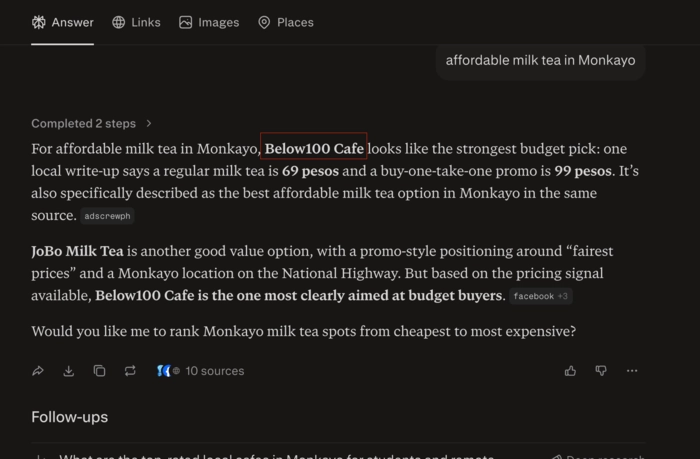
The most beautiful part? Everything we did for traditional Google SEO and Facebook visibility organically fed the AI discovery. The structured content, the reviews, the citations—they didn’t just improve one channel. They created a loop where stronger local SEO made the business more AI‑readable, and better AI visibility brought more visitors and reviews, which then boosted the local SEO further. We had genuinely bridged traditional SEO and AI search.
Questions:
How did Below100 Cafe become visible on AI search engines?
Adscrew PH used an Answer Engine Optimization (AEO) playbook: building a structured knowledge base on Facebook and Google Business Profile, optimizing content for natural, conversational queries, and generating consistent citations and mentions across the web. This Below100 Cafe AI search case study has the full breakdown.
What is Answer Engine Optimization for a small business?
AEO is about shaping your business information so AI search engines—ChatGPT, Perplexity, Gemini—can easily find, trust, and recommend you. It leans on structured data, clear Q&A content, entity consistency, and building digital footprints that machines recognize.
Can a Facebook page help a business rank in AI search results?
Absolutely. A fully optimized page like Below100 Cafe’s works as a machine‑readable knowledge base. When the About section, Services tab, photo albums, and posts are packed with location and product details, AI models index that information and use it to answer people’s questions.
How do AI assistants like ChatGPT decide which business to recommend?
They look for the most credible, consistent, and clearly described entity across multiple web sources. Structured info, natural language that matches the query, fresh reviews, and citation consistency all tip the scale.
What’s the difference between AI search optimization and traditional SEO?
Traditional SEO aims for the ten blue links. AI search optimization aims to be the direct answer an AI gives. The two overlap, but AI optimization puts structured data, conversational content, and entity authority ahead of old signals like keyword density and raw backlinks.
Key Takeaways
- AI search is wide open right now. Most small businesses haven’t started optimizing for ChatGPT, Gemini, or Perplexity. That means early movers can lock up local AI recommendations with very little competition.
- You don’t need a website to be AI‑visible. A fully filled Facebook page and Google Business Profile, treated like structured databases, can be enough for AI models to trust and recommend you.
- Write like a human, not a keyword machine. AI thrives on conversational language. Create content that directly answers the natural questions your customers ask aloud or in chats.
- Entity consistency is everything. Make sure your name, address, phone number, and description match exactly everywhere you appear. AI confidence depends on seeing the same data repeated across trusted sources.
- Citations and mentions are trust signals for machines. Local blog spots, directory profiles, school event shout‑outs, and a strong review page all feed AI models and build your authority in their eyes.
When I first sat with the cousins at Below100 Cafe, they just hoped a few students would wander in. They had no website, no budget, and definitely no idea that AI chatbots would become a customer channel. Today, their shop isn’t just on the map—it’s inside the answers of the AI assistants millions of people talk to every single day. That’s the power of this new frontier. It’s not about chasing algorithms; it’s about making your business so clear, so consistent, and so helpful that even machines can’t overlook you.
If you’re a business owner, let this be your proof that AI search matters right now. If you’re a freelancer or agency, start digging into Answer Engine Optimization before the crowd catches on. The playing field is level, and the businesses that show up first in AI answers will win the next decade. Adscrew PH is already doing it for clients like Below100. The only question left is—will your business be the one an AI recommends tomorrow?
Explore the cafe that started it all: read our review of the best milk tea in Monkayo , dive into the original SEO client landing case study , visit Below100 on Facebook , or find them on Google Maps . And follow Adscrew PH for more real‑world AI search wins.